
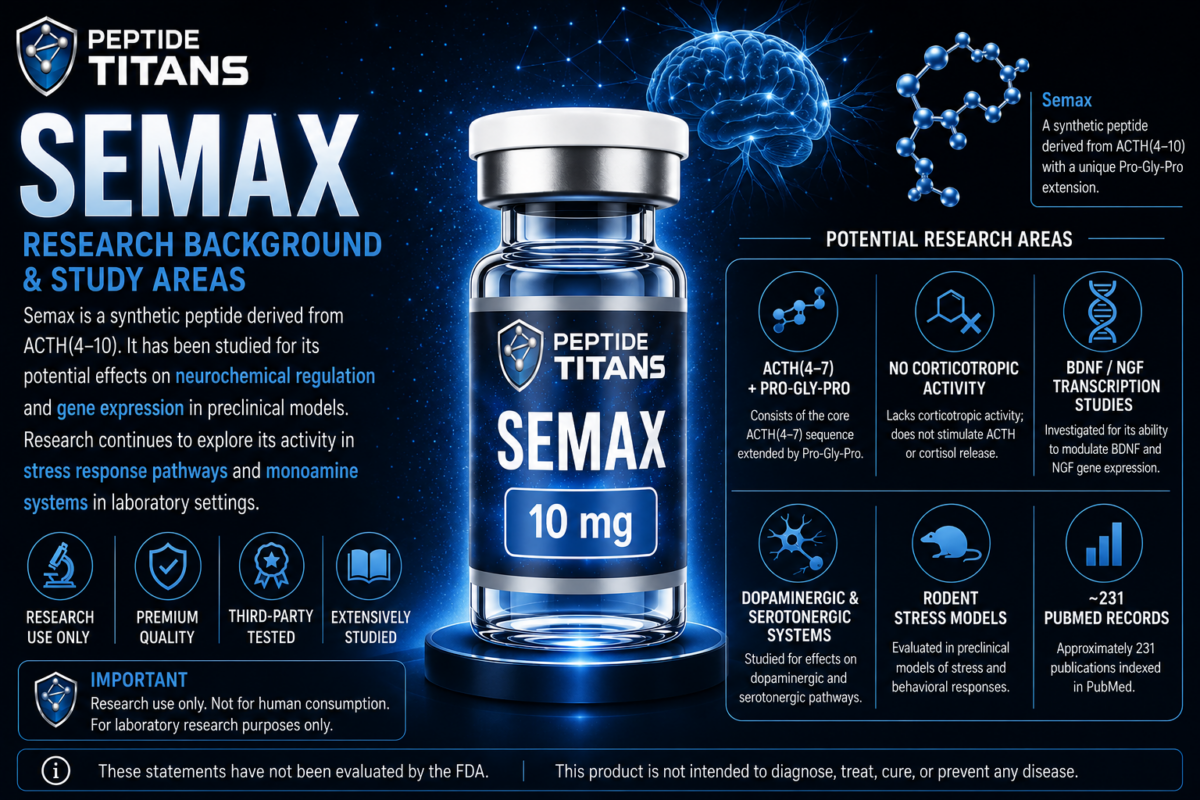
Semax is a synthetic heptapeptide with the sequence Met-Glu-His-Phe-Pro-Gly-Pro. The first four residues are taken from adrenocorticotropic hormone — the ACTH(4–7) fragment — and the trailing Pro-Gly-Pro was added to slow enzymatic breakdown. The literature conventionally describes it as a synthetic ACTH(4–10) analog.
Like Selank, it came out of the Institute of Molecular Genetics at the Russian Academy of Sciences, and the two share that same Pro-Gly-Pro stabilising tail — the same design solution applied to two different parent molecules.
The point of the design: no hormonal activity
ACTH is a hormone that drives cortisol release from the adrenal cortex. Taking a fragment of it and using it as a research compound would be unhelpful if the hormonal activity came along too.
It does not. The ACTH(4–7) region carries the neurotropic properties without the corticotropic ones — Semax is not reported to stimulate cortisol release. That separation is the reason the fragment was of interest in the first place, and it is worth understanding before reading anything that treats Semax as though it were an ACTH derivative in the hormonal sense.
What the published research examines
The sections below describe where the literature is — study areas, models, recurring vocabulary. They are not statements of effect.
- Neurotrophin transcription. The dominant mechanistic theme. A 2006 study in Brain Research examined Semax regulating BDNF (PMID 16996037). Follow-up work showed Semax and Pro-Gly-Pro activating transcription of neurotrophins (PMID 19633950, 2010), and a companion study compared the temporal dynamics of NGF and BDNF gene expression (PMID 19662538, 2010).
- Monoamine systems. A 2005 study in Neurochemical Research reported activation of dopaminergic and serotoninergic brain systems in rodents (PMID 16362768).
- Stress and affective models. Antidepressant-like and antistress effects of the ACTH(4–10) synthetic analog were examined in European Journal of Pharmacology in 2024 (PMID 39442746). A 2021 study in Neuropeptides looked at behavioural and neurochemical alterations following early-life fluvoxamine exposure in rats (PMID 33418449).
- Metal coordination chemistry. Work on how N-terminal acetylation affects copper(II) and zinc(II) coordination and the resulting biological properties (PMID 27586814, 2016) — relevant to formulation and stability rather than to effect.
- Imaging. A functional connectomic study examined Semax and Selank effects together (PMID 32342318, 2020).
- Clinical work in Russia. Published efficacy studies exist in Russian journals (for example PMID 29798983, 2018).
- Study methodology note: much of the rodent and clinical work used intranasal administration. That describes how the experiments were run, not a route recommendation.
How large the literature is
A PubMed search for Semax returns roughly 231 indexed papers. For calibration against other compounds covered here: that is a considerably deeper record than Selank’s, and vastly deeper than 5-Amino-1MQ, which has three.
Depth is not the same as strength, though — see immediately below.
The caveat: origin concentrates the evidence
As with Selank, a large share of Semax research is Russian, much of it published in Russian-language journals and available in English only as abstracts. The compound is described in that literature as a registered medication in Russia, with indications including stroke and cognitive impairment.
That status does not transfer. Western regulators have never evaluated Semax, and the clinical work has not been independently replicated outside Russia. A larger literature concentrated in one research system is not equivalent to a smaller literature replicated across several — and Semax’s 231 papers should be read with that in mind.
Semax and Selank
They are frequently compared, and the comparison is more interesting than most because the two are siblings in design: same institute, same Pro-Gly-Pro stabilising tail, different parent molecules.
| Semax | Selank | |
|---|---|---|
| Sequence | Met-Glu-His-Phe-Pro-Gly-Pro | Thr-Lys-Pro-Arg-Pro-Gly-Pro |
| Parent molecule | ACTH(4–7) | Tuftsin |
| Shared element | Both carry the same C-terminal Pro-Gly-Pro added for enzymatic stability | |
| Dominant research theme | Neurotrophins (BDNF, NGF), monoamine systems, cognitive and neuroprotective models | Anxiety models, GABAergic and enkephalin signalling |
For the full side-by-side, see Semax vs Selank: what is the difference?. Peptide Titans lists Semax, Selank and a Semax + Selank blend separately. No published research characterises the two administered together; the connectomic study above examined them, but not as a combination.
What the literature does not establish
- No approval by the FDA, EMA, MHRA or any comparable regulator.
- No independently replicated evidence outside Russia.
- No established dosing, route, schedule or duration — and none is given here.
- No long-term safety data, and no data on the Semax + Selank combination.
- ACTH’s hormonal properties do not apply, and neither do findings about the full hormone.
Handling and storage
- Sealed vials: −20 °C to −80 °C, protected from light and moisture, desiccated. Allow to reach room temperature before opening.
- Reconstituted: up to about 7 days at 4 °C, or −20 °C in single-use aliquots. Minimise freeze–thaw cycles.
- Reconstitution: add diluent slowly down the vial wall, swirl gently, never shake.
Frequently asked questions
What is Semax?
A synthetic seven-amino-acid peptide (Met-Glu-His-Phe-Pro-Gly-Pro) built from an ACTH fragment plus a stabilising Pro-Gly-Pro tail, developed in Russia and studied mainly in cognitive and neuroprotective models.
Does Semax affect cortisol?
It is not reported to. Although derived from ACTH, the fragment used retains neurotropic activity without the corticotropic activity of the parent hormone — that separation is the basis of the design.
What does Semax do?
Published research associates it with regulation of BDNF and NGF transcription and with activity in dopaminergic and serotoninergic systems. Those are observations from laboratory models, not effects established in people outside the Russian clinical literature.
What is the difference between Semax and Selank?
Both are Russian-developed heptapeptides sharing the same Pro-Gly-Pro stabilising tail, but they derive from different parents — ACTH(4–7) for Semax, tuftsin for Selank — and their literatures address different themes: neurotrophins and cognition for Semax, anxiety models for Selank.
Is Semax approved anywhere?
Not by the FDA, EMA or MHRA. It is described in the Russian literature as a registered medication there. That status is specific to Russia and the underlying work has not been independently replicated.
Why is there so much Semax research compared with other research peptides?
Because it has been studied continuously within one national research system since the 1980s. The volume reflects sustained institutional attention rather than broad international validation.
Research use only
This product is not for human consumption. It is sold strictly for research and educational purposes and is not intended to diagnose, treat, cure, or prevent any disease. Research information on this page is derived from peer-reviewed scientific literature and provided for educational reference only; it does not constitute medical advice or product claims.
References
- Semax, an analog of ACTH(4-10) with cognitive effects, regulates BDNF. Brain Res, 2006. PMID 16996037
- Semax and Pro-Gly-Pro activate the transcription of neurotrophins. Cell Mol Neurobiol, 2010. PMID 19633950
- Comparison of the temporary dynamics of NGF and BDNF gene expression. J Mol Neurosci, 2010. PMID 19662538
- Semax, an ACTH(4-10) analogue with nootropic properties, activates dopaminergic and serotoninergic brain systems in rodents. Neurochem Res, 2005. PMID 16362768
- Antidepressant-like and antistress effects of the ACTH(4-10) synthetic analog. Eur J Pharmacol, 2024. PMID 39442746
- Semax, synthetic ACTH(4-10) analogue, attenuates behavioural and neurochemical alterations following early-life fluvoxamine exposure in white rats. Neuropeptides, 2021. PMID 33418449
- Influence of the N-terminus acetylation of Semax on copper(II) and zinc(II) coordination and biological properties. J Inorg Biochem, 2016. PMID 27586814
- Functional connectomic approach to studying Selank and Semax effects. Dokl Biol Sci, 2020. PMID 32342318
Research-use product reference: Semax is listed at Peptide Titans for laboratory research use only. Products are not for human consumption.
Related
- What is Selank? Research background and study areas
- What is KPV peptide? Research background
- What is NAD+? Research background
Reference & documentation
- Semax research profile — molecular data and indexed literature
- Semax research material
- Lot-specific Certificate of Analysis for Semax