
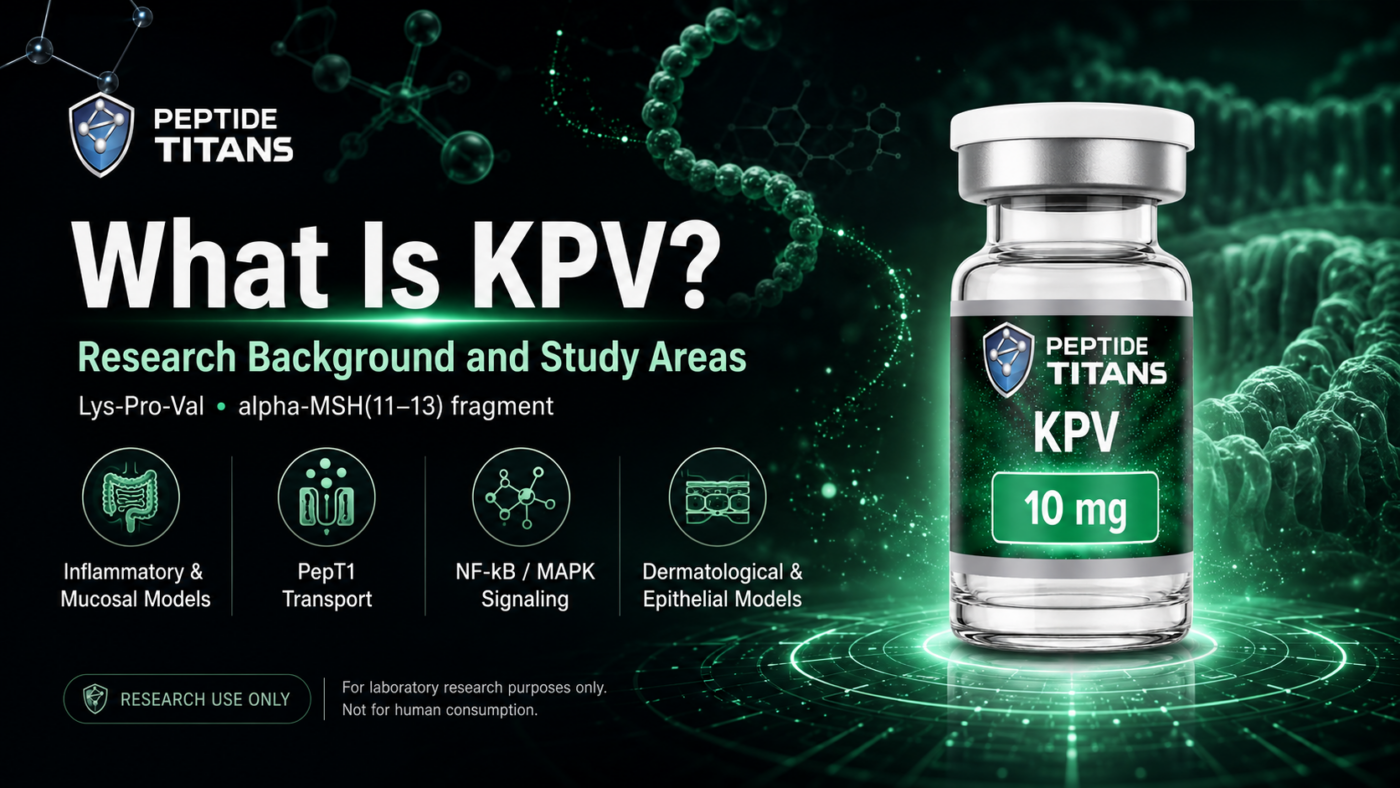
KPV is a tripeptide made of three amino acids — lysine, proline and valine (Lys-Pro-Val). It is the C-terminal fragment of alpha-melanocyte-stimulating hormone (alpha-MSH), and is often written in the literature as alpha-MSH(11–13) after the positions it occupies in the parent hormone.
The reason it attracted research attention is specific: alpha-MSH has documented anti-inflammatory activity, and work through the 2000s asked how much of that activity survives in just the final three residues. The answer — that a substantial part does — is what the KPV literature is built on.
What the published research examines
The sections below describe where the literature is — study areas, model types and recurring vocabulary. They are not statements of effect and do not describe outcomes in humans.
Inflammatory bowel and mucosal models
The largest body of KPV work sits here. A 2008 study in Inflammatory Bowel Disease examined the tripeptide in murine models of inflammatory bowel disease (PMID 18092346). Subsequent work is dominated by delivery engineering rather than new biology — hyaluronic-acid-functionalised nanoparticles for oral targeting in ulcerative colitis models (PMID 28143741, Molecular Therapy, 2017) and self-cross-linked hydrogels stabilising KPV in TNBS-induced colitis in rats (PMID 34547895, 2021).
That pattern is itself informative: researchers keep building carriers because peptide stability and targeted delivery are the unsolved problem, not because the underlying signalling is unclear.
Transport and mechanism
KPV is taken up by cells through PepT1, a di- and tripeptide transporter expressed in intestinal epithelium. PepT1 expression increases in inflamed tissue, which is the mechanistic basis for the frequently cited observation that uptake concentrates where inflammation is greatest. Once internalised, the literature describes inhibition of NF-κB and MAP kinase signalling, with reduced pro-inflammatory cytokine expression in cultured cells.
Dermatological and epithelial models
A 2004 study in the Journal of Investigative Dermatology examined alpha-MSH, MSH(11–13) KPV and ACTH signalling in human keratinocyte cells (PMID 15102092). Separate work looked at the tripeptide in corneal epithelial wound-healing models, examining the role of nitric oxide (PMID 16965771, Experimental Eye Research, 2006).
Antimicrobial and immunomodulatory context
Broader alpha-MSH peptide reviews position this family as anti-inflammatory and immunomodulating agents (PMID 17934097, Annals of the Rheumatic Diseases, 2007), and antimicrobial effects of alpha-MSH peptides have their own literature (PMID 10670585, 2000).
Regulatory status
This gets asked often and is rarely answered directly, so:
- KPV has no marketing authorisation. It is not approved by the FDA — or by any comparable regulator — for any indication, in any form.
- It is not an approved dietary supplement ingredient.
- The research-peptide category is under active enforcement. The FDA issued warning letters across this sector in March 2026.
- For competition contexts, consult the current WADA Prohibited List directly. Prohibited-list status changes annually and no supplier page should be treated as authoritative on it.
Everything on this page describes laboratory research. It is not a statement that KPV may be used in or on people.
What the literature reports on tolerability
Searches for KPV side effects are common, so it is worth being precise. There is no human safety profile for KPV. The studies above are cell-culture and rodent work; none was designed to characterise safety in people, and no controlled human trials exist. Absence of reported adverse effects in a rodent colitis model is not evidence of safety — it is the absence of a question having been asked.
What the literature does not establish
- No human efficacy data of any kind.
- No established dosing, route, schedule or duration — and none is given here.
- Peptide stability and delivery remain unsolved, which is why so much of the literature is carrier engineering.
- Findings about the parent hormone alpha-MSH do not automatically transfer to the KPV fragment.
Handling and storage
- Sealed vials: −20 °C to −80 °C, protected from light and moisture, desiccated. Allow to reach room temperature before opening.
- Reconstituted: up to about 7 days at 4 °C, or −20 °C in single-use aliquots. Minimise freeze–thaw cycles.
- Reconstitution: add diluent slowly down the vial wall, swirl gently, never shake.
Frequently asked questions
What is KPV peptide?
A three-amino-acid peptide — lysine, proline, valine — that forms the C-terminal end of alpha-melanocyte-stimulating hormone. It is studied mainly for anti-inflammatory activity in gut and skin models.
Is KPV the same as alpha-MSH?
No. KPV is the last three residues of alpha-MSH, which is a 13-amino-acid hormone. The fragment retains part of the parent hormone’s described anti-inflammatory activity, which is why it is studied separately, but the two are not interchangeable.
Is KPV approved or legal?
It has no marketing authorisation anywhere and is not an approved supplement ingredient. It is sold strictly as a research material. See the regulatory section above.
Research use only
This product is not for human consumption. It is sold strictly for research and educational purposes and is not intended to diagnose, treat, cure, or prevent any disease. Research information on this page is derived from peer-reviewed scientific literature and provided for educational reference only; it does not constitute medical advice or product claims.
References
- Melanocortin-derived tripeptide KPV has anti-inflammatory potential in murine models of inflammatory bowel disease. Inflamm Bowel Dis, 2008. PMID 18092346
- Orally targeted delivery of tripeptide KPV via hyaluronic acid-functionalized nanoparticles efficiently alleviates ulcerative colitis. Mol Ther, 2017. PMID 28143741
- Self-cross-linked hydrogel of cysteamine-grafted gamma-polyglutamic acid stabilized tripeptide KPV for alleviating TNBS-induced ulcerative colitis in rats. ACS Biomater Sci Eng, 2021. PMID 34547895
- alpha-Melanocyte-stimulating hormone, MSH 11-13 KPV and adrenocorticotropic hormone signalling in human keratinocyte cells. J Invest Dermatol, 2004. PMID 15102092
- Effects of the COOH-terminal tripeptide alpha-MSH(11-13) on corneal epithelial wound healing: role of nitric oxide. Exp Eye Res, 2006. PMID 16965771
- alpha-MSH related peptides: a new class of anti-inflammatory and immunomodulating drugs. Ann Rheum Dis, 2007. PMID 17934097
- PepT1-mediated tripeptide KPV uptake reduces intestinal inflammation. PMC2431115
Research-use product reference: KPV and KPV 500 mcg Capsules are listed at Peptide Titans for laboratory research use only. Products are not for human consumption.
Related
- What is KLOW peptide? Composition and research overview
- What is CJC-1295? DAC vs No DAC
- What is NAD+? Research background
Related research resources
- KPV research profile — molecular data and indexed literature
- KPV research material — lot-tested with a published COA
- View the lot-specific COA for KPV