
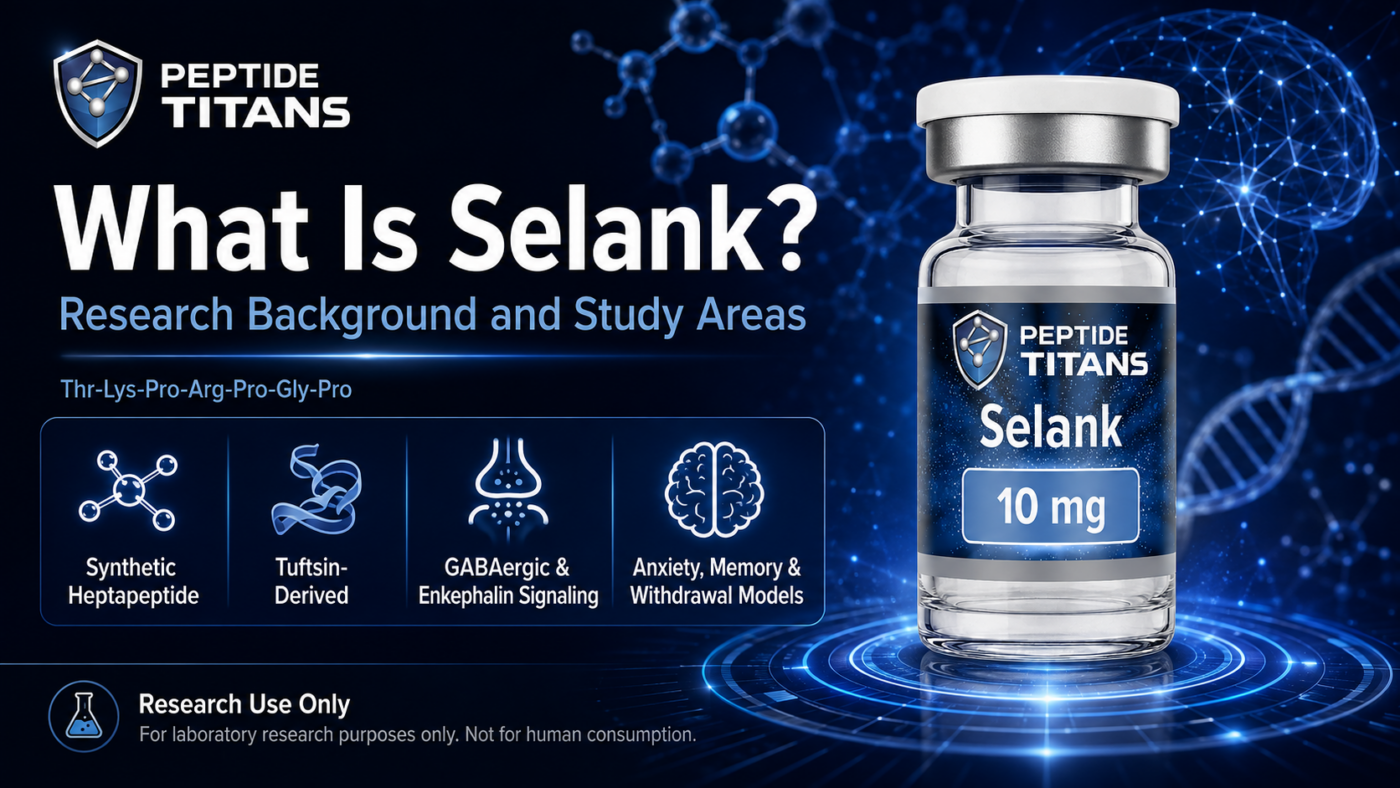
Selank is a synthetic heptapeptide — a seven-amino-acid chain with the sequence Thr-Lys-Pro-Arg-Pro-Gly-Pro. The first four residues are tuftsin, a naturally occurring immunomodulatory peptide fragment; the trailing Pro-Gly-Pro was added to slow enzymatic breakdown, since tuftsin alone degrades almost immediately.
It was developed at the Institute of Molecular Genetics of the Russian Academy of Sciences, and that origin shapes the entire literature — see the caveat below, which is the single most important thing to understand before reading anything else about this compound.
The caveat that governs the whole literature
Almost all published Selank research is Russian. A large share appears in Russian-language journals such as Eksperimental’naya i Klinicheskaya Farmakologiya and Zhurnal Nevrologii i Psikhiatrii, often available only as translated abstracts.
This matters for three reasons. The work has not been independently replicated outside Russia. Western regulators have never evaluated it. And the clinical studies that do exist are small and single-region, so they carry far less weight than their existence alone suggests. Sources that cite “clinical trials” for Selank without noting any of this are giving a misleading impression of the evidence base.
What the published research examines
The sections below describe where the literature is — study areas, model types, mechanistic vocabulary. They are not statements of effect.
- Anxiolytic activity in rodent models. The core theme. A 2017 study in Behavioural Neurology examined Selank alongside diazepam under unpredictable chronic mild stress conditions in rats (PMID 28280289).
- Molecular mechanism. A 2018 review in Protein & Peptide Letters covers the molecular aspects of Selank’s biological activity (PMID 30255741). Recurring themes include interaction with GABAergic signalling, effects on enkephalin degradation, and serotonin metabolism.
- BDNF and memory models. A 2019 study examined BDNF content in hippocampus and prefrontal cortex in rats in an ethanol-induced memory impairment model (PMID 31625062).
- Withdrawal models. Studies in rats examined effects during morphine withdrawal (PMID 36322304, 2022) and in a model of alcohol withdrawal (PMID 24913576, 2014).
- Human clinical work (Russia). Published studies examined Selank in generalised anxiety disorder and neurasthenia (PMID 18454096, 2008) and compared it with phenazepam in anxiety disorders (PMID 25176261, 2014).
- Imaging. A 2020 functional-connectomic study examined Selank and Semax effects (PMID 32342318).
- Study methodology note: rodent work in this area commonly used intranasal administration, which is a description of how the experiments were run — not a route recommendation.
“Selank withdrawal” means something different than most people expect
This is a common search, and it usually reflects a misreading.
The withdrawal studies above are about Selank being examined in models of withdrawal from other substances — morphine, alcohol. They are not reports of withdrawal from Selank. As far as the published record goes, there is no dependence or withdrawal literature for Selank itself, in either direction: no evidence that it causes dependence, and no evidence establishing that it does not. The question simply has not been studied in humans.
Selank and Semax
The two are constantly compared, and they do share an origin story: both are short synthetic peptides developed in Russia and studied in neurological and psychiatric models. They are otherwise different molecules with different research themes.
| Selank | Semax | |
|---|---|---|
| Derived from | Tuftsin, an immunomodulatory peptide fragment | ACTH(4–10), a fragment of adrenocorticotropic hormone |
| Length | 7 amino acids | 7 amino acids |
| Dominant research theme | Anxiety models, GABAergic and enkephalin signalling | Cognitive and neuroprotective models, BDNF signalling |
For the other side of this comparison in detail, see what Semax is and what its research examines, or the full Semax vs Selank comparison. Peptide Titans lists Selank, Semax and a Semax + Selank blend as separate research materials. No published research characterises the two administered together.
What the literature does not establish
- No approval by the FDA, EMA, MHRA or any comparable regulator.
- No independently replicated evidence outside Russia.
- No established dosing, route, schedule or duration — and none is given here.
- No long-term safety data, and no dependence or withdrawal data for Selank itself.
- Tuftsin’s properties do not automatically transfer to Selank; the added Pro-Gly-Pro changes its stability profile.
Handling and storage
- Sealed vials: −20 °C to −80 °C, protected from light and moisture, desiccated. Allow to reach room temperature before opening.
- Reconstituted: up to about 7 days at 4 °C, or −20 °C in single-use aliquots. Minimise freeze–thaw cycles.
- Reconstitution: add diluent slowly down the vial wall, swirl gently, never shake.
Frequently asked questions
What is Selank?
A synthetic seven-amino-acid peptide (Thr-Lys-Pro-Arg-Pro-Gly-Pro) based on tuftsin, developed in Russia and studied primarily in anxiety-related animal models.
What does Selank do?
In published research it is associated with anxiolytic activity in rodent models, with mechanistic work pointing at GABAergic signalling, enkephalin degradation and serotonin metabolism. That describes observed activity in laboratory models, not an effect in people.
Is Selank approved anywhere?
It has no approval from the FDA, EMA or MHRA. Clinical studies have been published in Russia, and the compound is described in that literature as a registered anxiolytic there, but that status has no bearing elsewhere and the work has not been independently replicated.
What is the difference between Selank and Semax?
Both are Russian-developed seven-amino-acid peptides, but they come from different parent molecules — Selank from tuftsin, Semax from ACTH(4–10) — and their research literatures address different themes: anxiety models for Selank, cognitive and neuroprotective models for Semax.
Does Selank cause withdrawal?
Unknown, and the search results on this topic are misleading. The withdrawal studies in the Selank literature examine it in models of withdrawal from morphine and alcohol — not withdrawal from Selank. No dependence data exists for the compound itself.
Why is so much Selank research in Russian?
Because it was developed at the Russian Academy of Sciences and studied almost entirely within that research system. This is a genuine limitation on how much weight the evidence can carry, not a quirk of indexing.
Research use only
This product is not for human consumption. It is sold strictly for research and educational purposes and is not intended to diagnose, treat, cure, or prevent any disease. Research information on this page is derived from peer-reviewed scientific literature and provided for educational reference only; it does not constitute medical advice or product claims.
References
- Peptide-based anxiolytics: the molecular aspects of heptapeptide Selank biological activity. Protein Pept Lett, 2018. PMID 30255741
- Peptide Selank enhances the effect of diazepam in reducing anxiety in unpredictable chronic mild stress conditions in rats. Behav Neurol, 2017. PMID 28280289
- Selank, peptide analogue of tuftsin, protects against ethanol-induced memory impairment by regulating BDNF content in the hippocampus and prefrontal cortex in rats. Bull Exp Biol Med, 2019. PMID 31625062
- Selank, a peptide analog of tuftsin, attenuates aversive signs of morphine withdrawal in rats. Bull Exp Biol Med, 2022. PMID 36322304
- Efficacy of peptide anxiolytic selank during modeling of withdrawal syndrome in rats with stable alcoholic motivation. Bull Exp Biol Med, 2014. PMID 24913576
- Efficacy and possible mechanisms of action of a new peptide anxiolytic selank in the therapy of generalized anxiety disorders and neurasthenia. Zh Nevrol Psikhiatr, 2008. PMID 18454096
- A comparison of the anxiolytic effect and tolerability of selank and phenazepam in the treatment of anxiety disorders. Zh Nevrol Psikhiatr, 2014. PMID 25176261
- Functional connectomic approach to studying Selank and Semax effects. Dokl Biol Sci, 2020. PMID 32342318
Research-use product reference: Selank is listed at Peptide Titans for laboratory research use only. Products are not for human consumption.
Related
- What is KPV peptide? Research background
- What is CJC-1295? DAC vs No DAC
- What is NAD+? Research background
Reference & documentation
- Selank research profile — mechanisms and indexed literature
- Selank research material
- Lot-specific Certificate of Analysis for Selank