
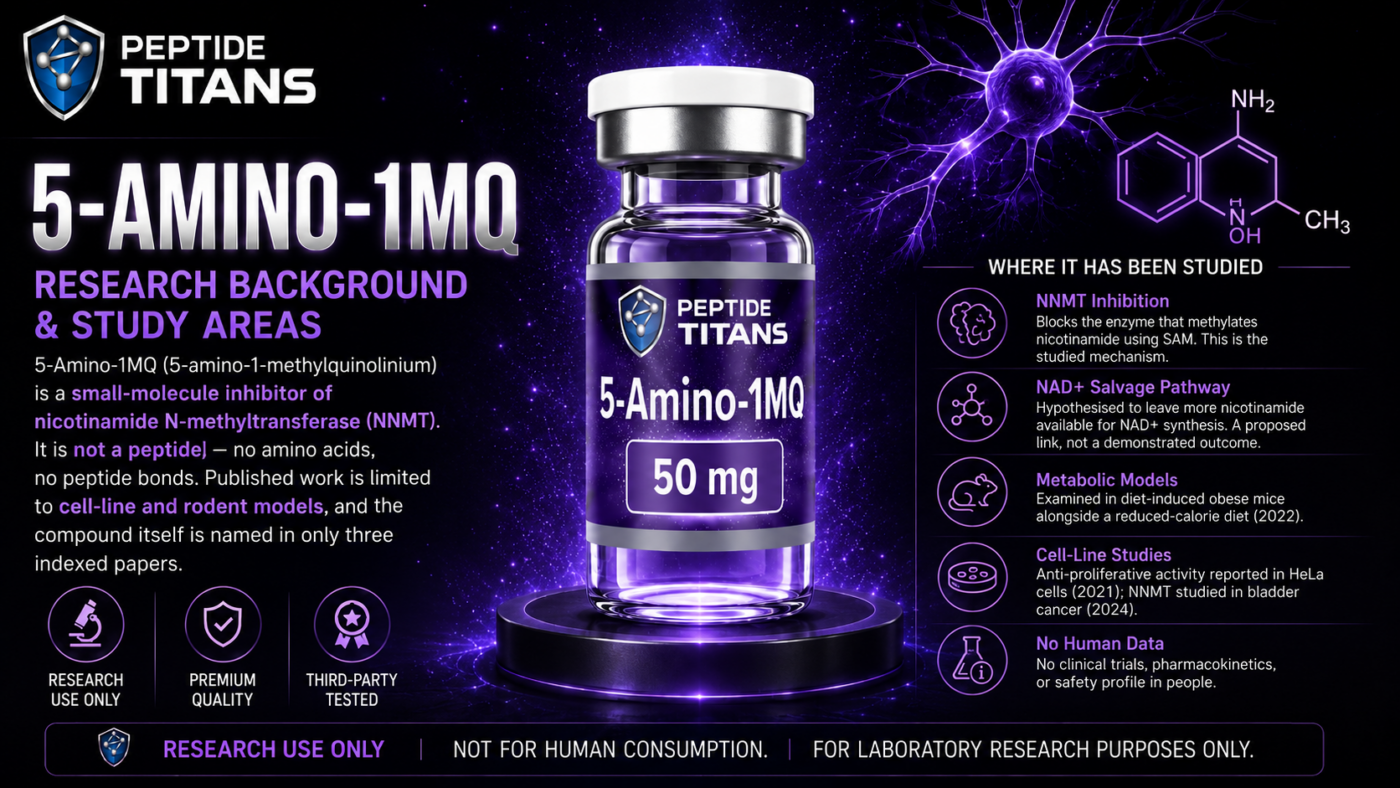
5-Amino-1MQ is a small molecule that inhibits nicotinamide N-methyltransferase (NNMT). Its full chemical name is 5-amino-1-methylquinolinium — a quinolinium ring carrying an amino group at position 5 and a methyl group on the ring nitrogen. The “1MQ” is simply 1-methylquinolinium.
It is not a peptide
Roughly 3,000 searches a month look for “5-Amino-1MQ peptide”, and research suppliers routinely shelve it beside peptides, so this is worth stating clearly.
Peptides are chains of amino acids joined by peptide bonds. 5-Amino-1MQ is a single small aromatic molecule with no amino acids and no peptide bonds — structurally closer to a pharmaceutical scaffold than to anything in a peptide catalogue. The practical consequences are real: it is considerably more stable than a lyophilized peptide, it is orally bioavailable in the published animal work, and it does not require the cold-chain handling peptides do.
What NNMT does, and why inhibiting it is studied
NNMT transfers a methyl group from S-adenosylmethionine (SAM) onto nicotinamide, producing 1-methylnicotinamide. That single reaction consumes two things the cell uses elsewhere: a methyl donor, and nicotinamide.
Nicotinamide is a precursor in the NAD+ salvage pathway. The reasoning behind NNMT inhibition is therefore that blocking the enzyme leaves more nicotinamide available for NAD+ synthesis and preserves SAM for other methylation reactions. That is the mechanistic hypothesis; whether it produces defined outcomes is a separate question the literature has not settled. For background on the coenzyme itself, see what NAD+ is and what its research examines.
NNMT is highly expressed in adipose tissue and liver, and its expression is elevated in a number of disease models — which is why the enzyme has attracted attention as a target.
How large the literature actually is
This is the part most write-ups skip, and it is the most useful thing on this page.
A PubMed search for the exact chemical name 5-amino-1-methylquinolinium returns three indexed papers. Not three hundred, and not thirty. Three:
- Anti-proliferative activity in HeLa cells — a small-molecule NNMT inhibitor examined in a cervical cancer cell line (PMID 33645410, J Obstet Gynaecol, 2021).
- Diet plus NNMT inhibition in DIO mice — reduced-calorie diet combined with NNMT inhibition established a distinct microbiome in diet-induced obese mice (PMID 35013352, Scientific Reports, 2022).
- NNMT in cancer-associated fibroblasts — NNMT driving tumour progression and immunotherapy resistance in urothelial bladder cancer (PMID 39067875, J Immunother Cancer, 2024).
The enzyme NNMT has a substantial literature. The compound 5-Amino-1MQ does not. Material that cites the broad NNMT field as though it were evidence for this specific molecule is conflating a target with an inhibitor of it — and most NNMT research uses other inhibitors entirely.
The wider NNMT target literature, clearly labelled
The following concern the enzyme rather than 5-Amino-1MQ, and are included as context only:
- Reviews of NNMT across metabolic pathways and as a therapeutic target (PMID 39604638, 2024; PMID 39312861, 2024).
- NNMT upregulation in alcohol-related fatty liver development (PMID 32389809, Journal of Hepatology, 2020).
- NNMT inhibition in a heart-failure-with-preserved-ejection-fraction mouse model (PMID 40484359, Pharmacological Research, 2025).
Models throughout are cell lines and rodents. There are no human trials of 5-Amino-1MQ.
What the literature does not establish
- No human data of any kind — no clinical trials, no pharmacokinetics in people, no safety profile.
- No established dosing, route, schedule or duration, and none is given here.
- Weight-related claims circulate widely and rest on rodent diet-induced-obesity models, not on human evidence.
- NNMT is broadly expressed and involved in methylation balance, so the consequences of inhibiting it long-term are not characterised.
- No approval by the FDA or any comparable regulator, in any form, for any indication.
Handling and storage
Being a small molecule rather than a peptide, this is less demanding than most items in a peptide catalogue:
- Powder or capsules: stable at room temperature for short periods; cool, dry and dark for longer storage. Keep sealed and protected from moisture.
- In solution: refrigerate and use promptly; small molecules are generally more solution-stable than peptides but are not indefinitely so.
- No cold chain is required in the way it is for lyophilized peptides — a genuine practical difference.
Frequently asked questions
What is 5-Amino-1MQ?
A small-molecule inhibitor of the enzyme nicotinamide N-methyltransferase (NNMT). Its chemical name is 5-amino-1-methylquinolinium.
Is 5-Amino-1MQ a peptide?
No. It contains no amino acids and no peptide bonds. It is a single small aromatic molecule, commonly catalogued alongside peptides but chemically unrelated to them.
How much research exists on it?
Very little. Three PubMed-indexed papers name the compound. The NNMT enzyme is well studied; this particular inhibitor is not.
Is it related to NAD+?
Indirectly. NNMT consumes nicotinamide, which is a precursor in the NAD+ salvage pathway, so inhibiting NNMT is hypothesised to leave more available for NAD+ synthesis. It is a proposed mechanistic link, not a demonstrated outcome.
Research use only
This product is not for human consumption. It is sold strictly for research and educational purposes and is not intended to diagnose, treat, cure, or prevent any disease. Research information on this page is derived from peer-reviewed scientific literature and provided for educational reference only; it does not constitute medical advice or product claims.
References
Papers naming the compound:
- Small molecule inhibitor of nicotinamide N-methyltransferase shows anti-proliferative activity in HeLa cells. J Obstet Gynaecol, 2021. PMID 33645410
- Reduced calorie diet combined with NNMT inhibition establishes a distinct microbiome in DIO mice. Sci Rep, 2022. PMID 35013352
- NAD+ metabolism enzyme NNMT in cancer-associated fibroblasts drives tumor progression and resistance to immunotherapy by modulating macrophages in urothelial bladder cancer. J Immunother Cancer, 2024. PMID 39067875
NNMT target literature (about the enzyme, not this compound):
- Exploring NNMT: from metabolic pathways to therapeutic targets. Arch Pharm Res, 2024. PMID 39604638
- Nicotinamide N-methyltransferase (NNMT): a key enzyme in cancer metabolism and therapeutic target. Int Immunopharmacol, 2024. PMID 39312861
- ER stress-induced upregulation of NNMT contributes to alcohol-related fatty liver development. J Hepatol, 2020. PMID 32389809
- Nicotinamide-N-methyltransferase inhibition improves cardiac function and structure in a heart failure with preserved ejection fraction mouse model. Pharmacol Res, 2025. PMID 40484359
Research-use product reference: 5-Amino-1MQ and 5-Amino-1MQ 50 mg Capsules are listed at Peptide Titans for laboratory research use only. Products are not for human consumption.
Related
- What is SLU-PP-332? — a small-molecule ERR agonist, also not a peptide
- What is NAD+? Research background and study areas
- What is KPV peptide? Research background
- What is Selank? Research background
Related research resources
- 5-Amino-1MQ research profile — NNMT background and indexed literature
- 5-Amino-1MQ research material
- View the lot-specific COA for 5-Amino-1MQ