
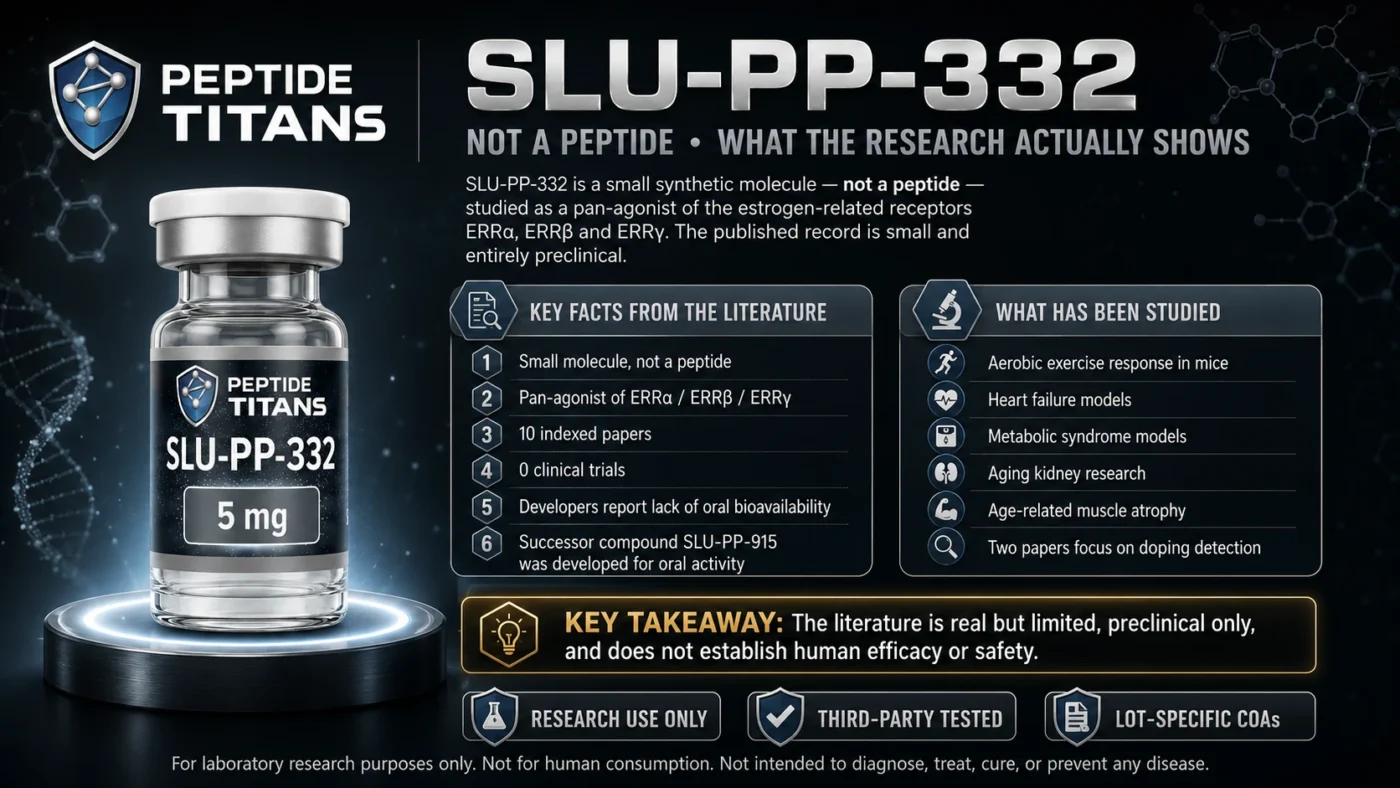
Short answer: SLU-PP-332 is not a peptide. It is a small synthetic molecule — a pan-agonist of the estrogen-related receptors ERRα, ERRβ and ERRγ — developed as a research tool for studying how exercise adaptation is regulated. The literature calls compounds like it exercise mimetics.
The published record is small and specific: 10 indexed papers, none of them a clinical trial, and the compound’s own developers report that it lacks oral bioavailability. Both points are covered below, with sources.
What SLU-PP-332 actually is
| Class | Small molecule, not a peptide — no amino acid sequence |
| Target | Pan-agonist of estrogen-related receptors ERRα / ERRβ / ERRγ, a family of orphan nuclear receptors |
| Pathways studied | Mitochondrial biogenesis, oxidative phosphorylation, fatty acid oxidation and the Krebs cycle |
| Origin | Developed in the Burris laboratory, first characterised in ACS Chemical Biology, 2023 |
| Indexed papers | 10 — of which 0 are clinical trials |
Counts retrieved from the PubMed E-utilities API on 20 August 2026, using the same search convention as the rest of this library.
The oral bioavailability problem
This is the single most important thing to understand about SLU-PP-332, and it comes from the people who made it.
In a 2026 paper introducing a successor compound, the same laboratory writes that they previously developed SLU-PP-332, which improves aerobic performance in mice, but lacks oral bioavailability. That limitation is the stated reason they went on to develop SLU-PP-915 — a chemically distinct pan-ERR agonist that is orally bioavailable and reaches comparable efficacy when given by mouth.
So the research programme itself moved past SLU-PP-332 for oral work. Anyone evaluating the compound should know the follow-up molecule exists and why it was made.
What the studies actually did
The work is genuine and appears in serious journals. It is also entirely preclinical.
- Aerobic capacity (2023, ACS Chem Biol). The foundational paper: the compound induced an ERRα-dependent acute aerobic exercise response and enhanced exercise capacity in mice.
- Heart failure (2024, Circulation). Pan-ERR agonists improved cardiac fatty acid metabolism and mitochondrial function in a heart failure model, published in one of cardiology’s leading journals.
- Metabolic syndrome (2024, J Pharmacol Exp Ther). A synthetic ERR agonist alleviated features of metabolic syndrome.
- Aging kidney (2023, Am J Pathol). ERR agonism reversed mitochondrial dysfunction and inflammation.
- Muscle atrophy (2025, Front Physiol). A pilot study targeting ERRs against age-related atrophy linked to physical inactivity.
Five of the ten records are explicitly in mice or rats. None is a trial in people.
Two of the ten papers exist to detect it in athletes
This is worth stating plainly, because it says something about how the compound is regarded. Of the ten indexed papers, two are analytical chemistry work for doping control — characterising the compound’s metabolites so that anti-doping laboratories can identify it in samples. One is titled, in part, Novel Pan-ERR Agonists With Doping Potential.
Anyone working with this compound in a context governed by anti-doping rules should treat that as the relevant signal. Detection methods are being published.
What the literature does not establish
- No clinical trial. Zero records indexed as clinical trials, and no human efficacy or safety study of any kind.
- No human safety profile. Nothing has been established about tolerability or risk in people, by any route.
- No evidence supporting oral administration — the developers state the opposite, and built a different molecule to solve it.
- No approved drug status anywhere. It is a research chemical.
- Ten papers is a small base. For comparison, the counts stated across this library run from three papers for 5-Amino-1MQ to 3,837 for kisspeptin. SLU-PP-332 sits near the bottom.
A note on disclosed interests
The 2026 successor paper carries a conflict-of-interest statement worth reading: the successor compound is covered by university intellectual property with the senior author named as an inventor, and that author is a stockholder in two companies developing ERR agonists. This is disclosed in the paper itself and is entirely normal in translational pharmacology — but it is context a reader should have when weighing how the compound is described.
Frequently asked questions
Is SLU-PP-332 a peptide?
No. It is a small synthetic molecule with no amino acid sequence. It is frequently listed alongside research peptides by suppliers and search engines, but structurally it belongs to a different class entirely — as do NAD+ and 5-Amino-1MQ, both covered in this library.
How much research is there really?
Ten indexed papers as of 20 August 2026. Two of those are doping-detection methods rather than studies of effect. None is a clinical trial.
Research use only
These products are not for human consumption. They are sold strictly for research and educational purposes and are not intended to diagnose, treat, cure, or prevent any disease. SLU-PP-332 is not an approved drug in the United States. Information here is derived from peer-reviewed literature and public databases, for educational reference only; it does not constitute medical advice or product claims. No dosing guidance appears on this page.
References
- Synthetic ERRα/β/γ agonist induces an ERRα-dependent acute aerobic exercise response and enhances exercise capacity. ACS Chem Biol, 2023. PMID 36988910
- Estrogen-related receptor agonism reverses mitochondrial dysfunction and inflammation in the aging kidney. Am J Pathol, 2023. PMID 37717940
- A synthetic ERR agonist alleviates metabolic syndrome. J Pharmacol Exp Ther, 2024. PMID 37739806
- Novel pan-ERR agonists ameliorate heart failure through enhancing cardiac fatty acid metabolism and mitochondrial function. Circulation, 2024. PMID 37961903
- Targeting ERRs to counteract age-related muscle atrophy associated with physical inactivity: a pilot study. Front Physiol, 2025. PMID 40692696
- An orally active estrogen receptor-related receptor agonist, SLU-PP-915, enhances aerobic exercise capacity. J Pharmacol Exp Ther, 2026. PMID 41421047
- In vitro metabolism and analytical characterization of SLU-PP-332 and SLU-PP-915: novel pan-ERR agonists with doping potential. Rapid Commun Mass Spectrom, 2026. PMID 41588687
- Analysis and identification of in vitro metabolites of exercise mimetic SLU-PP-332 ERRα/β/γ agonist for doping-control purposes. Drug Test Anal, 2026. PMID 41688415
- Chemical optimization of the exercise mimetic SLU-PP-332 enables insight into estrogen-related receptor signaling. Int J Biol Macromol, 2026. PMID 41850449
- Record counts retrieved from the PubMed E-utilities API (esearch.fcgi), 20 August 2026.
Research-use product reference: SLU-PP-332 is listed at Peptide Titans for laboratory research use only, with lot-specific certificates of analysis. Products are not for human consumption.
Related
- What is 5-Amino-1MQ? — another small molecule commonly listed as a peptide
- What is NAD+? — a coenzyme, also not a peptide
- What is Tesamorelin? — by contrast, a compound with a real FDA approval
- Reconstitution and concentration chart
Related research resources
- SLU-PP-332 research profile — ERR pathway background and indexed literature
- SLU-PP-332 research material
- Published Certificates of Analysis