
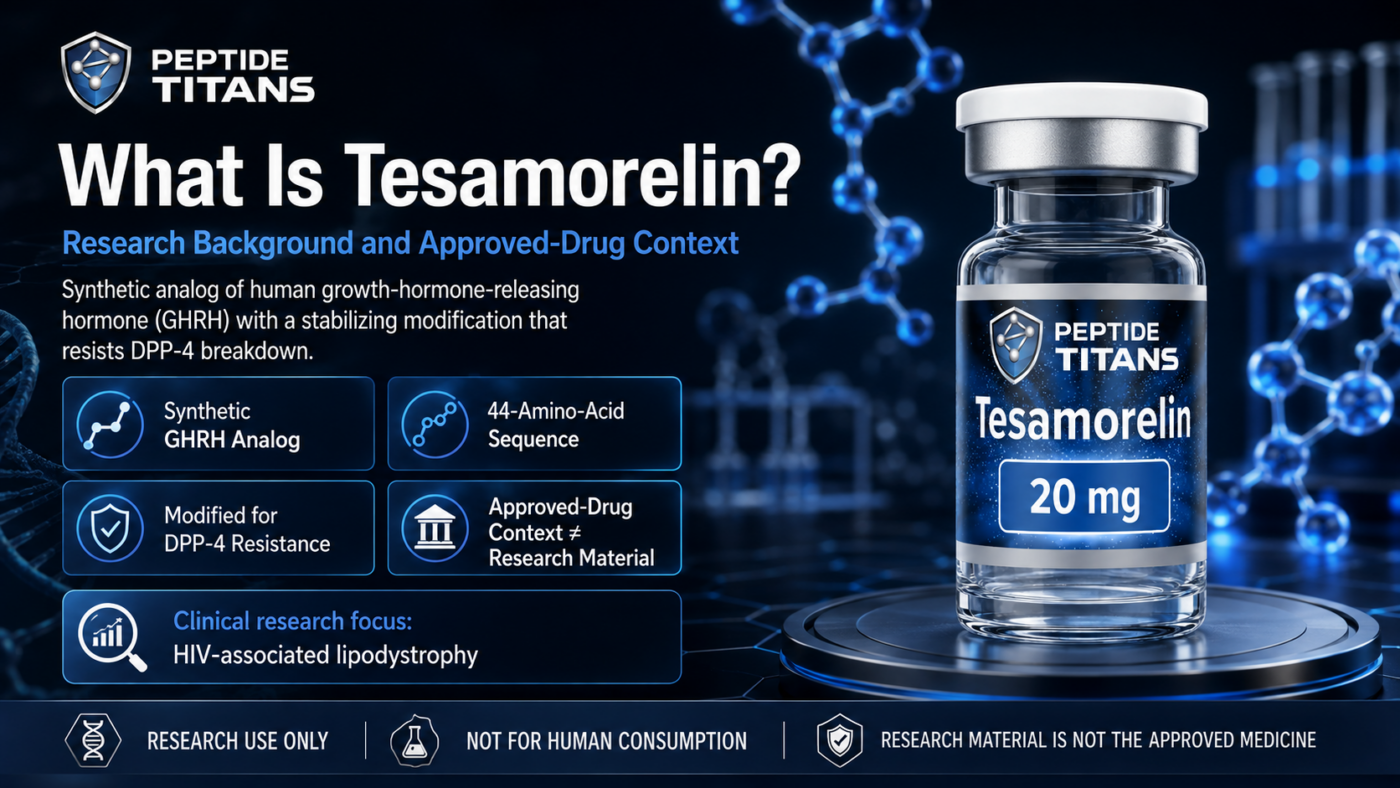
Tesamorelin is a synthetic analog of human growth-hormone-releasing hormone (GHRH). It contains all 44 amino acids of human GHRH with a trans-3-hexenoyl group attached to the N-terminal tyrosine — a modification that protects the peptide from degradation by dipeptidyl peptidase-4 (DPP-4), which otherwise clears native GHRH within minutes.
It is also the unusual case in this catalogue: tesamorelin is an FDA-approved drug. That changes what can and cannot be said about it, in both directions, so the distinction below comes first.
The approved drug is not the research material
This is the most important thing on the page.
Tesamorelin is approved by the FDA and marketed as EGRIFTA SV. That is a prescription medicine, manufactured to pharmaceutical standards, dispensed by a pharmacy, prescribed by a clinician for a specific diagnosis, and supplied with a label and a patient leaflet.
A research-grade tesamorelin listing is none of those things. It is a laboratory material sold for research use only. It is not EGRIFTA SV, it is not a prescription medicine, it has not been dispensed for any diagnosis, and it is not for human use. The existence of an approved formulation of the same molecule does not transfer any of that to a research chemical, and nothing on this page should be read as suggesting otherwise.
What the approved indication actually is
The approval is narrow. The FDA label states it verbatim:
“EGRIFTA SV is indicated for the reduction of excess abdominal fat in HIV-infected adult patients with lipodystrophy.”
Read that carefully, because a great deal of what circulates about tesamorelin ignores it. The indication is limited to HIV-infected adults with lipodystrophy — a specific metabolic complication of HIV and its treatment, involving abnormal fat redistribution. It is not an approval for general weight loss, not for body composition in healthy adults, and not for athletic or bodybuilding purposes.
What the clinical research measured
The trial programme behind that approval examined visceral adipose tissue (VAT) — the fat surrounding abdominal organs — measured by CT, in HIV-infected patients with lipodystrophy. Secondary measures included IGF-1, since GHRH analogs act by stimulating endogenous growth hormone, which in turn raises IGF-1.
The review literature is correspondingly focused. Contemporary reviews describe it specifically as a growth-hormone-releasing factor analogue for HIV-associated lipodystrophy (PMID 22298602, Annals of Pharmacotherapy, 2012; PMID 21668043, Drugs, 2011), with earlier coverage of its development as an investigational drug (PMID 19243281, Expert Opinion on Investigational Drugs, 2009) and its approval (PMID 21283099, Nature Reviews Drug Discovery, 2011). The NIH LiverTox database carries a monograph on it (PMID 31644039).
PubMed indexes roughly 121 records for tesamorelin — a modest but real literature, and importantly one that includes controlled human trials rather than only cell and rodent work.
Documented adverse reactions
Most compounds in this category have no safety profile at all, and pages about them can only say so. Tesamorelin is the exception: because it went through clinical trials and carries an approved label, adverse reactions are actually documented. The label lists the most common as:
- Injection site reactions — erythema, pruritus, pain, irritation
- Arthralgia (joint pain) and myalgia (muscle pain)
- Pain in extremities
- Peripheral edema
- Paresthesia — abnormal sensations such as tingling
- Rash
- Carpal tunnel syndrome
Several of these are recognisable as consequences of raising growth hormone and IGF-1 — fluid retention, joint discomfort and nerve compression effects appear across that drug class. This list describes the approved medicine used under supervision in the studied population. It is not a safety profile for a research material used outside that context, which has never been characterised.
Tesamorelin and sermorelin
These two are frequently compared, and the difference is substantive rather than cosmetic.
| Tesamorelin | Sermorelin | |
|---|---|---|
| Structure | Full 44-amino-acid GHRH with a trans-3-hexenoyl group | The GHRH(1–29) fragment |
| Stability | Modified specifically to resist DPP-4 degradation | Unmodified; short half-life |
| Approval status | FDA-approved (EGRIFTA SV) for one narrow indication | Previously approved in the US; the original product was withdrawn from marketing |
Both act at the same receptor. The practical difference is that tesamorelin was engineered for durability and carries a current approval with a clinical dataset behind it, whereas sermorelin is the shorter native fragment. For the full side-by-side, including regulatory standing and what neither was approved for, see Tesamorelin vs Sermorelin.
What the literature does not establish
- No approval for general fat loss, body recomposition, or athletic use. The indication is HIV-associated lipodystrophy, full stop.
- Muscle growth was not the endpoint. Trials measured visceral adipose tissue, not lean mass gain. GHRH analogs raise GH and IGF-1, but that mechanism is not the same as a demonstrated muscle outcome.
- No dosing, route, schedule or duration is given here — those exist only within the prescription label for the approved product and a specific diagnosis.
- Safety outside the studied population is not characterised.
- Research-grade material is not manufactured, tested, or regulated as the approved medicine.
Handling and storage
- Sealed vials: −20 °C, protected from light and moisture, desiccated. Allow to reach room temperature before opening.
- Reconstituted: short-term at 4 °C; −20 °C in single-use aliquots for longer. Minimise freeze–thaw cycles.
- Reconstitution: add diluent slowly down the vial wall, swirl gently, never shake.
Frequently asked questions
What is tesamorelin?
A synthetic analog of human GHRH — all 44 amino acids of the native hormone with a trans-3-hexenoyl group that resists DPP-4 breakdown. It stimulates the pituitary to release growth hormone.
Is tesamorelin FDA approved?
The medicine EGRIFTA SV is, for reduction of excess abdominal fat in HIV-infected adults with lipodystrophy. That approval attaches to the prescription product, not to research-grade material of the same molecule.
What are the side effects of tesamorelin?
The approved label documents injection site reactions, arthralgia, myalgia, pain in extremities, peripheral edema, paresthesia, rash and carpal tunnel syndrome. Those come from supervised clinical use in the studied population and do not describe research-material use, which is uncharacterised.
Does tesamorelin build muscle?
The clinical trials did not measure that. The endpoint was visceral abdominal fat measured by CT. Tesamorelin raises growth hormone and IGF-1, and people reason from that mechanism to muscle outcomes, but reasoning from a mechanism is not the same as evidence — and there is no approved indication for it.
What is the difference between tesamorelin and sermorelin?
Tesamorelin is the full 44-amino-acid GHRH sequence chemically modified for stability and currently approved for one indication; sermorelin is the shorter GHRH(1–29) fragment without that modification.
Is buying research tesamorelin the same as getting a prescription?
No, and the distinction matters. A prescription supplies a regulated medicine for a diagnosed condition under clinical supervision. A research listing supplies a laboratory material for research use only, not for human consumption.
Research use only
This product is not for human consumption. It is sold strictly for research and educational purposes and is not intended to diagnose, treat, cure, or prevent any disease. It is not the approved medicine EGRIFTA SV and is not a substitute for it. Research and label information on this page is derived from peer-reviewed literature and the FDA-approved prescribing information, and is provided for educational reference only; it does not constitute medical advice or product claims.
References
- FDA-approved prescribing information, EGRIFTA SV (tesamorelin), via the openFDA drug label API. Retrieved 19 August 2026.
- Tesamorelin: a growth hormone-releasing factor analogue for HIV-associated lipodystrophy. Ann Pharmacother, 2012. PMID 22298602
- Tesamorelin: a review of its use in the management of HIV-associated lipodystrophy. Drugs, 2011. PMID 21668043
- Tesamorelin. Nat Rev Drug Discov, 2011. PMID 21283099
- Tesamorelin, a human growth hormone releasing factor analogue. Expert Opin Investig Drugs, 2009. PMID 19243281
- Tesamorelin. LiverTox: Clinical and Research Information on Drug-Induced Liver Injury. PMID 31644039
Research-use product reference: Tesamorelin is listed at Peptide Titans for laboratory research use only. Products are not for human consumption.
Related
- What is CJC-1295? DAC vs No DAC — another GHRH analog
- What is NAD+? Research background
- What is KLOW peptide? Composition and research overview
Related reading
- Tesamorelin research profile — molecular data and indexed literature
- Are Peptides Legal in the United States? — where FDA-approved peptides fit in the wider legal picture
- Published Certificates of Analysis — how lots are documented