
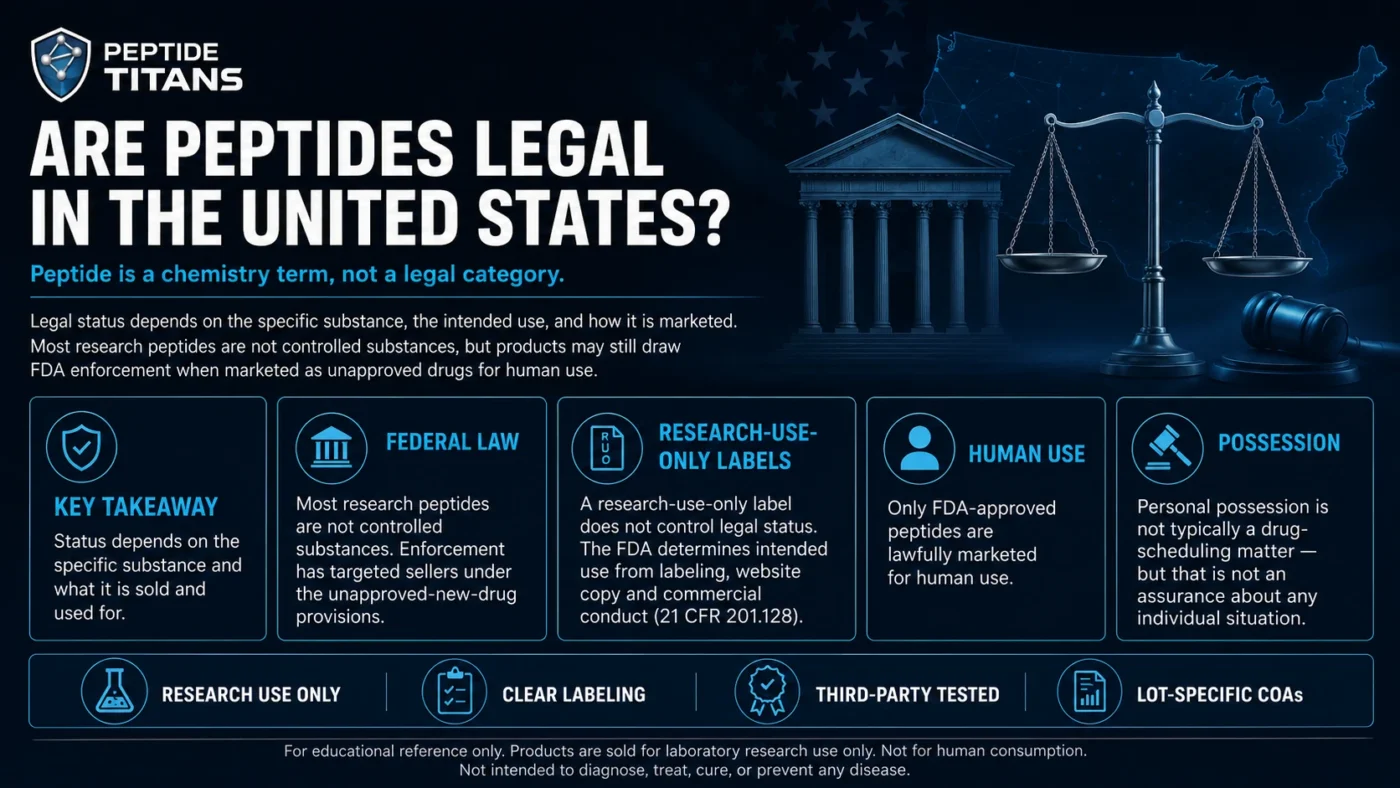
Short answer: there is no single answer, because “peptide” is a chemistry term, not a legal category. Insulin is a peptide and it is an approved drug. Other peptides are approved for nothing at all. The law does not ask whether a substance is a peptide — it asks which substance, and above all what it is sold and used for.
Three things are true at the same time in the United States as of 20 August 2026:
- Possessing or handling most research peptides is not a controlled-substances offence. They are not scheduled under the Controlled Substances Act.
- Almost none of the peptides discussed in fitness and longevity circles are approved drugs, and none may lawfully be sold for use in people without an approved application.
- A “research use only” label does not, by itself, decide anything. The FDA determines intended use from the whole picture, including website copy — and it has said so in writing, repeatedly, in 2026.
The regulatory picture also moved significantly in July 2026. That change is covered below, along with what it does not mean.
Why “are peptides legal” has no single answer
A peptide is simply a short chain of amino acids. That description covers insulin, which has been an approved medicine since the 1920s, and it covers compounds that have never been given to a human being under any protocol. Asking whether peptides are legal is a little like asking whether powders are legal.
In practice, any given peptide sits in one of four regulatory positions.
| Approved drugs | Peptides with an FDA-approved application for a specific indication. Legal to prescribe and dispense for that use. Insulin and tesamorelin are examples. |
| Compounding candidates | Substances a licensed pharmacy may compound only if they appear on the applicable bulk drug substances list under section 503A or 503B of the Federal Food, Drug, and Cosmetic Act. Most research peptides are not on those lists. |
| Research chemicals | Sold for laboratory work, not approved for human use, and not lawfully marketed for it. This is the category most compounds discussed online fall into. |
| Cosmetic ingredients | Peptides used topically in cosmetics, regulated as cosmetics so long as no drug claims are made about them. |
Nothing about being a peptide moves a substance between those boxes. What moves it is an approval, a listing decision, or the claims made about it.
What changed in July 2026
On 23 and 24 July 2026, the FDA’s Pharmacy Compounding Advisory Committee met to consider whether a group of peptides should be added to the 503A Bulks List — the list of bulk substances that licensed compounding pharmacies are permitted to use. The committee recommended six of the seven substances it voted on.
| Substance | Committee vote | Use the FDA actually evaluated |
|---|---|---|
| BPC-157 | 8 for, 6 against, 1 abstention — recommended | Ulcerative colitis |
| KPV | 8 for, 6 against, 1 abstention — recommended | Wound healing and inflammatory conditions |
| TB-500 | 8 for, 6 against, 1 abstention — recommended | Wound healing |
| MOTS-c | 7 for, 5 against, 2 abstentions — recommended | Obesity and osteoporosis |
| Semax | 8 for, 5 against, 1 abstention — recommended | Cerebral ischemia, migraine, trigeminal neuralgia |
| Epitalon | 7 for, 4 against, 1 abstention — recommended | Insomnia |
| Emideltide (DSIP) | 6 for, 7 against, 1 abstention — not recommended | Opioid withdrawal, chronic insomnia, narcolepsy |
The third column is the part most coverage leaves out, and it matters. The committee did not vote on whether these substances are broadly beneficial. It voted on specific proposed clinical uses, evaluated one at a time. A recommendation for TB-500 is a recommendation about wound healing. It is not a finding about anything else.
What that vote did not do
This is where most of the reporting goes wrong, so it is worth being blunt.
- The votes are advisory and non-binding. The committee recommends; the FDA decides.
- Nothing was approved. A place on the 503A Bulks List is permission for a licensed pharmacy to compound a substance. It is not a drug approval, and it says nothing about safety or efficacy having been established.
- Rulemaking has not happened. Adding a substance to the list requires notice-and-comment rulemaking. Until that process concludes, the listing is not in effect.
- Nothing changed for consumers. The vote created no route by which an individual may lawfully buy these substances for personal use.
The clearest evidence of all this is the FDA’s own list. Every substance the committee voted to recommend — BPC-157, KPV, TB-500, MOTS-c and epitalon among them — still sits today in Category 2 of the interim bulks list: substances the agency has identified as potentially presenting significant safety risks. That page was last revised on 22 April 2026 and has not been changed by the July vote.
The concerns the FDA records there are consistent across the group: risk of immunogenicity by certain routes of administration, difficulty characterising the active ingredient, and peptide-related impurities. For KPV the agency notes it has no human exposure data at all, by any route.
What is scheduled next
The committee is due to meet again before the end of February 2027 to consider five further substances for the same list:
- GHK-Cu
- Melanotan II
- Cathelicidin (LL-37)
- Dihexa acetate
- Mechano growth factor, pegylated (PEG-MGF)
The same caveats apply in advance: a recommendation would not be an approval, and would not take effect without rulemaking.
“Research use only” is not a legal shield
This is the single most misunderstood point in the entire subject, and the FDA has now spelled it out in public enforcement letters more than once.
Under 21 CFR 201.128, a product’s intended use is determined from the whole body of evidence surrounding it — labelling, website copy, and commercial conduct — not from a disclaimer. If that evidence shows a product is intended to affect the structure or function of the human body, it is a drug in law, whatever the label says.
In a warning letter dated 31 March 2026, the agency put it plainly:
Despite statements on your product labeling marketing your products for “Research Use Only,” and “not intended for human consumption, medical use, or veterinary use,” evidence obtained from your website establishes that your products are intended to be drugs for human use.
A second letter, issued 17 June 2026 to a different company, repeated the same finding almost word for word.
What is instructive is what the FDA cited as evidence. In the June letter the products were Prostamax and gonadorelin, and the quoted copy was written in a deliberately research-flavoured register. Sentences such as “Investigations show how gonadorelin affects testosterone production” and “Studies on prostate cancer cell growth and progression in laboratory settings” were still treated as establishing intended use as a drug — because they named conditions and described physiological effects.
The lesson is uncomfortable but clear: phrasing a claim as research does not neutralise it. What draws enforcement is naming a disease or describing an effect on the body. The FDA has also treated the sale of a sterile injection diluent alongside a peptide requiring reconstitution as evidence that the peptide was intended for injection into people.
In both letters the alleged violations were the same: the products were unapproved new drugs under section 505(a) of the FD&C Act, and shipping them in interstate commerce violated sections 301(d) and 505(a).
Peptides and anti-doping rules
For anyone subject to sport testing, the analysis is entirely separate from the FDA one, and considerably stricter.
The World Anti-Doping Agency’s category S0, non-approved substances, captures any substance not approved by any government health authority for human therapeutic use — including compounds in preclinical or clinical development, discontinued drugs and veterinary drugs. Most research peptides fall into S0 by definition, without needing to be named individually.
Some are named anyway. Section S2 covers peptide hormones, growth factors and related substances; growth hormone secretagogues sit there, and thymosin-beta-4 and its derivatives are listed by name.
The US Anti-Doping Agency has published specifically on BPC-157, stating that it is prohibited under S0, that it is “not approved for human clinical use by the U.S. Food and Drug Administration (FDA) or any other global health authority”, and that because it has not been studied extensively in humans it is unknown whether a safe dose exists.
Two practical points follow. Substances in S0 and S2 are prohibited at all times, not only in competition. And an anti-doping violation does not require a positive test — non-analytical cases can be brought on other evidence, including purchase records.
State law
The framework above is federal and applies nationwide. States add a further layer, chiefly through pharmacy licensing, medical practice rules and telehealth regulation, and these vary. Several states have moved recently to constrain how clinics may offer peptide services. Because that picture changes frequently and differs by state, anyone operating a clinic or a business in this area should take advice specific to their jurisdiction rather than rely on a general summary.
Frequently asked questions
Can you get in trouble for buying peptides?
Research peptides are generally not controlled substances, so personal possession is not typically a drug-scheduling matter. Enforcement in this area has been directed at sellers rather than buyers, under the unapproved-new-drug provisions described above. That is a description of where enforcement has fallen to date, not an assurance about any individual situation.
What peptides are legal in the United States?
Peptides with FDA approval are legal to prescribe and dispense for their approved indication — insulin and tesamorelin among them. Beyond that, a licensed pharmacy may compound substances that appear on the applicable 503A or 503B bulks list. Everything else is sold as a research chemical and is not lawfully marketed for human use.
Will peptides show up on a drug test?
Standard employment drug panels look for a fixed set of drugs of abuse and do not screen for research peptides. Sport testing is a different matter: accredited anti-doping laboratories develop targeted methods for these compounds, and detection methods are published in the analytical chemistry literature as new compounds appear.
Are peptides steroids?
No. Anabolic-androgenic steroids are synthetic derivatives of testosterone with a steroid ring structure, and in the United States they are Schedule III controlled substances. Peptides are amino acid chains and are chemically unrelated. The two are governed by entirely different laws.
Is BPC-157 legal? Did the July 2026 vote change that?
BPC-157 is not an FDA-approved drug and may not lawfully be sold for use in people. The July 2026 vote did not change that. It was a non-binding recommendation that BPC-157 be added to a list permitting licensed pharmacies to compound it for ulcerative colitis, subject to rulemaking that has not occurred. BPC-157 remains in Category 2 of the FDA’s interim list today, and remains prohibited in sport under S0.
Is GHK-Cu legal?
GHK-Cu is not a controlled substance, and it is not an FDA-approved drug, so it may not lawfully be sold for use in people. Like most research peptides it is sold as a laboratory chemical, and the same intended-use analysis described above applies to it.
Does a research-use-only label protect a seller?
On the evidence of the FDA’s 2026 warning letters, no. The agency has stated in writing that such labelling does not control where other evidence establishes intended use as a drug.
This page is not legal advice
This is a factual summary of publicly available regulatory material, written for general reference and current as of 20 August 2026. It is not legal advice, it does not create any professional relationship, and it should not be relied on in place of advice from a qualified attorney. Regulatory status in this area is changing quickly — the compounding position in particular is mid-process and may look different within months. Anyone making a decision that depends on the legal status of a specific substance should consult counsel licensed in their jurisdiction.
Research use only
Products sold by Peptide Titans are not for human consumption. They are supplied strictly for research and educational purposes and are not intended to diagnose, treat, cure, or prevent any disease. Nothing on this page is a claim that any product is approved, safe, or effective for use in people, and no dosing guidance appears anywhere on this site.
References
- U.S. Food and Drug Administration. Certain Bulk Drug Substances for Use in Compounding that May Present Significant Safety Risks (Category 2 list). Content current as of 22 April 2026. fda.gov
- U.S. Food and Drug Administration, Center for Drug Evaluation and Research. Warning letter reference 721806, 31 March 2026. fda.gov
- U.S. Food and Drug Administration, Center for Drug Evaluation and Research. Warning letter reference 729447, 17 June 2026. fda.gov
- Pharmacy Compounding Advisory Committee meeting, 23 and 24 July 2026. Vote outcomes and evaluated uses as reported by the Regulatory Affairs Professionals Society and by the National Community Pharmacists Association.
- World Anti-Doping Agency. The Prohibited List, 2026 edition. wada-ama.org
- U.S. Anti-Doping Agency. BPC-157: Experimental Peptide Creates Risk for Athletes. usada.org
- 21 CFR 201.128, Meaning of intended uses; Federal Food, Drug, and Cosmetic Act sections 201(g)(1), 301(d), 503A and 505(a).
Related
- Research Use Only: what it means for laboratories and researchers — the labelling designation itself, and its limits
- BPC-157 oral vs injection — what the evidence does and does not show
- What is GHK-Cu? — due before the committee in February 2027
- What is Tesamorelin? — a peptide that does hold an FDA approval
- Our Research Use Only policy — the standing policy for everything sold on this site
- Are Peptides FDA-Approved? — which peptide drugs hold approvals, and what approval actually means
- How research peptides are regulated in the U.S. — the FD&C Act, 503A and the PCAC in one map
- What research-use-only labels do and don’t do — labeling through the intended-use lens