
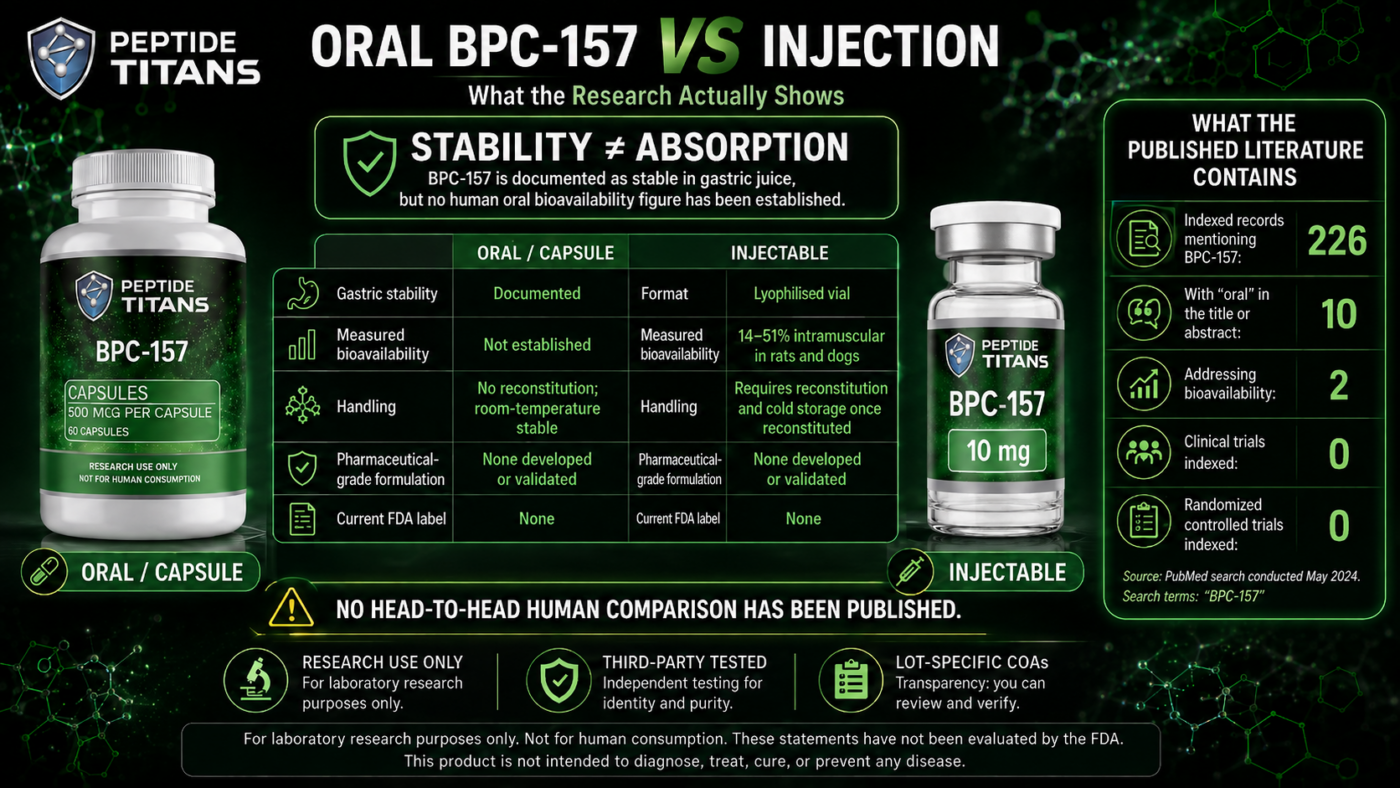
Short answer: BPC-157 is unusual among peptides in that it survives gastric acid — that part is genuinely documented. But surviving the stomach and being absorbed into the bloodstream are two different things, and only the first one has been shown. No oral bioavailability figure for BPC-157 has been established in humans. The percentages circulating in product copy come from intramuscular studies in rats and dogs.
That distinction — stability versus absorption — is the single most confused point in this category, and it is where this page starts.
Oral and injectable formats, side by side
| Oral / capsule | Injectable (lyophilised vial) | |
|---|---|---|
| Gastric stability | Documented — BPC-157 is reported stable in human gastric juice, which is why an oral format was investigated at all | Not applicable |
| Measured bioavailability | Not established — in any species | 14–51% intramuscular, species-dependent (rats and dogs) |
| Plasma half-life | Under 30 minutes — confirmed preclinically and in a two-subject human pilot | |
| Pharmaceutical-grade formulation | None developed or validated for either route | |
| Current FDA label | None. The openFDA drug-label database returns no current entry for BPC-157 | |
| Handling | Room-temperature stable; no reconstitution step | Requires reconstitution and cold storage once reconstituted |
The bioavailability number is not what it appears to be
A formal preclinical ADME study published in 2022 characterised BPC-157 in rats and dogs, reporting linear dose-proportional kinetics, a plasma half-life under 30 minutes, and intramuscular bioavailability ranging from 14% to 51% depending on species.
Those are the numbers that circulate. They describe injection into muscle, in two non-human species. They say nothing about how much of an oral dose reaches circulation, and a 2026 review in Pharmaceutics examining exactly this question found the peptide still lacks BCS classification data, permeability characterisation and formal excipient compatibility studies — the basic pharmaceutical work that would be needed to answer it.
Searching PubMed for BPC-157 together with bioavailability returns two indexed papers. Both are cited at the bottom of this page. An entire product format is being sold on a two-paper evidence base, and neither paper measures oral absorption in a person.
What the published literature actually contains
The house standard on these pages is to state the size of the literature rather than imply one. Counts below were pulled live from the PubMed E-utilities API on 20 August 2026 and are reproducible:
| Indexed records mentioning BPC-157 | 226 |
| … conducted in rats or mice | 125 |
| … with “oral” in the title or abstract | 10 |
| … addressing bioavailability | 2 |
| … indexed as a clinical trial | 0 |
| … indexed as a randomised controlled trial | 0 |
Two of the ten “oral” papers are studies in honeybees. That is not a joke at the compound’s expense — they are legitimate veterinary papers on Nosema infection in apiaries — but it is a fair illustration of how thin the oral-administration literature is once you look at it directly.
Human data: fewer than 30 subjects, none of it oral
The 2026 Pharmaceutics review is direct about this: available clinical data derive from fewer than 30 subjects across three uncontrolled pilot studies, none of which used standardised pharmaceutical preparations.
The clearest of them is a 2025 pilot examining the safety of intravenous BPC-157 infusion in humans. Intravenous — not oral, not intramuscular, and a safety pilot rather than an efficacy trial.
There is also a documented mismatch that nobody has resolved: the plasma half-life is under 30 minutes, yet the biological effects reported in animal work persist for hours to days. The review calls this a pharmacokinetic–pharmacodynamic disconnect, and notes it has real consequences for how any formulation would need to be designed. It is an open question, not a solved one.
Where that leaves the format choice
For a laboratory purchasing research material, the honest framing is that the oral-versus-injectable question cannot currently be answered on efficacy grounds, because the comparative data does not exist. What differs between the formats, and what is verifiable, is practical:
- Capsules arrive ready to handle, need no reconstitution step, and avoid the variability that reconstitution introduces.
- Lyophilised vials allow the concentration to be set by the researcher, which matters when a protocol specifies one.
- Neither format has a validated pharmaceutical specification behind it, so purity documentation on the specific lot carries more weight than the format does.
Anyone claiming a definitive efficacy advantage for one route over the other is going beyond what has been published.
Regulatory position
BPC-157 holds no marketing authorisation as a drug in the United States. A query against the openFDA drug-label database returns no current entry, which is consistent with a compound that is not marketed as an approved product. The 2026 review reaches the same conclusion from the development side: no approved formulation, no validated dosing regimen, and no completed Phase II clinical trial.
The review’s own summary of why is worth stating plainly, because it is more even-handed than either side of the usual argument: the barrier to clinical translation is not an absence of biological activity, but an absence of fundamental pharmaceutical science — characterised formulations, validated pharmacokinetics, and a coherent development strategy.
Update, July 2026. The FDA’s Pharmacy Compounding Advisory Committee voted 8 for, 6 against, with one abstention, to recommend BPC-157 for the 503A Bulks List — the substances licensed compounding pharmacies may use. The proposed use the committee evaluated was ulcerative colitis, not musculoskeletal repair. The vote is non-binding, the rulemaking needed to give it effect has not occurred, and BPC-157 remains in Category 2 of the FDA’s interim list. See Are peptides legal in the United States? for the full picture.
Frequently asked
What does taking BPC-157 orally do?
No published human study has measured this. The animal literature reports biological activity following oral administration in rodents, and the peptide’s stability in gastric juice is documented, but no trial has established what an oral dose does in a person. BPC-157 sold by Peptide Titans is research material and is not for human consumption.
Is oral BPC-157 as effective as injection?
There is no published head-to-head comparison in humans, so this cannot be answered from the evidence. Any figure presented as an oral-versus-injectable efficacy ratio is an extrapolation.
Can BPC-157 cause liver damage?
No human safety profile has been established for BPC-157 by any route, so this question cannot be answered from the published literature. The available human data amounts to fewer than 30 subjects across three uncontrolled pilots. Absence of reported harm in a dataset that small is not evidence of safety, and this page makes no safety claim in either direction.
What should you not combine it with?
No interaction studies have been published. Nothing in the literature supports a combination claim, and nothing supports a warning about a specific one either — the work simply has not been done.
Which supplier should be trusted?
No independent ranking of research-peptide suppliers exists, and any page presenting one is expressing an opinion. What can actually be checked is documentation: whether a supplier publishes third-party HPLC purity testing tied to the specific production lot you receive, rather than a generic certificate. Peptide Titans publishes lot-specific certificates of analysis for every production lot; the point stands regardless of supplier, and it is the right question to ask of any of them.
How many published papers are there on BPC-157?
226 indexed records as of 20 August 2026, of which 125 are in rats or mice and none are indexed as clinical trials. For comparison, the counts stated across this research library range from three papers for 5-Amino-1MQ to 3,837 for kisspeptin — BPC-157 sits in the middle, with an unusually preclinical distribution.
Research use only
These products are not for human consumption. They are sold strictly for research and educational purposes and are not intended to diagnose, treat, cure, or prevent any disease. BPC-157 is not an approved drug in the United States and no research-grade material is a substitute for one. Information here is derived from peer-reviewed literature and public regulatory databases, for educational reference only; it does not constitute medical advice or product claims. No dosing guidance appears on this page, because no validated human dosing regimen for BPC-157 has been published.
References
- BPC-157 as an investigational peptide therapeutic: biopharmaceutical challenges, formulation strategies, and translational development barriers. Pharmaceutics, 2026. PMID 42198317
- Pharmacokinetics, distribution, metabolism, and excretion of body-protective compound 157, a potential drug for treating various wounds, in rats and dogs. Front Pharmacol, 2022. PMID 36588717
- Safety of intravenous infusion of BPC157 in humans: a pilot study. Altern Ther Health Med, 2025. PMID 40131143
- Safety and efficacy of approved and unapproved peptide therapies for musculoskeletal injuries and athletic performance. Sports Med, 2026. PMID 41966639
- From regeneration to analgesia: the role of BPC-157 in tissue repair and pain management. Int J Mol Sci, 2026. PMID 41898733
- Pentadecapeptide BPC 157 (PL 14736) improves ligament healing in the rat. J Orthop Res, 2010. PMID 20225319
- Physiological and immunological status of adult honeybees (Apis mellifera) fed sugar syrup supplemented with pentadecapeptide BPC 157. Biology (Basel), 2021. PMID 34571768
- Record counts retrieved from the PubMed E-utilities API (esearch.fcgi), 20 August 2026. FDA label status retrieved from the openFDA drug-label API, 20 August 2026.
Research-use product reference: BPC-157 500 mcg Capsules, BPC-157 lyophilised vials, BPC-157 + KPV 500/500 mcg Capsules and BPC-157 + TB-500 500/500 mcg Capsules are listed at Peptide Titans for laboratory research use only. Products are not for human consumption.
Related
- What is the Wolverine peptide stack? — BPC-157 paired with TB-500, and what the one combination study found
- What is TB-500? Research background and study areas — frequently paired with BPC-157
- What is KPV? Research background and study areas
- What is KLOW? — the blend containing BPC-157, TB-500, KPV and GHK-Cu
- KLOW reconstitution and concentration chart
Related research resources
- BPC-157 research profile — sequence, mechanisms and indexed literature
- BPC-157 research material (lyophilized vials)
- BPC-157 in capsule form