
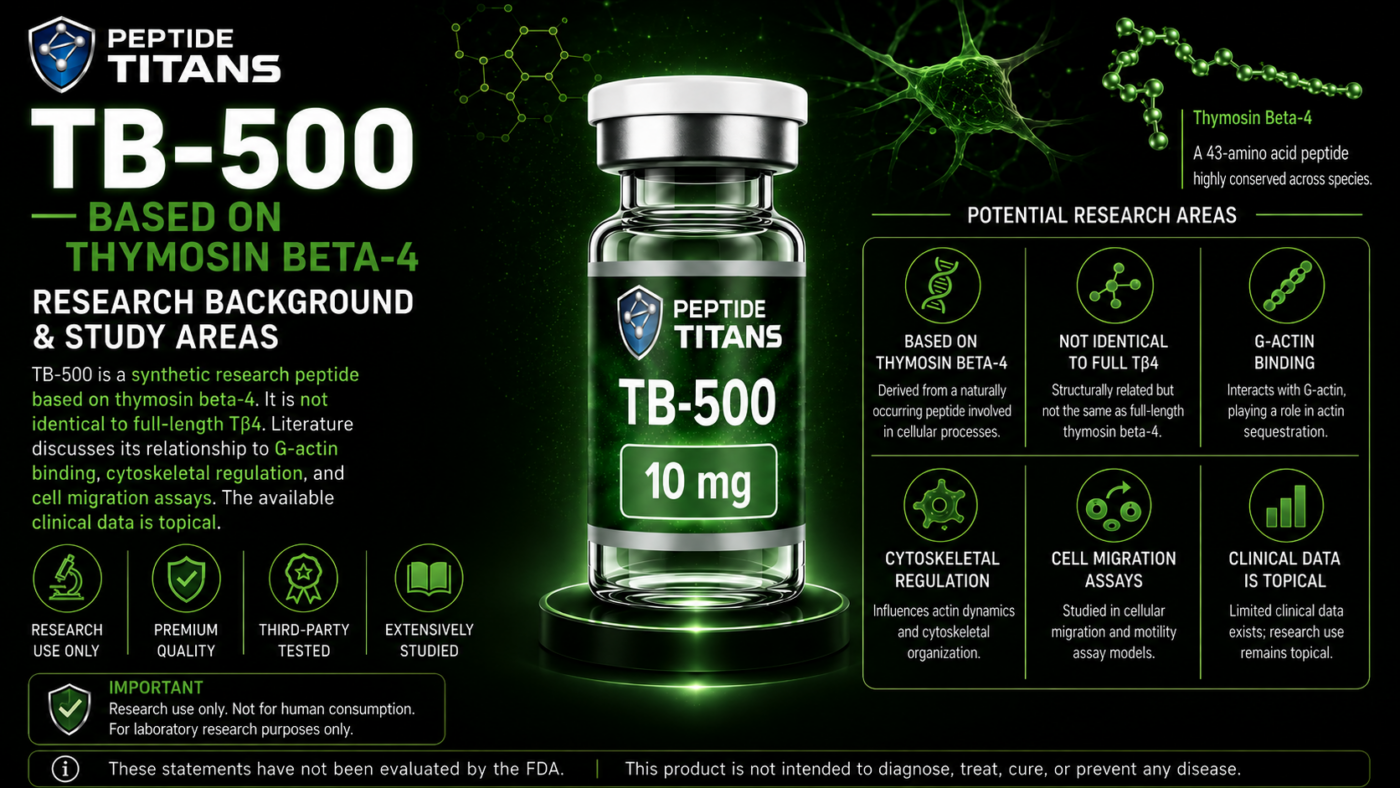
TB-500 is the name used in research catalogues for a synthetic peptide based on thymosin beta-4 (Tβ4). Thymosin beta-4 is a naturally occurring 43-amino-acid protein found in most human cells and in high concentration in platelets and wound fluid. Its primary known function is binding G-actin, the monomeric form of actin, which makes it central to how cells build and reorganise their internal skeleton — and therefore to how they move.
TB-500 and thymosin beta-4 are not strictly the same thing
This distinction gets flattened almost everywhere, and it matters when reading the literature.
The published research is about thymosin beta-4 — the full 43-amino-acid protein. TB-500 is a supplier designation, commonly described as a synthetic peptide corresponding to the biologically active region of Tβ4 rather than the complete protein. The two names are used interchangeably in catalogues, but a paper about Tβ4 is a paper about the full protein.
So when a product page cites Tβ4 research, it is citing work on a related but not necessarily identical molecule. That is worth knowing before treating the two as equivalent.
What the published research examines
PubMed indexes roughly 1,053 records for thymosin beta-4 — a substantial literature, with some clinical work in it. The supplier designation TB-500 itself returns only 25, and that gap is the sharpest available measure of the distinction described above: the published research is on the protein, not on the product name. Counts retrieved from the PubMed E-utilities API, 20 August 2026.
- Actin binding and cell migration. The foundational mechanism. Tβ4 sequesters G-actin, regulating polymerisation and therefore cytoskeletal reorganisation — the machinery cells use to migrate. Reviews of the beta-thymosin family cover this in depth (PMID 17468232 and PMID 17495248, both Annals of the New York Academy of Sciences, 2007).
- Tissue repair. A 2012 review in Expert Opinion on Biological Therapy describes Tβ4 as a multi-functional regenerative peptide and surveys basic properties alongside clinical applications (PMID 22074294).
- Ophthalmology. The most clinically advanced line. Work on Tβ4 and the eye has progressed from bench to bedside, particularly in corneal wound healing (PMID 30063853, 2018).
- Sepsis and inflammation. Research on Tβ4 regulation of actin in sepsis (PMID 29508629, 2018).
- Model types. Cell migration assays, multiple animal wound models, and topical clinical trial work in dermatology and ophthalmology. Systemic clinical evidence is far thinner than topical.
Why TB-500 and BPC-157 are discussed together
The pairing is one of the most searched topics in this category, so it is worth addressing directly rather than leaving to a product page.
The rationale offered is that the two address tissue repair through different mechanisms: Tβ4 through actin binding and cell migration, BPC-157 through angiogenic and cytoprotective signalling pathways. Because the mechanisms are distinct, the compounds are studied and sold together.
What does not exist is research on the combination. Published work examines each peptide separately, overwhelmingly in cell and rodent models. No study characterises them administered together, and adding two sets of preclinical findings does not produce evidence about a pairing. Peptide Titans lists a BPC-157 + TB-500 blend and capsules; the same caveat applies to both.
What the literature does not establish
- No FDA approval, and no approved indication in any form.
- No established dosing, route, schedule or duration — and none is given here.
- Where clinical data exists it is largely topical — eye and skin. Systemic use is not supported by comparable evidence.
- No research on the BPC-157 combination.
- Findings about full-length Tβ4 do not automatically transfer to a shorter synthetic fragment.
- TB-500 appears on anti-doping prohibited lists in some contexts; for competition purposes consult the current WADA Prohibited List directly.
Handling and storage
- Sealed vials: −20 °C to −80 °C, protected from light and moisture, desiccated. Allow to reach room temperature before opening.
- Reconstituted: up to about 7 days at 4 °C, or −20 °C in single-use aliquots. Minimise freeze–thaw cycles.
- Reconstitution: add diluent slowly down the vial wall, swirl gently, never shake.
Frequently asked questions
What is TB-500?
A synthetic research peptide based on thymosin beta-4, a naturally occurring actin-binding protein involved in cytoskeletal regulation and cell migration.
Is TB-500 the same as thymosin beta-4?
Not strictly. Tβ4 is the full 43-amino-acid protein and is what the published literature studies; TB-500 is a supplier name for a synthetic peptide based on its active region. The names are used interchangeably in catalogues, which can be misleading when citing research.
Is TB-500 related to thymosin alpha-1?
Only by name. They are unrelated molecules with different sequences, different mechanisms and separate literatures. Thymosin alpha-1 is studied for immune modulation.
What does thymosin beta-4 do?
It binds G-actin, regulating actin polymerisation and therefore the cytoskeletal reorganisation underlying cell migration. That mechanism is why it appears throughout tissue-repair research.
Why is TB-500 paired with BPC-157?
Because they are described as acting through different repair-related mechanisms. No published research characterises the combination, so the pairing rests on mechanism rather than on combination data.
Is there human evidence for TB-500?
There is clinical work on thymosin beta-4, but it is concentrated in topical applications — corneal and dermal. Systemic evidence is limited and largely preclinical.
Research use only
This product is not for human consumption. It is sold strictly for research and educational purposes and is not intended to diagnose, treat, cure, or prevent any disease. Research information on this page is derived from peer-reviewed scientific literature and provided for educational reference only; it does not constitute medical advice or product claims.
References
- Thymosin β4: a multi-functional regenerative peptide. Basic properties and clinical applications. Expert Opin Biol Ther, 2012. PMID 22074294
- beta-Thymosins. Ann N Y Acad Sci, 2007. PMID 17468232
- The beta-thymosin enigma. Ann N Y Acad Sci, 2007. PMID 17495248
- Thymosin beta 4 and the eye: the journey from bench to bedside. Expert Opin Biol Ther, 2018. PMID 30063853
- Thymosin beta 4 regulation of actin in sepsis. Expert Opin Biol Ther, 2018. PMID 29508629
- Thymosin beta-4 review. PMC8724243
Research-use product reference: TB-500, TB-500 500 mcg Capsules and the BPC-157 + TB-500 Blend are listed at Peptide Titans for laboratory research use only. Products are not for human consumption.
Related
- What is the Wolverine peptide stack? — TB-500 paired with BPC-157, and the one study that tested the combination
- What is KLOW peptide? — TB-500 is one of its four components
- What is Thymosin Alpha-1? — same family name, unrelated molecule
- What is KPV peptide? Research background
Reference & documentation
- TB-500 research profile — sequence, mechanisms and indexed literature
- TB-500 research material
- Lot-specific Certificate of Analysis for TB-500