
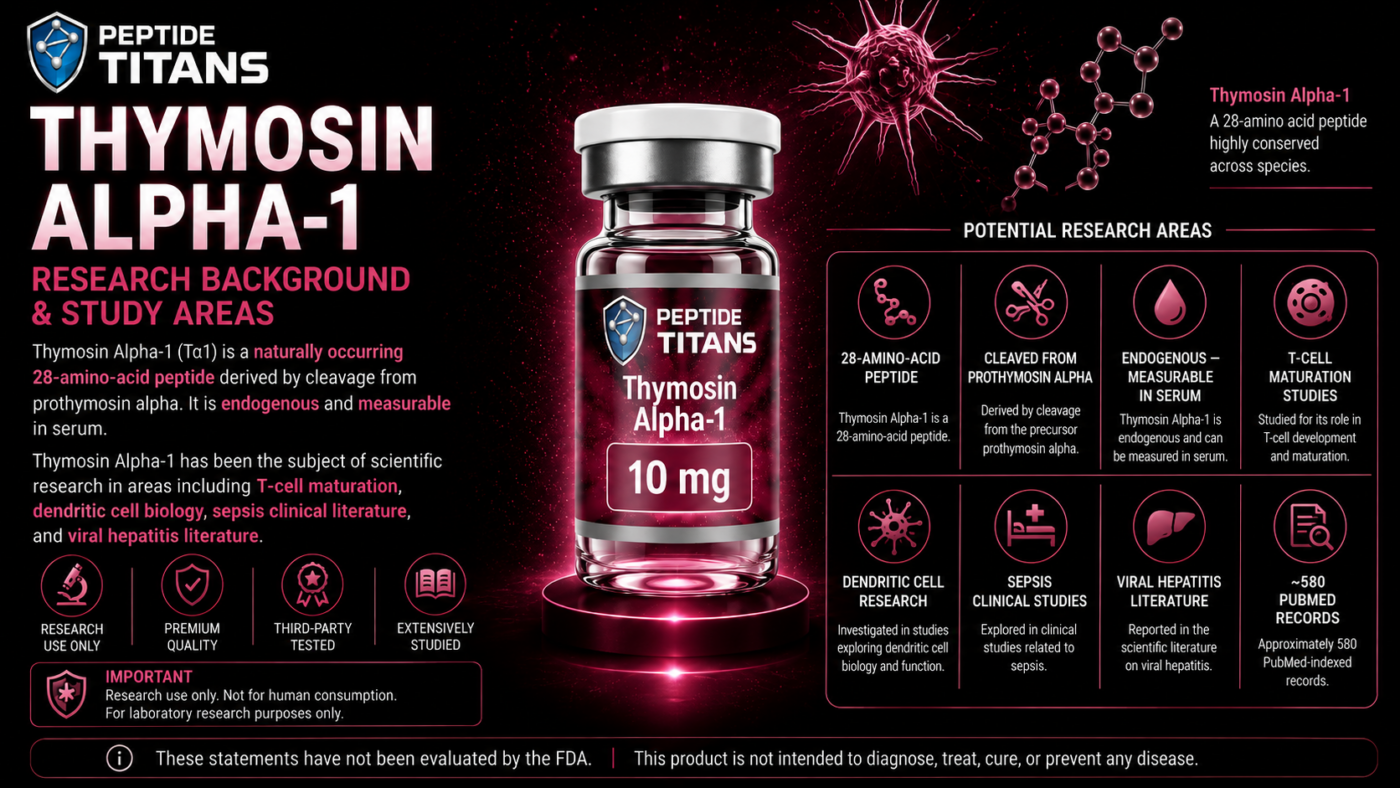
Thymosin alpha-1 is a 28-amino-acid peptide originally isolated from the thymus gland. It is cleaved from a larger precursor protein, prothymosin alpha, and unlike most compounds in this catalogue it is endogenous — the body produces it, and it is measurable in human serum.
That last point matters for reading the literature: research here divides between studies of naturally circulating levels and studies of the synthetic peptide as an administered agent.
What the published research examines
PubMed indexes roughly 580 records for thymosin alpha 1 — a substantial literature by the standards of this catalogue, and one with genuine clinical work in it.
- Immune modulation. The central theme throughout. Published studies report T-cell maturation and dendritic-cell endpoints, and the reviews in this area distinguish the two response profiles they measure. A 2020 review in World Journal of Virology covers the field comprehensively (PMID 33362999).
- Sepsis. A distinct clinical research line examined thymosin alpha 1 treatment in sepsis patients (PMID 30063866, Expert Opinion on Biological Therapy, 2018).
- Endogenous levels. Work characterising serum thymosin alpha 1 in normal and pathological conditions (PMID 30063864, 2018) — relevant because it establishes the compound as a physiological constituent, not only an exogenous agent.
- Pharmacology overviews. A 2001 monograph in the American Journal of Health-System Pharmacy (PMID 11381492) and a 2024 Frontiers in Medicine paper framing it as a case study in phenotypic drug discovery (PMID 38903817).
- Model types. A mix of cell work, animal models and human clinical studies — a broader base than most research peptides can claim.
Regulatory status
Querying the openFDA drug-label database returns no current US label for thymosin alpha-1 or thymalfasin. It is not an FDA-approved medicine in the United States, and it is not an approved dietary supplement ingredient.
Regulatory standing for this compound differs between countries, and the position outside the US should be checked against the relevant national regulator rather than inferred from a supplier page. Whatever that status is elsewhere, it does not apply to research-grade material sold in the US, which is not a medicine in any jurisdiction.
What the literature does not establish
- No FDA approval; no approved indication in the US.
- No established dosing, route, schedule or duration for research material, and none is given here.
- Clinical work exists but is concentrated in specific patient populations — sepsis, hepatitis — and does not transfer to general use in healthy adults.
- The immune system is homeostatic; “modulation” in the literature does not mean a directional improvement that can be assumed.
Handling and storage
- Sealed vials: −20 °C to −80 °C, protected from light and moisture, desiccated. Allow to reach room temperature before opening.
- Reconstituted: up to about 7 days at 4 °C, or −20 °C in single-use aliquots. Minimise freeze–thaw cycles.
- Reconstitution: add diluent slowly down the vial wall, swirl gently, never shake.
Frequently asked questions
What is thymosin alpha-1?
A 28-amino-acid peptide cleaved from prothymosin alpha, originally isolated from the thymus. It occurs naturally in humans and is also produced synthetically for research.
What does the research examine?
Predominantly immune modulation — T-cell maturation and dendritic cell function — with distinct clinical research lines in sepsis and viral hepatitis, plus work characterising natural serum levels.
Is thymosin alpha-1 FDA approved?
No. The openFDA label database returns no current US entry. Status elsewhere varies by country and should be checked with the relevant regulator.
Is it the same as thymosin beta-4 or TB-500?
No. Despite the shared “thymosin” name they are unrelated molecules with different sequences and different research literatures. The two are indexed separately here: the thymosin alpha-1 literature and the thymosin beta-4 literature cite different sequences, different assays and different study models.
What are the benefits of thymosin alpha-1?
No benefits are established for research material. The literature describes study areas and reports from specific clinical populations; that is not the same as a demonstrated benefit for general use.
Research use only
This product is not for human consumption. It is sold strictly for research and educational purposes and is not intended to diagnose, treat, cure, or prevent any disease. Research information on this page is derived from peer-reviewed scientific literature and provided for educational reference only; it does not constitute medical advice or product claims.
References
- Thymosin alpha 1: a comprehensive review of the literature. World J Virol, 2020. PMID 33362999
- Thymosin alpha-1. Am J Health Syst Pharm, 2001. PMID 11381492
- Thymosin alpha 1 treatment for patients with sepsis. Expert Opin Biol Ther, 2018. PMID 30063866
- Serum thymosin alpha 1 levels in normal and pathological conditions. Expert Opin Biol Ther, 2018. PMID 30063864
- Phenotypic drug discovery: a case for thymosin alpha-1. Front Med, 2024. PMID 38903817
Research-use product reference: Thymosin Alpha-1 and Thymosin Alpha-1 500 mcg Capsules are listed at Peptide Titans for laboratory research use only. Products are not for human consumption.