
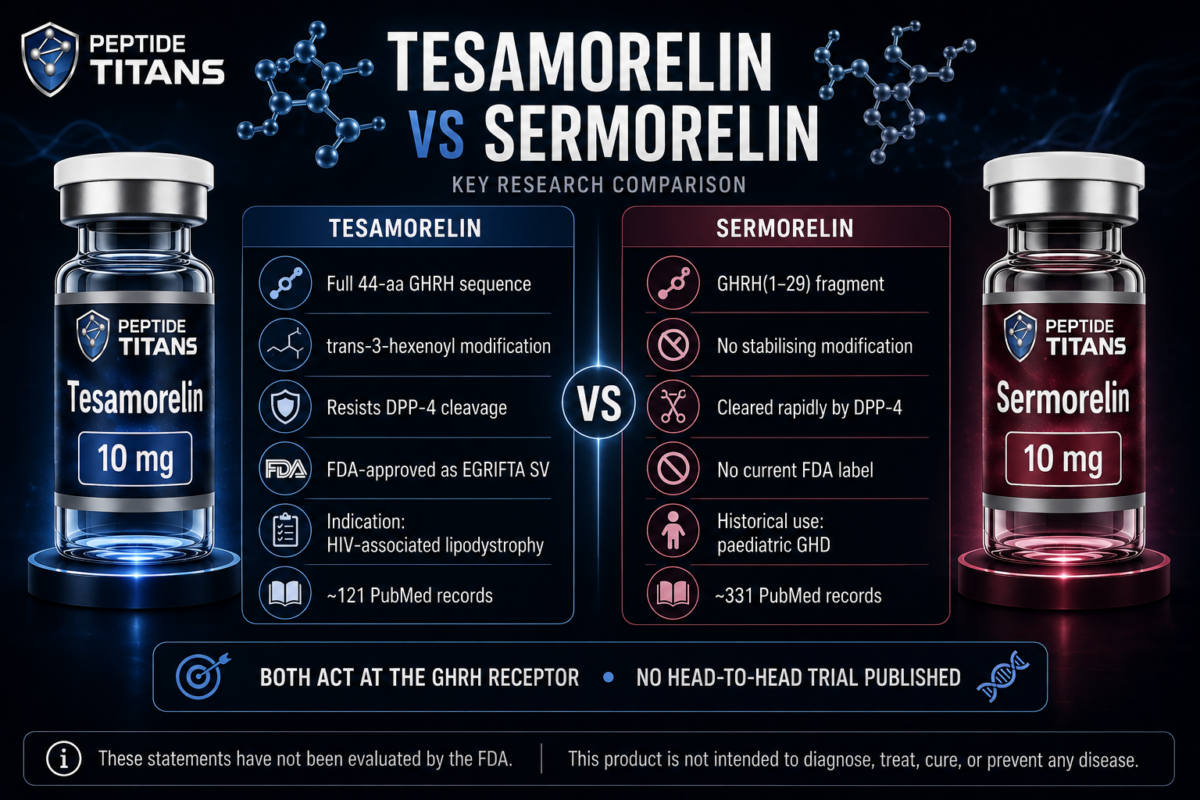
Short answer: both are growth-hormone-releasing hormone (GHRH) analogs acting at the same pituitary receptor, but they are built differently and stand in very different regulatory positions. Sermorelin is the short GHRH(1–29) fragment, unmodified and rapidly degraded. Tesamorelin is the full 44-amino-acid sequence with a chemical modification that resists breakdown, and it holds a current FDA approval for one narrow indication.
The most useful thing to understand, though, is what neither of them was approved for — covered further down.
Side by side
| Tesamorelin | Sermorelin | |
|---|---|---|
| Structure | All 44 amino acids of human GHRH | GHRH(1–29) — the shortest fragment retaining full activity |
| Modification | trans-3-hexenoyl group on the N-terminal tyrosine, resisting DPP-4 cleavage | None |
| Stability | Engineered for durability | Short-lived; cleared rapidly |
| Receptor | Both: the GHRH receptor on the anterior pituitary | |
| Current FDA label | Yes — EGRIFTA SV | No current label returned by the openFDA database |
| PubMed records | ~121 | ~331 |
Counts and label lookups retrieved 19 August 2026 via the NCBI E-utilities and openFDA APIs.
Length and stability: the engineering difference
Native GHRH is 44 amino acids long, and its biological activity lives almost entirely in the first 29. That is why sermorelin exists at all — it is the shortest fragment that still does the job, which made it attractive as a simpler molecule to manufacture and study.
The problem with both native GHRH and sermorelin is dipeptidyl peptidase-4 (DPP-4), an enzyme that cleaves the peptide near its N-terminus and inactivates it within minutes. Tesamorelin addresses this directly: the trans-3-hexenoyl group attached to its N-terminal tyrosine physically obstructs that cleavage.
So the two represent opposite design choices. Sermorelin is a minimisation — strip the molecule to its active core. Tesamorelin is a fortification — keep the full sequence and armour the vulnerable end. Peptide stability and degradation profiles across this family are themselves a research subject (PMID 37688464).
Regulatory standing: the sharpest difference
Tesamorelin is currently approved and marketed as EGRIFTA SV. Querying the openFDA drug-label database returns a full current label, with an indication reading verbatim: “EGRIFTA SV is indicated for the reduction of excess abdominal fat in HIV-infected adult patients with lipodystrophy.”
Sermorelin returns no current label from the same database. Historically it did hold approved status — a 1999 review in BioDrugs describes its established use in the diagnosis and treatment of children with idiopathic growth hormone deficiency (PMID 18031173) — but it is not currently marketed as an FDA-approved product in the US. Material available today is compounded or research-grade rather than an approved medicine.
That asymmetry is the single most consequential difference between the two, and it is routinely flattened in comparisons that treat them as interchangeable options.
Neither was approved for what people search them for
This is the part worth reading twice.
Search demand around both compounds is dominated by adult body composition — fat loss, muscle, anti-ageing. Now look at what the approvals actually cover:
- Tesamorelin’s approval is for reduction of excess abdominal fat in HIV-infected adults with lipodystrophy — a specific metabolic complication of HIV and its treatment. Not general fat loss, and not in healthy adults.
- Sermorelin’s historical approval concerned growth hormone deficiency in children — diagnosis and treatment of a paediatric endocrine disorder.
Neither approval covers adult body recomposition in healthy people. There is a research literature examining growth hormone secretagogues in adult body-composition contexts (for example PMID 32257855, Translational Andrology and Urology, 2020, and PMID 18046908 on adult-onset growth hormone insufficiency), but examining a question is not the same as an approval, and neither compound has one for that use.
Why sermorelin has more papers
Sermorelin’s ~331 PubMed records against tesamorelin’s ~121 can look like a strength-of-evidence gap. It is mostly an age gap. Sermorelin has been studied since the 1980s, largely in paediatric endocrinology and as a diagnostic agent for pituitary function; tesamorelin is a later, narrower development programme aimed at a single indication.
Volume and relevance are different things. Tesamorelin’s smaller literature includes the controlled trials that produced a current approval; much of sermorelin’s concerns a diagnostic and paediatric role that has little bearing on how the compound is discussed today.
What neither literature establishes
- No approval, for either compound, for adult body recomposition, athletic use or anti-ageing.
- No established dosing, route, schedule or duration is given here for either.
- No head-to-head trial comparing the two has been published, so any claim that one outperforms the other is not drawn from comparative evidence.
- Research-grade material of either compound is not manufactured, tested or regulated as an approved medicine.
Choosing between them for a research question
Framed as experimental design rather than recommendation: the two differ in exposure profile more than in target. A protocol concerned with sustained GHRH-receptor signalling connects to the tesamorelin literature, which is where the DPP-4-resistant design and the controlled trial data sit. A protocol concerned with short-pulse signalling closer to endogenous GHRH release, or with the older diagnostic and paediatric literature, connects to sermorelin.
No comparative research supports selecting one over the other on outcome grounds, because none exists.
Frequently asked questions
What is the main difference between tesamorelin and sermorelin?
Length, stability and regulatory standing. Tesamorelin is the full 44-amino-acid GHRH sequence chemically protected against DPP-4 and currently FDA-approved for one narrow indication; sermorelin is the unmodified 29-amino-acid fragment with no current FDA label.
Which is stronger?
No head-to-head trial has been published, so “stronger” has no evidential basis. They differ in how long they persist before enzymatic clearance, which is a difference in exposure rather than a ranking.
Is sermorelin FDA approved?
Not currently. The openFDA label database returns no entry for it. It held approved status historically for paediatric growth hormone deficiency; material available now is compounded or research-grade.
Is either approved for weight loss?
No. Tesamorelin’s indication is reduction of excess abdominal fat specifically in HIV-infected adults with lipodystrophy. Sermorelin’s historical approval concerned growth hormone deficiency in children. Neither covers general weight loss.
Do they work on the same receptor?
Yes — both act at the GHRH receptor on the anterior pituitary, stimulating release of endogenous growth hormone rather than supplying growth hormone directly.
Why does sermorelin have more published papers?
It is the older compound, studied since the 1980s mainly in paediatric endocrinology and pituitary diagnostics. Tesamorelin’s literature is smaller but newer and concentrated on the trials behind its approval.
Research use only
These products are not for human consumption. They are sold strictly for research and educational purposes and are not intended to diagnose, treat, cure, or prevent any disease. Research-grade tesamorelin is not the approved medicine EGRIFTA SV and is not a substitute for it. Information here is derived from peer-reviewed literature and FDA-approved prescribing information, for educational reference only; it does not constitute medical advice or product claims.
References
- FDA-approved prescribing information, EGRIFTA SV (tesamorelin), via the openFDA drug label API. Retrieved 19 August 2026.
- Sermorelin: a review of its use in the diagnosis and treatment of children with idiopathic growth hormone deficiency. BioDrugs, 1999. PMID 18031173
- Sermorelin: a better approach to management of adult-onset growth hormone insufficiency? Clin Interv Aging, 2006. PMID 18046908
- Tesamorelin: a review of its use in the management of HIV-associated lipodystrophy. Drugs, 2011. PMID 21668043
- Tesamorelin: a growth hormone-releasing factor analogue for HIV-associated lipodystrophy. Ann Pharmacother, 2012. PMID 22298602
- Beyond the androgen receptor: the role of growth hormone secretagogues in the modern management of body composition in hypogonadal males. Transl Androl Urol, 2020. PMID 32257855
- In-house standards derived from doping peptides: enzymatic and serum stability and degradation profile of GHRP and GHRH-related peptides. Biomed Chromatogr, 2023. PMID 37688464
Research-use product reference: Tesamorelin, Sermorelin and Sermorelin 500 mcg Capsules are listed at Peptide Titans for laboratory research use only. Products are not for human consumption.
Related
- What is Tesamorelin? Research background and approved-drug context
- What is Sermorelin? Research background and study areas
- What is CJC-1295? DAC vs No DAC — a third GHRH analog
- Semax vs Selank: what is the difference?
Related research resources
- Tesamorelin research profile
- Sermorelin research profile
- What is Tesamorelin? — a peptide that does hold an FDA approval