
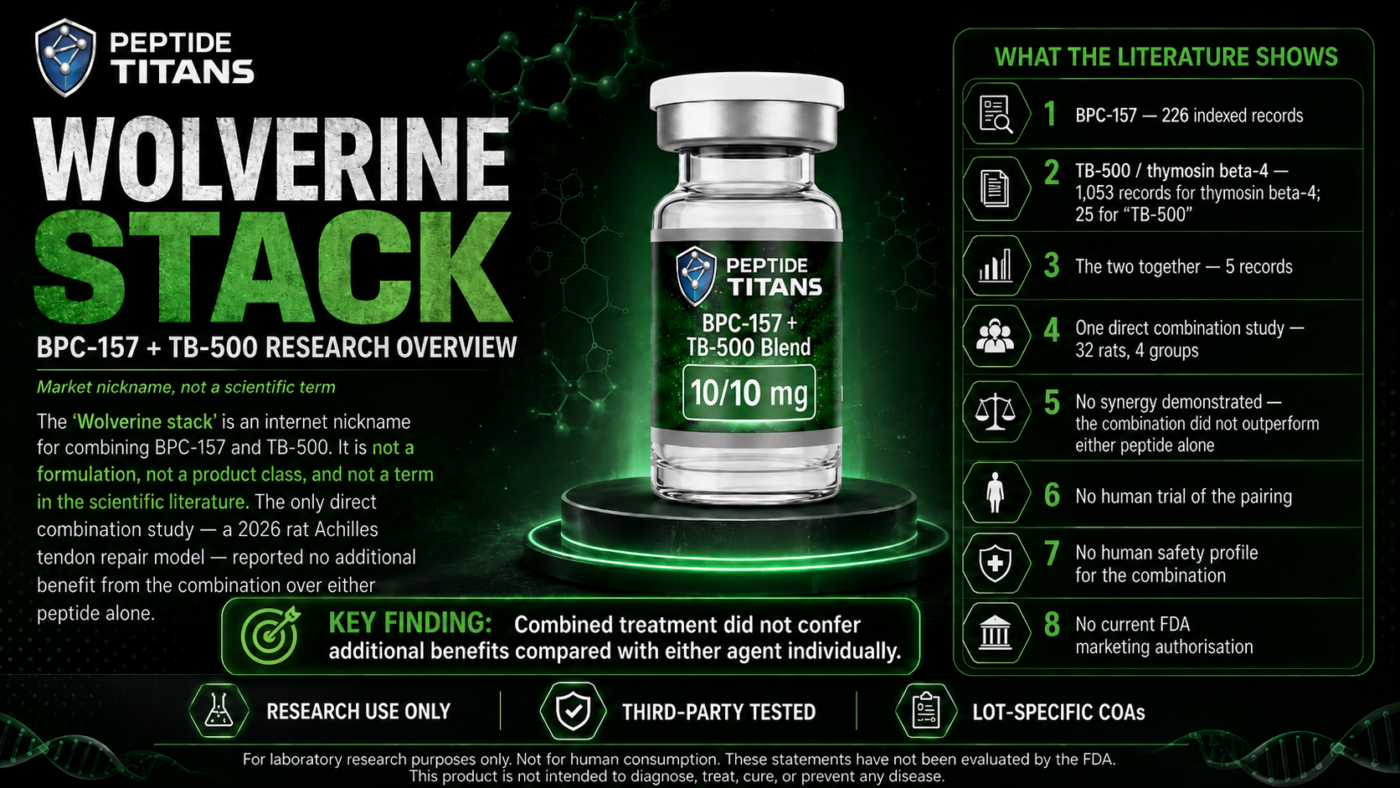
Short answer: the “Wolverine stack” is an internet nickname for combining two research peptides — BPC-157 and TB-500 — named after the comic character’s healing factor. It is not a formulation, not a product class, and not a term that appears anywhere in the scientific literature.
The premise of the stack is that the two together do more than either alone. That premise has been tested once, and it did not hold. A 2026 rat study ran both peptides separately and combined, and reported that the combination conferred no additional benefit over either agent on its own. Details below, because it is the most useful thing published on this subject.
What the name actually refers to
| Component | What it is | Indexed records |
|---|---|---|
| BPC-157 | A synthetic 15-amino-acid sequence derived from a gastric protein fragment. | 226 |
| TB-500 | A synthetic peptide based on the active region of thymosin beta-4 — not the full 43-amino-acid protein. | 1,053 for thymosin beta-4; 25 for the term TB-500 itself |
| The two together | Records mentioning both, of which one is a study of the two administered together. | 5 |
Counts retrieved from the PubMed E-utilities API on 20 August 2026, using the same search convention as the rest of this library.
Where the name comes from
From the Marvel character, whose defining trait is rapid healing. The label was applied by clinics, forums and suppliers because the two peptides are both studied in tissue-repair contexts — not because any researcher grouped them that way.
A useful illustration of that: searching PubMed for the exact phrase “wolverine stack” returns eight records, and every one of them is about the actual animal or unrelated laboratory work — predator ecology in Arctic tundra, ferret cortical development, prion protein structure. None concerns peptides. The nickname exists entirely outside the literature.
This matters for a practical reason: searching the marketing term will not find the research. The underlying work is indexed under BPC-157 and thymosin beta-4.
The one study that tested the combination
Published in Joint Diseases and Related Surgery in July 2026, this is a rat model of Achilles tendon repair — and it is the only work that directly compares the two peptides against their combination.
Design: 32 male Sprague-Dawley rats underwent standardised Achilles tendon transection and repair, then were randomised into four groups of eight: control, BPC-157 alone, TB-500 alone, and both together. Treatment ran for four weeks, after which tendons went to biomechanical testing or histological evaluation.
What it found:
- TB-500 alone performed best. It was the only group to reach statistical significance on maximum load to failure, and it showed significantly improved histopathological scores on both scoring systems used.
- BPC-157 alone showed numerically lower scores that did not reach statistical significance on the total measures.
- The combination did not beat either peptide alone. The authors state it plainly: combined treatment did not confer additional benefits compared with either agent individually.
The authors suggest the absence of an additive effect may reflect the two peptides converging on shared downstream pathways — and are careful to note that this is a hypothesis requiring further confirmation, in an exploratory study.
Two things follow. First, this is a rat study with eight animals per group, which is a small exploratory design and not a basis for conclusions about people. Second, within its limits it tested the exact claim the stack is sold on, and did not find support for it. Anyone asserting a synergistic advantage is asserting something the only relevant experiment did not observe.
What the literature does not establish
- No clinical trial of the combination exists. Zero records indexed as clinical trials for the two together, and no human study of the pairing at all.
- No synergy has been demonstrated. One rodent experiment looked for it and reported none.
- No human safety profile exists for the combination. BPC-157’s own human data amounts to fewer than 30 subjects across three uncontrolled pilots; there is nothing for the pairing.
- Neither component is an approved drug. Neither holds a current FDA marketing authorisation, and the combination is not an approved product anywhere.
- TB-500 is not identical to thymosin beta-4. Most of the 1,053 records concern the full protein. Treating that literature as evidence for the supplier peptide overstates it — see What Is TB-500?
Formats and handling
The pairing is supplied both as a lyophilised blend in a single vial and as separate vials, and in capsule form. Practically, a pre-blended vial fixes the ratio; separate vials leave it to the researcher, which matters when a protocol specifies one — as the tendon study did, running each peptide as its own arm.
Lyophilised material ships as a dry powder. Standard practice is cold storage of the sealed vial, protection from light, and refrigeration once reconstituted, with reconstituted material treated as short-lived. On the oral format specifically, note that the absorption question for BPC-157 is unresolved — covered on Oral BPC-157 vs Injection.
Frequently asked questions
What is the Wolverine peptide stack?
A nickname for using BPC-157 and TB-500 together, after the comic character’s healing factor. It describes a market practice, not a defined formulation, and the term does not appear in the scientific literature.
Is the combination better than either peptide alone?
The one study that tested this reported no additional benefit from the combination compared with either agent alone, in a rat Achilles tendon model. TB-500 alone produced the strongest results in that experiment. No human comparison has been published.
Does it build muscle mass?
Nothing in the published literature supports that. The research on both peptides sits in tissue-repair and cell-migration contexts — tendon healing, actin binding, wound models — not muscle hypertrophy. Claims about muscle growth are not extrapolations from this literature; they are unconnected to it.
Is BPC-157 hard on the liver?
No human safety profile has been established for BPC-157 by any route, so this cannot be answered from the published literature. The available human data amounts to fewer than 30 subjects across three uncontrolled pilot studies. A dataset that small showing no reported harm is not evidence of safety, and this page makes no safety claim in either direction.
How long is it typically used for?
There is no established protocol, duration or schedule for either peptide in humans, so there is nothing to report. The rat study above ran four weeks, which is a description of that experiment and not a template for anything else. These are research materials and are not for human use.
Is there a Wolverine peptide dosing chart?
Not on this site, deliberately. No validated human dosing exists for either component, so any chart would be an invented number presented as guidance. Reconstitution arithmetic — how much solvent produces what concentration — is a property of the material and is covered separately.
Research use only
These products are not for human consumption. They are sold strictly for research and educational purposes and are not intended to diagnose, treat, cure, or prevent any disease. Neither BPC-157 nor TB-500 is an approved drug in the United States. Information here is derived from peer-reviewed literature and public databases, for educational reference only; it does not constitute medical advice or product claims. No dosing guidance appears on this page.
References
- Effects of BPC-157 and TB-500 on Achilles tendon healing in rats: a histopathological and biomechanical study. Jt Dis Relat Surg, 2026. PMID 42542926
- Safety and efficacy of approved and unapproved peptide therapies for musculoskeletal injuries and athletic performance. Sports Med, 2026. PMID 41966639
- Peptide supplements and their therapeutic applications in sports medicine. Am J Sports Med, 2026. PMID 42578445
- Intra-articular injection of BPC 157 for multiple types of knee pain. Altern Ther Health Med, 2021. PMID 34324435
- BPC-157 as an investigational peptide therapeutic: biopharmaceutical challenges, formulation strategies, and translational development barriers. Pharmaceutics, 2026. PMID 42198317
- Thymosin beta-4: a multi-functional regenerative peptide. Basic properties and clinical applications. Expert Opin Biol Ther, 2012. PMID 22074294
- Pentadecapeptide BPC 157 (PL 14736) improves ligament healing in the rat. J Orthop Res, 2010. PMID 20225319
- Record counts retrieved from the PubMed E-utilities API (esearch.fcgi), 20 August 2026.
Research-use product reference: the pairing is listed at Peptide Titans as the BPC-157 + TB-500 Blend and the BPC-157 + TB-500 Capsules, or as separate BPC-157 and TB-500 vials, all with lot-specific certificates of analysis. Peptide Titans does not market any product under the name “Wolverine”. Products are for laboratory research use only and are not for human consumption.
Related
- Are peptides legal in the United States? — both BPC-157 and TB-500 were recommended for the 503A compounding list in July 2026
- Oral BPC-157 vs injection: what the research actually shows
- Testing and purity articles — how research material is assayed and what a certificate of analysis actually shows
- All blend research articles
- What is TB-500? Research background and study areas
- What is GLOW peptide? — the same two peptides plus GHK-Cu
- What is KLOW peptide? — those three plus KPV
- Reconstitution and concentration chart