
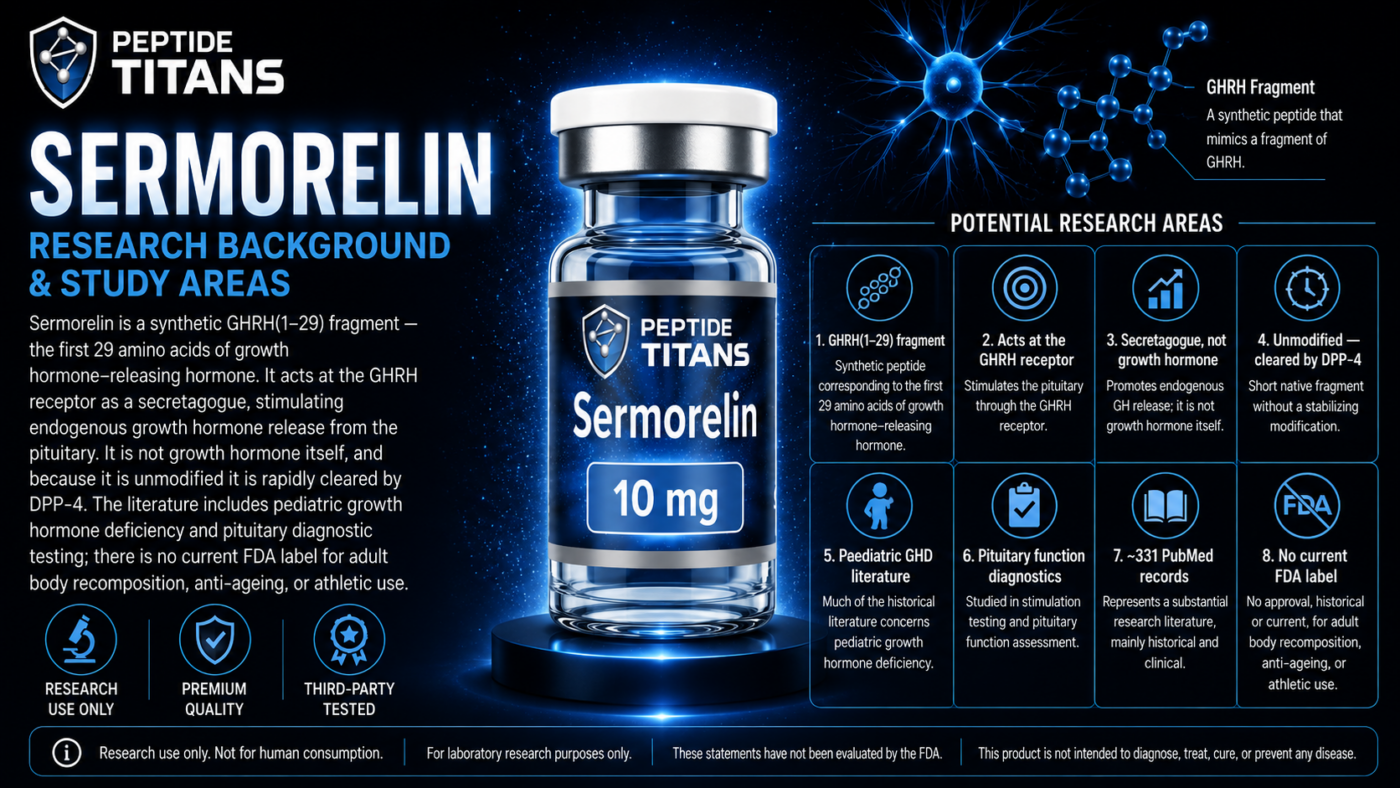
Sermorelin is GHRH(1–29) — the first 29 amino acids of human growth-hormone-releasing hormone. Native GHRH is 44 amino acids long, but essentially all of its biological activity resides in that opening fragment, which is why sermorelin exists: it is the shortest piece of the hormone that still does the job.
It acts at the GHRH receptor on the anterior pituitary, stimulating release of the body’s own growth hormone rather than supplying growth hormone directly. That distinction — secretagogue rather than replacement — is the defining feature of this class.
An unusual regulatory history
Sermorelin is one of the few compounds in this catalogue that used to be an approved medicine and no longer is.
A 1999 review in BioDrugs describes its established role at the time in the diagnosis and treatment of children with idiopathic growth hormone deficiency (PMID 18031173) — both as a diagnostic agent for testing pituitary function and as a treatment in paediatric endocrinology.
Today, querying the openFDA drug-label database returns no current US label for sermorelin. It is not a marketed FDA-approved product in the United States. Material available now is compounded or research-grade, neither of which carries that former status.
Note what the historical approval actually covered: growth hormone deficiency in children. It was never an approval for adult body composition, anti-ageing or athletic use, which is how the compound is most often discussed now.
What the published research examines
PubMed indexes roughly 331 records for sermorelin — more than tesamorelin’s 121, though largely because sermorelin is the older compound, studied since the 1980s.
- Paediatric endocrinology and diagnostics. The bulk of the older literature: pituitary function testing and management of growth hormone deficiency in children (PMID 18031173).
- Adult growth hormone insufficiency. A 2006 review in Clinical Interventions in Aging examined sermorelin in adult-onset growth hormone insufficiency (PMID 18046908) — note the framing is a clinical deficiency state, not healthy ageing.
- Body composition context. Growth hormone secretagogues have been reviewed in the management of body composition in hypogonadal males (PMID 32257855, 2020) — again, a defined clinical population.
- Peptide stability. Work characterising enzymatic and serum stability across GHRP and GHRH-related peptides (PMID 37688464, 2023), relevant because sermorelin is unmodified and cleared quickly by DPP-4.
The stability limitation
Sermorelin carries no chemical modification to protect it. Dipeptidyl peptidase-4 (DPP-4) cleaves GHRH-family peptides near the N-terminus and inactivates them within minutes, and sermorelin is fully exposed to this.
That is the specific problem tesamorelin was engineered to solve, by attaching a trans-3-hexenoyl group to the N-terminal tyrosine. The two compounds represent opposite approaches to the same molecule — minimise it, or armour it. See the full Tesamorelin vs Sermorelin comparison.
What the literature does not establish
- No current FDA approval. The historical approval concerned paediatric growth hormone deficiency and no longer applies to any marketed US product.
- No approval, historical or current, for adult body recomposition, anti-ageing or athletic use.
- No established dosing, route, schedule or duration for research material — and none is given here.
- Adult research is concentrated in defined deficiency states, not healthy adults.
- Research-grade or compounded material is not equivalent to an approved medicine.
Handling and storage
- Sealed vials: −20 °C, protected from light and moisture, desiccated. Allow to reach room temperature before opening.
- Reconstituted: short-term at 4 °C; −20 °C in single-use aliquots for longer. Minimise freeze–thaw cycles.
- Reconstitution: add diluent slowly down the vial wall, swirl gently, never shake.
Frequently asked questions
What is sermorelin?
The GHRH(1–29) fragment — the shortest portion of growth-hormone-releasing hormone that retains full activity at the GHRH receptor.
Is sermorelin FDA approved?
Not currently. The openFDA label database returns no entry for it. It held approved status historically for diagnosis and treatment of growth hormone deficiency in children.
What is the difference between sermorelin and growth hormone?
Sermorelin stimulates the pituitary to release the body’s own growth hormone; it is not growth hormone and does not supply it. The two act at different points and are not interchangeable.
How does it compare with tesamorelin?
Sermorelin is the short unmodified fragment and clears quickly; tesamorelin is the full 44-amino-acid sequence chemically protected against DPP-4, and holds a current FDA approval for one narrow indication. See the full comparison.
Was sermorelin approved for anti-ageing?
No. Its historical approval concerned growth hormone deficiency in children. No approval has ever covered anti-ageing or adult body composition in healthy people.
Why does it clear so quickly?
Because it carries no protective modification. DPP-4 cleaves it near the N-terminus within minutes, which is the limitation later GHRH analogs were designed around.
Research use only
This product is not for human consumption. It is sold strictly for research and educational purposes and is not intended to diagnose, treat, cure, or prevent any disease. Research information on this page is derived from peer-reviewed scientific literature and provided for educational reference only; it does not constitute medical advice or product claims.
References
- Sermorelin: a review of its use in the diagnosis and treatment of children with idiopathic growth hormone deficiency. BioDrugs, 1999. PMID 18031173
- Sermorelin: a better approach to management of adult-onset growth hormone insufficiency? Clin Interv Aging, 2006. PMID 18046908
- Beyond the androgen receptor: the role of growth hormone secretagogues in the modern management of body composition in hypogonadal males. Transl Androl Urol, 2020. PMID 32257855
- In-house standards derived from doping peptides: enzymatic and serum stability and degradation profile of GHRP and GHRH-related peptides. Biomed Chromatogr, 2023. PMID 37688464
Research-use product reference: Sermorelin and Sermorelin 500 mcg Capsules are listed at Peptide Titans for laboratory research use only. Products are not for human consumption.
Related
- Tesamorelin vs Sermorelin: what is the difference?
- What is Tesamorelin? Research background and approved-drug context
- What is CJC-1295? DAC vs No DAC
Related reading
- Sermorelin research profile — molecular data and indexed literature
- Published Certificates of Analysis — lot-level documentation for eligible products