
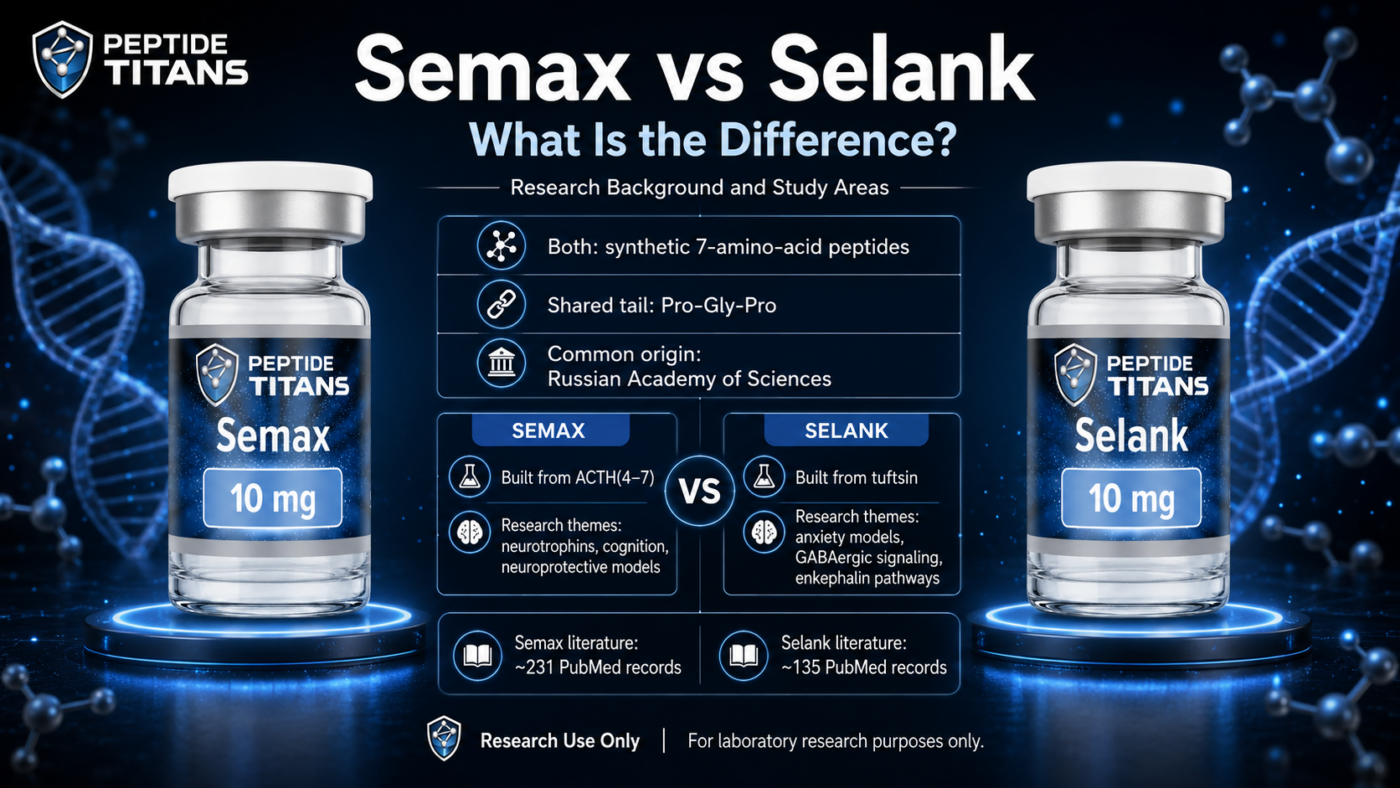
Short answer: Semax and Selank are both synthetic seven-amino-acid peptides developed at the same Russian institute, and both carry the same Pro-Gly-Pro tail added for stability. They differ in what sits in front of that tail — a fragment of ACTH for Semax, a fragment of tuftsin for Selank — and their research literatures address different themes: neurotrophins and cognition for Semax, anxiety models for Selank.
Side by side
| Semax | Selank | |
|---|---|---|
| Sequence | Met-Glu-His-Phe-Pro-Gly-Pro | Thr-Lys-Pro-Arg-Pro-Gly-Pro |
| Built from | ACTH(4–7), a fragment of adrenocorticotropic hormone | Tuftsin, an immunomodulatory peptide fragment |
| Length | 7 amino acids | 7 amino acids |
| Dominant research theme | Neurotrophin transcription (BDNF, NGF), dopaminergic and serotoninergic systems, cognitive and neuroprotective models | Anxiety models, GABAergic signalling, enkephalin degradation, serotonin metabolism |
| PubMed records | ~231 | ~135 |
| Origin | Both: Institute of Molecular Genetics, Russian Academy of Sciences | |
| Western regulatory status | Both: no FDA, EMA or MHRA approval. Neither is an approved supplement ingredient | |
PubMed counts retrieved 19 August 2026 via the NCBI E-utilities API.
The shared design: why both end in Pro-Gly-Pro
This is the most interesting thing the two have in common, and it explains why they exist in the form they do.
Short peptide fragments are attractive research subjects but hopeless in practice: they are degraded by peptidases almost immediately. Tuftsin on its own has a very short half-life, and so does a bare ACTH fragment. The solution applied to both was the same — append the tripeptide Pro-Gly-Pro to the C-terminus, which resists enzymatic cleavage and protects the active portion in front of it.
So Semax and Selank are not two unrelated compounds that happen to be compared. They are two applications of one stabilisation strategy, from one research programme, to two different starting molecules. That shared tail is also why Pro-Gly-Pro appears in its own right in the Semax literature (PMID 19633950).
What each is actually studied for
Semax — neurotrophins and cognition
The Semax literature centres on gene transcription of neurotrophic factors. Studies examine regulation of BDNF (PMID 16996037) and comparative dynamics of NGF and BDNF expression (PMID 19662538), alongside activation of dopaminergic and serotoninergic systems in rodents (PMID 16362768). Applied work sits in cognitive and neuroprotective models.
One structural point matters here: although Semax derives from ACTH, it is not reported to have corticotropic activity — the fragment used carries neurotropic properties without driving cortisol release. Findings about the parent hormone do not transfer.
Selank — anxiety models
The Selank literature centres on anxiolytic activity in rodent models, with mechanistic work pointing at GABAergic signalling, enkephalin degradation and serotonin metabolism (PMID 30255741). A representative study examined Selank alongside diazepam under chronic mild stress conditions (PMID 28280289). Russian clinical work examined it in generalised anxiety disorder and neurasthenia (PMID 18454096).
Note that tuftsin’s own immunomodulatory properties do not automatically carry over — the added tail changes the molecule.
Comparing the evidence, not just the compounds
Semax has roughly 231 PubMed records to Selank’s 135, so on volume alone Semax has the deeper file. That comparison needs an important qualification, though, and it applies to both.
Both literatures are heavily Russian. A large share of each appears in Russian-language journals, often reachable in English only as abstracts, and neither has been independently replicated outside Russia. Both compounds are described in that literature as registered medications there; neither has been evaluated by a Western regulator.
A larger body of work concentrated in a single research system is not the same as a smaller body replicated across several. Semax’s numerical advantage should be read as more sustained institutional attention, not as stronger independent validation.
What neither literature establishes
- No approval by the FDA, EMA, MHRA or comparable regulators, for either compound.
- No independently replicated evidence outside Russia, for either.
- No established dosing, route, schedule or duration — and none is given on this page.
- No long-term safety data for either.
- No research characterising the two administered together. A 2020 functional connectomic study examined Selank and Semax effects (PMID 32342318), but examining two compounds in one study is not the same as studying a combination.
On the combined product
Peptide Titans lists a Semax + Selank blend alongside the individual materials. As above, no published work characterises the combination, and the two research themes should not be added together to infer a combined outcome.
Choosing between them for a research question
Framed as experimental design rather than recommendation, the distinction is straightforward: the two literatures answer different questions. Work concerning neurotrophic factor expression, monoamine systems, or cognitive and neuroprotective models has more prior art to build on with Semax. Work concerning anxiety-related behaviour or GABAergic and enkephalin signalling has more with Selank.
Neither choice is supported by comparative research — no study has directly compared them head to head — so the basis for selection is which existing literature a given protocol connects to.
Frequently asked questions
What is the main difference between Semax and Selank?
What sits in front of their shared Pro-Gly-Pro tail. Semax uses an ACTH(4–7) fragment and is studied around neurotrophins and cognition; Selank uses a tuftsin fragment and is studied around anxiety models.
Are Semax and Selank the same thing?
No. They share a length, an origin institute and a stabilising tail, but they are different molecules with different sequences and different research literatures.
Which one has more research behind it?
Semax, by volume — about 231 PubMed records to Selank’s 135. Both are concentrated in Russian research and neither is independently replicated, so the gap is smaller in practical terms than the numbers suggest.
Can they be studied together?
They have been examined in the same study, but no published research characterises them as a combination. Nothing in either literature supports inferring a combined effect.
Is either approved for use?
Not by the FDA, EMA or MHRA. Both are described as registered medications in Russia; that status does not extend elsewhere and the underlying work has not been independently replicated.
Why do both end in Pro-Gly-Pro?
Because both were designed at the same institute using the same stabilisation strategy. The tripeptide resists enzymatic cleavage, protecting the short active fragment in front of it from the rapid degradation that would otherwise make it unusable.
Research use only
These products are not for human consumption. They are sold strictly for research and educational purposes and are not intended to diagnose, treat, cure, or prevent any disease. Research information on this page is derived from peer-reviewed scientific literature and provided for educational reference only; it does not constitute medical advice or product claims.
References
- Semax, an analog of ACTH(4-10) with cognitive effects, regulates BDNF. Brain Res, 2006. PMID 16996037
- Semax and Pro-Gly-Pro activate the transcription of neurotrophins. Cell Mol Neurobiol, 2010. PMID 19633950
- Comparison of the temporary dynamics of NGF and BDNF gene expression. J Mol Neurosci, 2010. PMID 19662538
- Semax, an ACTH(4-10) analogue with nootropic properties, activates dopaminergic and serotoninergic brain systems in rodents. Neurochem Res, 2005. PMID 16362768
- Peptide-based anxiolytics: the molecular aspects of heptapeptide Selank biological activity. Protein Pept Lett, 2018. PMID 30255741
- Peptide Selank enhances the effect of diazepam in reducing anxiety in unpredictable chronic mild stress conditions in rats. Behav Neurol, 2017. PMID 28280289
- Efficacy and possible mechanisms of action of a new peptide anxiolytic selank in the therapy of generalized anxiety disorders and neurasthenia. Zh Nevrol Psikhiatr, 2008. PMID 18454096
- Functional connectomic approach to studying Selank and Semax effects. Dokl Biol Sci, 2020. PMID 32342318
Research-use product reference: Semax, Selank and the Semax + Selank blend are listed at Peptide Titans for laboratory research use only. Products are not for human consumption.
Related
- What is Semax? Research background and study areas
- What is Selank? Research background and study areas
- KLOW vs GLOW: what is the difference?