
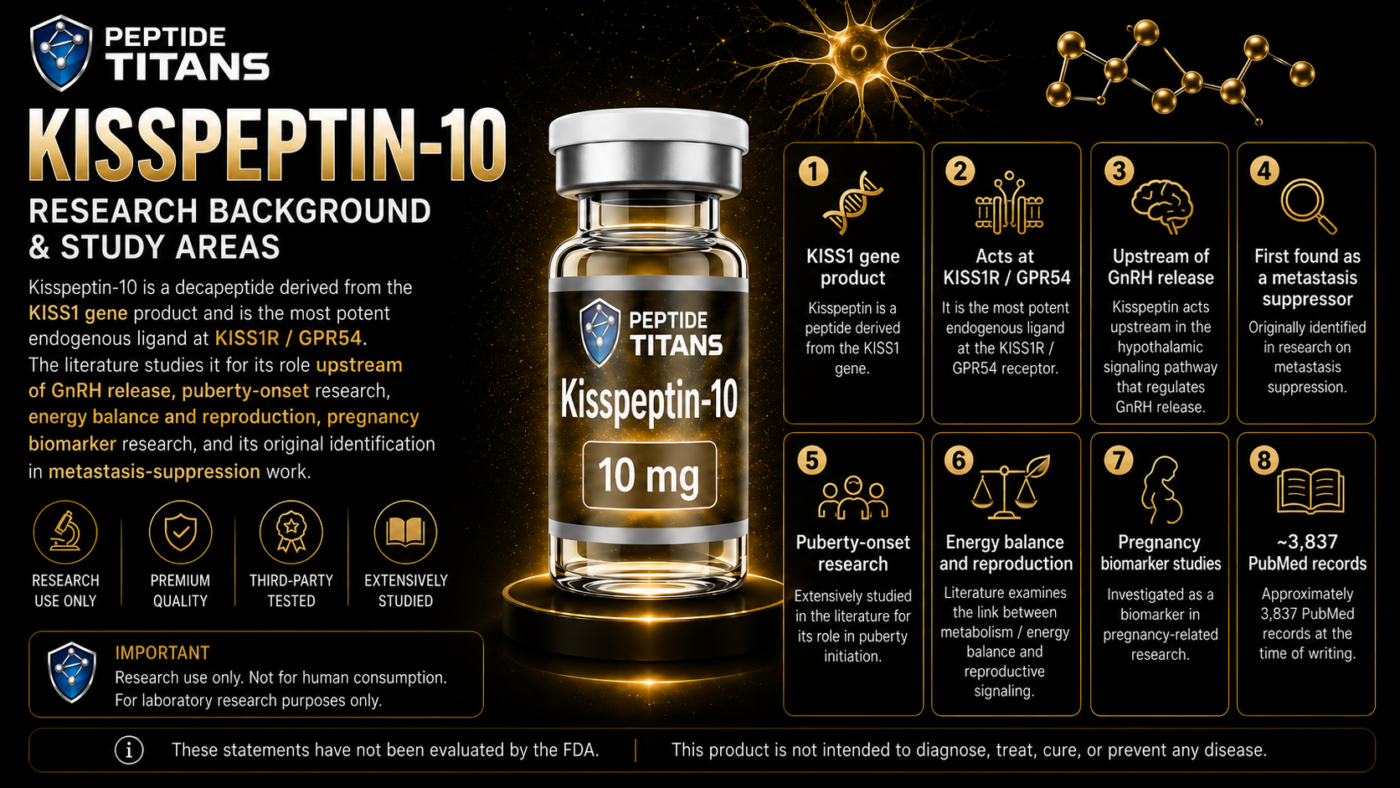
Kisspeptin is a peptide encoded by the KISS1 gene that acts on the receptor KISS1R (also called GPR54). Its central role is upstream regulation of the reproductive axis: kisspeptin neurons in the hypothalamus drive the release of gonadotropin-releasing hormone (GnRH), which in turn governs LH and FSH, which govern the gonads.
Kisspeptin-10 is the shortest fragment retaining full receptor activity — the final ten amino acids of the parent peptide — and is the form most often supplied for research.
It was discovered as a cancer gene, not a reproductive one
The name is a genuine curiosity with a real explanation. The KiSS-1 gene was identified in Hershey, Pennsylvania, as a metastasis-suppressor gene — a gene whose expression reduced the spread of melanoma cells — and was named in a nod to Hershey’s Kisses.
Only later did work on the receptor reveal that the same gene product is a master regulator of puberty and reproduction. Loss-of-function mutations in KISS1R were found to cause failure of puberty onset, which is how a cancer-biology gene became a cornerstone of reproductive endocrinology. Both research lines remain active, which is part of why the literature is as large as it is.
Why the literature is unusually large
PubMed indexes roughly 3,837 records for kisspeptin. For calibration against other compounds covered here: that is an order of magnitude more than most, and roughly a thousand times the literature on 5-Amino-1MQ.
The reason is that kisspeptin is not primarily a “research peptide” in the supplier sense. It is a fundamental signalling molecule in mainstream reproductive endocrinology, studied in academic and clinical settings worldwide. Its literature is broad, independent and international — a genuinely different footing from compounds studied within a single programme.
What the published research examines
- Reproductive axis control. The core theme: kisspeptin neurons as the gatekeeper of GnRH release, puberty onset, and the LH surge.
- Energy balance and metabolism. A 2020 review in Nature Reviews Endocrinology examines the metabolic regulation of kisspeptin as the link between energy balance and reproduction (PMID 32427949) — the mechanism connecting nutritional state to fertility. Related work covers kisspeptin and glucose homeostasis (PMID 31869842).
- Pregnancy. Placental kisspeptin has been examined as a potential biomarker across pregnancy (PMID 31344665) and specifically in the prediction of pregnancy complications (PMID 35928889).
- Behaviour. A distinct line examines kisspeptin as a behavioural hormone, beyond its endocrine role (PMID 31847025).
- Model types. Rodent models, human physiology studies, and clinical research — including studies in people, which is uncommon in this catalogue.
What the literature does not establish
A large literature is not the same as an established use, and the gap is wide here.
- No FDA approval and no approved indication. Kisspeptin is a research and investigational agent, not a medicine.
- No established dosing, route, schedule or duration — and none is given here.
- It acts at the top of the reproductive axis, so its effects are inherently systemic and hormonal. That is precisely why it is studied under clinical supervision in the published work, and why nothing in that literature supports unsupervised use.
- Much of the clinical research is physiological — measuring hormone responses — rather than therapeutic.
Handling and storage
- Sealed vials: −20 °C to −80 °C, protected from light and moisture, desiccated. Allow to reach room temperature before opening.
- Reconstituted: up to about 7 days at 4 °C, or −20 °C in single-use aliquots. Minimise freeze–thaw cycles.
- Reconstitution: add diluent slowly down the vial wall, swirl gently, never shake.
Frequently asked questions
What is kisspeptin?
A peptide encoded by the KISS1 gene, acting at the KISS1R/GPR54 receptor, that sits upstream of GnRH and therefore governs the reproductive hormone axis.
What is the difference between kisspeptin and kisspeptin-10?
Kisspeptin-10 is the ten-amino-acid C-terminal fragment of the parent peptide. It retains full activity at the receptor and is the form usually supplied for research.
Why is it called kisspeptin?
The KiSS-1 gene was discovered in Hershey, Pennsylvania as a metastasis-suppressor gene, and named with reference to Hershey’s Kisses. Its reproductive role was identified later.
Is kisspeptin FDA approved?
No. It has no approved indication and is used in research and investigational settings only.
Does kisspeptin have more research behind it than other peptides?
Considerably — roughly 3,837 PubMed records, and unlike most compounds in this category that work is international and independent rather than concentrated in one programme. Volume of research still does not amount to an approved use.
Research use only
This product is not for human consumption. It is sold strictly for research and educational purposes and is not intended to diagnose, treat, cure, or prevent any disease. Research information on this page is derived from peer-reviewed scientific literature and provided for educational reference only; it does not constitute medical advice or product claims.
References
- Metabolic regulation of kisspeptin — the link between energy balance and reproduction. Nat Rev Endocrinol, 2020. PMID 32427949
- Kisspeptin and glucose homeostasis. Semin Reprod Med, 2019. PMID 31869842
- Kisspeptin as a behavioral hormone. Semin Reprod Med, 2019. PMID 31847025
- Kisspeptin in the prediction of pregnancy complications. Front Endocrinol, 2022. PMID 35928889
- Kisspeptin as a potential biomarker throughout pregnancy. Eur J Obstet Gynecol Reprod Biol, 2019. PMID 31344665
Research-use product reference: Kisspeptin-10 is listed at Peptide Titans for laboratory research use only. Products are not for human consumption.
Related
- What is Thymosin Alpha-1? Research background
- What is CJC-1295? DAC vs No DAC
- What is NAD+? Research background