
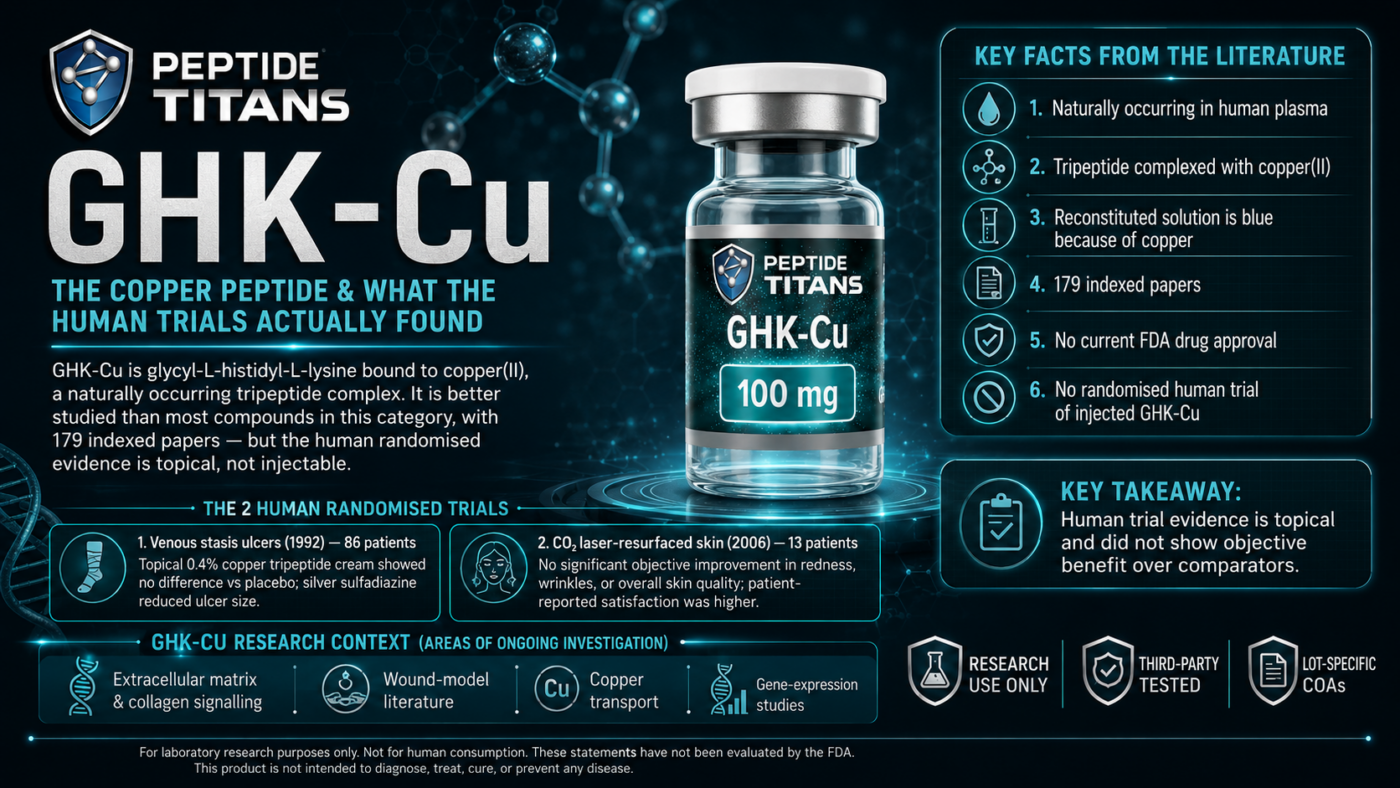
Short answer: GHK-Cu is a real, naturally occurring molecule — the tripeptide glycyl-L-histidyl-L-lysine bound to copper — and it is genuinely better studied than most compounds in this category, with 179 indexed papers and, unusually, randomised controlled trials in humans.
That last point is where it gets interesting, and where most pages about GHK-Cu stop. Both human randomised trials applied it topically to skin, and neither showed an objective benefit over its comparator. The details are below, because they are more useful than another list of claimed benefits.
What GHK-Cu actually is
| Structure | Glycyl-L-histidyl-L-lysine, a three-amino-acid sequence, complexed with copper(II) |
| Also called | Copper tripeptide-1, copper peptide, GHK, tripeptide-copper complex |
| Endogenous? | Yes — GHK occurs naturally in human plasma, which separates it from most synthetic research peptides |
| Why it is blue | The copper. Reconstituted GHK-Cu solutions are distinctly blue, and it is why GLOW and KLOW blends are blue too |
| Indexed papers | 179 (288 for the broader term “copper tripeptide”) |
Counts retrieved from the PubMed E-utilities API on 20 August 2026, using the same search convention as the rest of this library.
The two human randomised trials
Three records are indexed as randomised controlled trials. One is in rabbits. The two human trials are both worth reading in full, and both are topical.
Venous stasis ulcers, 1992 — 86 patients
A prospective, randomised, evaluator-blinded trial compared a 0.4% copper tripeptide cream against silver sulfadiazine and against an inert vehicle placebo, in chronic venous ulcers.
Silver sulfadiazine significantly reduced ulcer size. The copper tripeptide cream did not: in the authors’ words, there was no difference between the copper tripeptide and the placebo. This is the largest randomised human trial of the compound, and its result for GHK-Cu was null.
CO2 laser-resurfaced facial skin, 2006 — 13 patients
Patients undergoing facial laser resurfacing were randomised to post-treatment skincare with or without GHK-Cu. Blinded evaluators and computer analysis found no significant difference in resolution of redness, and objective assessment found no significant improvement in wrinkles or overall skin quality.
One measure did differ: patient-reported satisfaction with overall skin quality was significantly higher in the GHK-Cu group. That is a real finding, but it is a subjective endpoint in thirteen people, and it is not the same as a measured improvement in the skin.
What the preclinical literature examines
None of the above means GHK-Cu is inert. The mechanistic and animal literature is substantial and is where the interest comes from:
- Extracellular matrix and collagen signalling — effects on fibroblast function, collagen and glycosaminoglycan synthesis.
- Wound models — 54 of the 179 records involve wound healing contexts, the largest single theme.
- Copper transport — GHK binds copper(II) with high affinity, and much of the proposed mechanism runs through copper delivery rather than the peptide alone.
- Gene expression — a widely cited 2018 analysis reports GHK modulating a large number of human genes, which is the basis for most of the broader claims made about it.
- Skin permeation — an active formulation question, with recent work on liposomal encapsulation specifically because getting the intact complex through skin is difficult.
What the literature does not establish
- No human trial of injected GHK-Cu. Only 19 of the 179 records mention injection at all, and none is a randomised human trial. A research vial is for injection studies — and that is precisely the route with no human randomised evidence behind it.
- The two human trials that exist are topical and did not show objective benefit. Stated plainly because most pages on this subject cite the mechanistic work and skip the trials.
- Only 12 records concern topical application specifically, despite topical being the dominant commercial format.
- Only 7 records involve hair, despite hair growth being one of the most heavily marketed applications.
- No approved drug status. GHK-Cu is used in cosmetics; it holds no FDA marketing authorisation as a drug.
A note on who wrote the reviews
This is worth knowing when reading about GHK-Cu, and it is verifiable from the papers themselves rather than a matter of opinion. The most-cited enthusiastic reviews — including the 2018 gene-data paper and the anti-aging review — list their authors’ affiliation as a commercial skin-care research and development company. One of those authors is also the researcher who originally characterised GHK.
That does not make the work wrong, and primary researchers writing reviews of their own field is entirely normal. But a reader weighing the evidence should know that much of the most favourable secondary literature originates with a party that commercialises the compound, and should weight the randomised trials accordingly.
Handling and storage
Lyophilised GHK-Cu ships as a dry powder and is stable at room temperature in transit. Standard practice is cold storage of the sealed vial, protection from light, and refrigeration once reconstituted, with reconstituted material treated as short-lived.
The reconstituted solution is blue — that is the copper complex and it is expected. A colourless solution in a vial labelled GHK-Cu is a reason to check the certificate of analysis.
Research use only
These products are not for human consumption. They are sold strictly for research and educational purposes and are not intended to diagnose, treat, cure, or prevent any disease. GHK-Cu is not an approved drug in the United States. Information here is derived from peer-reviewed literature and public databases, for educational reference only; it does not constitute medical advice or product claims. No dosing guidance appears on this page.
References
- A prospective randomized evaluator-blinded trial of two potential wound healing agents for the treatment of venous stasis ulcers. J Vasc Surg, 1992. PMID 1495150
- Effects of topical copper tripeptide complex on CO2 laser-resurfaced skin. Arch Facial Plast Surg, 2006. PMID 16847171
- Evaluation of the effects of topical tripeptide-copper complex and zinc oxide on open-wound healing in rabbits. Vet Dermatol, 2006. PMID 17083573
- GHK peptide as a natural modulator of multiple cellular pathways in skin regeneration. Biomed Res Int, 2015. PMID 26236730
- Regenerative and protective actions of the GHK-Cu peptide in the light of the new gene data. Int J Mol Sci, 2018. PMID 29986520
- The potential of GHK as an anti-aging peptide. Aging Pathobiol Ther, 2020. PMID 35083444
- Are we ready to measure skin permeation of modern antiaging GHK-Cu tripeptide encapsulated in liposomes? Molecules, 2025. PMID 39795193
- Topically applied GHK as an anti-wrinkle peptide: advantages, problems and prospective. Bioimpacts, 2025. PMID 39963574
- Exploring the beneficial effects of GHK-Cu on an experimental model of colitis and the underlying mechanisms. Front Pharmacol, 2025. PMID 40672369
- Record counts retrieved from the PubMed E-utilities API (esearch.fcgi), 20 August 2026.
Research-use product reference: GHK-Cu lyophilised vials and GHK-Cu 2 mg Capsules are listed at Peptide Titans for laboratory research use only, with lot-specific certificates of analysis. It is also the largest component of the GLOW and KLOW blends. Products are not for human consumption.
Related
- Are peptides legal in the United States? — GHK-Cu goes before the FDA compounding advisory committee in February 2027
- What is GLOW peptide? — GHK-Cu plus BPC-157 and TB-500
- What is KLOW peptide? — those three plus KPV
- KLOW vs GLOW: what is the difference?
- What is TB-500? — another component of both blends
- Reconstitution and concentration chart
Reference & documentation
- GHK-Cu research profile — molecular data and indexed literature
- GHK-Cu research material
- Lot-specific Certificate of Analysis for GHK-Cu