
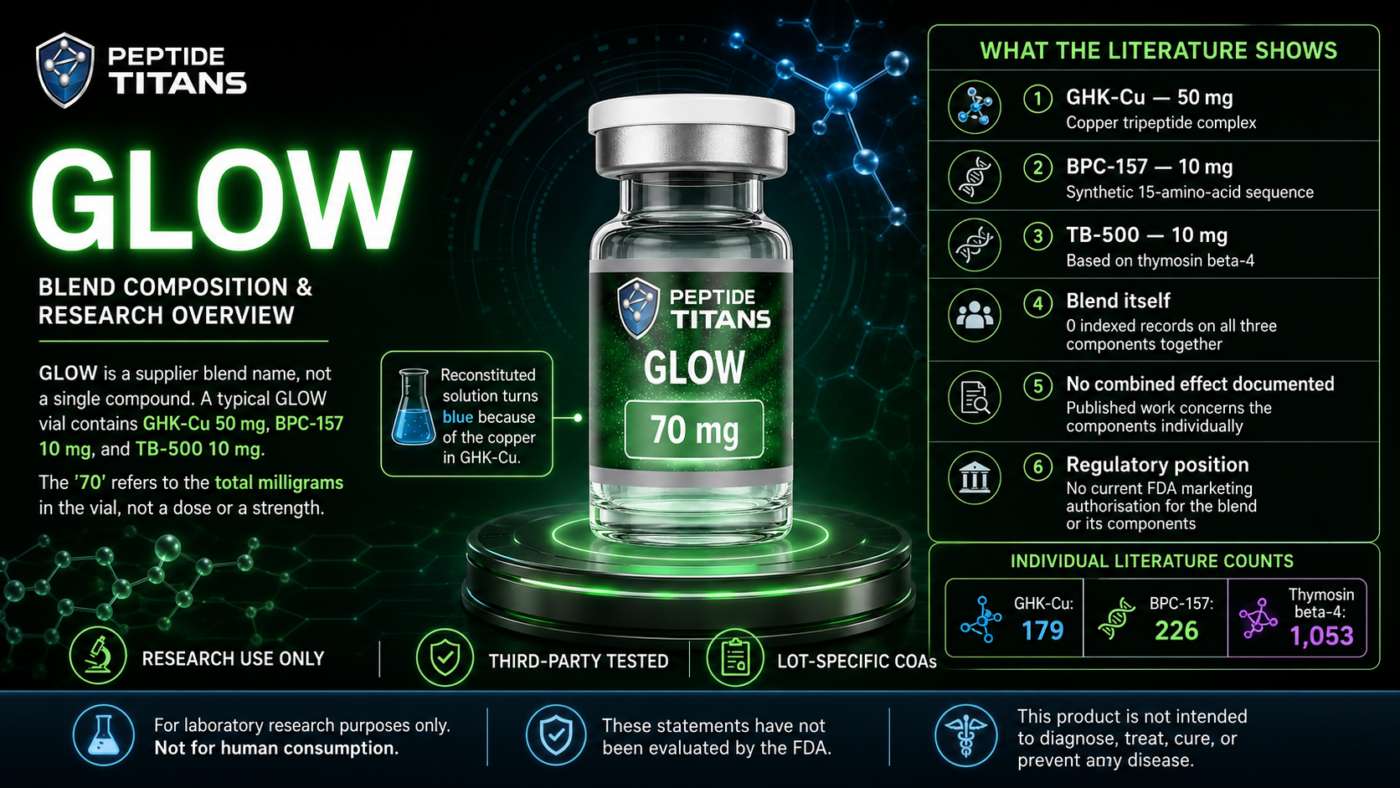
Short answer: GLOW is a supplier blend name, not a compound. A GLOW vial contains three separate research peptides — GHK-Cu 50 mg, BPC-157 10 mg and TB-500 10 mg — which is where the “70” in GLOW 70 comes from. It is the total milligrams in the vial, not a dose and not a strength.
The single most useful thing to know before reading anything else about it: the blend itself has never been studied. A PubMed search for the three components together returns zero records. Everything published concerns the three peptides individually, mostly separately, and in different research contexts.
What is in a GLOW vial
| Component | Amount | What it is |
|---|---|---|
| GHK-Cu | 50 mg | Glycyl-L-histidyl-L-lysine bound to copper — a copper tripeptide complex. The copper is why the reconstituted solution is blue. |
| BPC-157 | 10 mg | A synthetic 15-amino-acid sequence derived from a gastric protein fragment. |
| TB-500 | 10 mg | A synthetic peptide based on the active region of thymosin beta-4 — not the full protein itself. |
| Total | 70 mg | Hence “GLOW 70”. Composition and ratios vary between suppliers — check the specific vial. |
Where the name comes from
GLOW is not an acronym for a mechanism and it does not describe a scientific classification. It is a market name for a particular three-peptide combination, and it circulates because suppliers and clinics adopted it, not because it was defined anywhere in the literature.
The related name KLOW is the same three peptides plus KPV 10 mg, which takes the vial from 70 mg to 80 mg. That is the entire difference between them — covered in detail on KLOW vs GLOW.
Because these are supplier names rather than defined formulations, two vials labelled GLOW from different sources are not guaranteed to contain the same ratios. The certificate of analysis for the specific lot is the only thing that establishes what is actually in a given vial.
What the published research examines, component by component
Counts below were retrieved from the PubMed E-utilities API on 20 August 2026 using a standard PubMed search for each term — the same convention used throughout this research library, so the figures are reproducible and comparable across pages. Counts do shift with how a search is phrased, and where that materially changes the picture it is stated rather than hidden.
GHK-Cu (glycyl-L-histidyl-L-lysine copper complex)
179 records — covered in full on What Is GHK-Cu?, including the two randomised human trials and what they found. GHK is a naturally occurring tripeptide whose plasma concentration declines with age, and the published work examines copper transport, gene-expression effects, extracellular matrix and collagen signalling, antioxidant behaviour, and wound models.
One qualification matters more than the count: a large share of the GHK-Cu literature concerns topical application — creams and cosmetic formulations — rather than injection. A 2025 review is explicitly about topically applied GHK, including its problems. Research citing GHK-Cu skin findings is frequently citing topical work.
BPC-157
226 records, of which 125 are in rats or mice and none are indexed as clinical trials. The available human data amounts to fewer than 30 subjects across three uncontrolled pilot studies. Covered in more depth, including the oral-versus-injectable question, on Oral BPC-157 vs Injection.
TB-500 / thymosin beta-4
1,053 records for thymosin beta-4. Searching the supplier designation TB-500 itself returns only 25 — and that gap is the point. The research is on the full 43-amino-acid thymosin beta-4 protein; TB-500 is a supplier name for a synthetic peptide based on its active region. They are related but not interchangeable, so a Tβ4 paper is not automatically a TB-500 paper. See What Is TB-500?
What the literature does not establish
This is the section most GLOW pages leave out, so it is worth being specific.
- Nothing has been published on the blend. A search for the three components together returns zero indexed records. GHK-Cu and BPC-157 appear together in 6; GHK-Cu and thymosin beta-4 in 2. There is no study of the three-way combination at any ratio, in any model.
- No combined effect is documented. Claims that the components are synergistic, or that the blend does more than its parts, have no published basis. They may turn out to be true; nothing has tested them.
- Route matters and is often glossed over. Much of the GHK-Cu evidence is topical; the BPC-157 human data is intravenous; the thymosin beta-4 clinical work includes topical ophthalmic studies. A blend presented for injection is not the route most of the underlying research used.
- No human safety profile exists for the combination. Not a favourable one and not an unfavourable one — the studies have not been done, and a small unstudied dataset is not evidence of safety.
- No regulatory approval. None of the three components holds a current FDA marketing authorisation, and the blend is not an approved product anywhere.
Handling and storage
Lyophilised GLOW is shipped as a dry powder and is stable at room temperature in transit. Standard laboratory practice for this class of material is cold storage of the sealed vial, protection from light, and refrigeration once reconstituted, with reconstituted material treated as short-lived.
The reconstituted solution is blue. That is expected: it comes from the copper in GHK-Cu, at 50 mg the largest component in the vial. A colourless solution in a vial labelled GLOW is a reason to check the certificate of analysis.
For the arithmetic of reconstitution volume and resulting concentration, see the reconstitution and concentration chart. It is written for KLOW but the method is identical; only the component masses differ.
Frequently asked questions
What is GLOW peptide?
A supplier name for a three-peptide research blend containing GHK-Cu, BPC-157 and TB-500, typically 50/10/10 mg for 70 mg total. It is not a single compound and not a defined pharmaceutical formulation.
What does the 70 in GLOW 70 mean?
The total milligrams of peptide in the vial: 50 + 10 + 10. It is a description of contents, not a dose. KLOW 80 follows the same convention, with the extra 10 mg being KPV.
Is GLOW the same as the GHK-Cu / BPC-157 / TB-500 blend?
Yes — those are the three components, and the longer name is simply the composition spelled out. Ratios can differ between suppliers, so the certificate of analysis for the lot is what settles it.
What are the benefits of GLOW?
No benefit has been established for the blend, because the blend has not been studied. The individual components have research literatures covering extracellular matrix and collagen signalling, actin binding and cell migration, and tissue-repair models — but those are descriptions of what researchers have investigated, not outcomes demonstrated in people. Pages presenting a list of GLOW benefits are extrapolating from component research, generally from topical or animal studies.
Does GLOW have side effects?
No side-effect profile has been published for the combination, so this cannot be answered from the literature. That is a statement about missing evidence, not a suggestion that none exist. GLOW sold by Peptide Titans is research material and is not for human consumption.
Why does the solution turn blue?
The copper in GHK-Cu. Copper complexes of this kind are blue in solution, and at 50 mg GHK-Cu is the bulk of the vial, so the colour is pronounced.
What is the difference between GLOW and KLOW?
KLOW is GLOW plus 10 mg of KPV, so 80 mg instead of 70 mg. Same three base peptides, same amounts. See KLOW vs GLOW.
Is there a GLOW dosing chart?
Not on this site, deliberately. There is no established human dosing for any of the three components, let alone the combination, so any chart would be an invented number presented as guidance. Reconstitution arithmetic — how much solvent gives what concentration — is a property of the material and is covered separately.
Research use only
These products are not for human consumption. They are sold strictly for research and educational purposes and are not intended to diagnose, treat, cure, or prevent any disease. None of the components is an approved drug in the United States. Information here is derived from peer-reviewed literature and public databases, for educational reference only; it does not constitute medical advice or product claims. No dosing guidance appears on this page.
References
- Regenerative and protective actions of the GHK-Cu peptide in the light of the new gene data. Int J Mol Sci, 2018. PMID 29986520
- The potential of GHK as an anti-aging peptide. Aging Pathobiol Ther, 2020. PMID 35083444
- Topically applied GHK as an anti-wrinkle peptide: advantages, problems and prospective. Bioimpacts, 2025. PMID 39963574
- Exploring the beneficial effects of GHK-Cu on an experimental model of colitis and the underlying mechanisms. Front Pharmacol, 2025. PMID 40672369
- BPC-157 as an investigational peptide therapeutic: biopharmaceutical challenges, formulation strategies, and translational development barriers. Pharmaceutics, 2026. PMID 42198317
- Pharmacokinetics, distribution, metabolism, and excretion of body-protective compound 157, in rats and dogs. Front Pharmacol, 2022. PMID 36588717
- Thymosin beta-4: a multi-functional regenerative peptide. Basic properties and clinical applications. Expert Opin Biol Ther, 2012. PMID 22074294
- Thymosin beta 4 and the eye: the journey from bench to bedside. Expert Opin Biol Ther, 2018. PMID 30063853
- Record counts retrieved from the PubMed E-utilities API (esearch.fcgi), 20 August 2026.
Research-use product reference: GLOW and KLOW are listed at Peptide Titans for laboratory research use only, with lot-specific certificates of analysis. Individual components are also listed separately: GHK-Cu, BPC-157 and TB-500. Products are not for human consumption.
Related
- KLOW vs GLOW: what is the difference between the two blends?
- All blend research articles — every multi-peptide blend covered in this library
- Free research peptides guide
- What is KLOW peptide? Blend composition and research overview
- Oral BPC-157 vs injection: what the research actually shows
- What is TB-500? Research background and study areas
- KLOW reconstitution and concentration chart
Reference & documentation
- GLOW research blend — BPC-157, TB-500 and GHK-Cu components
- Lot-specific Certificate of Analysis for GLOW