
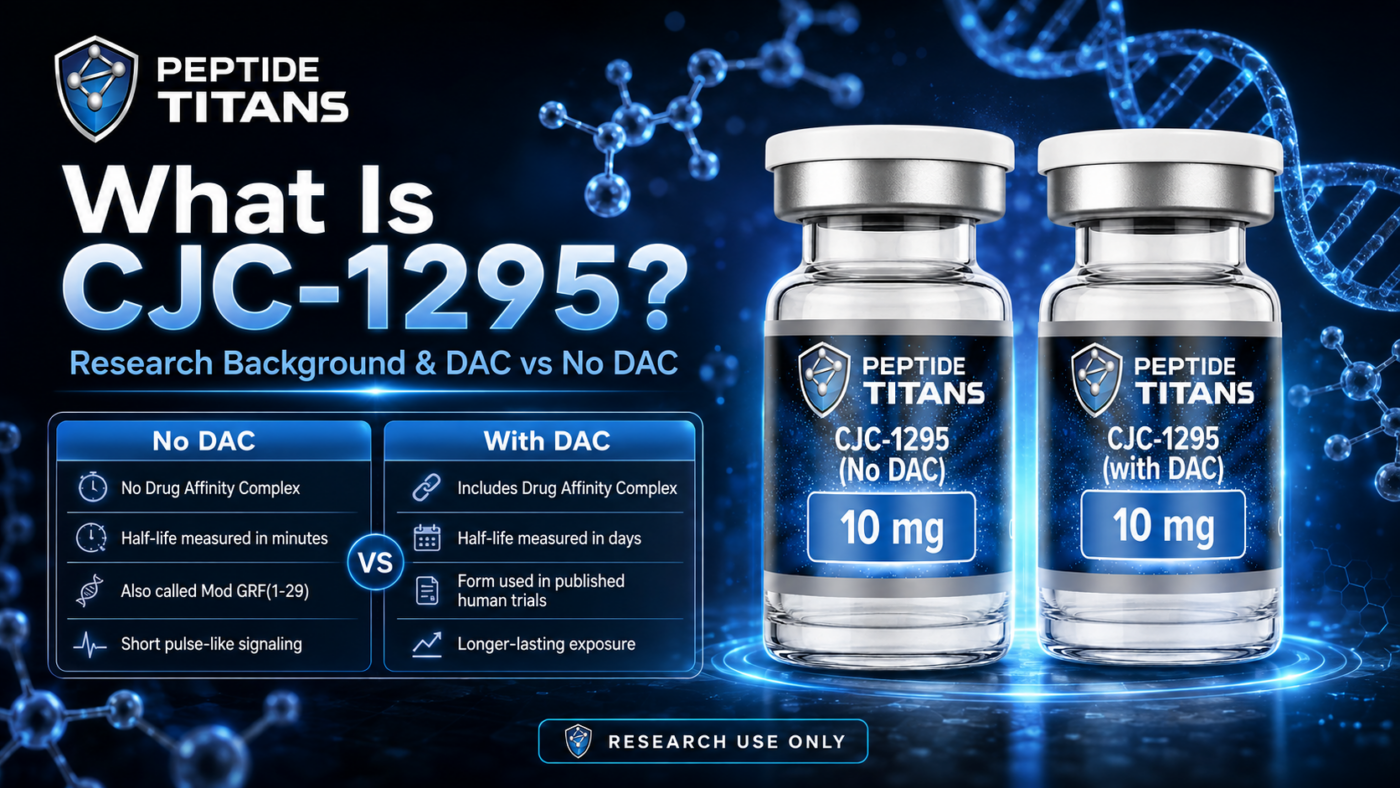
CJC-1295 is a synthetic analog of growth-hormone-releasing hormone (GHRH). It is built from the first 29 amino acids of human GHRH — the fragment known as hGRF(1–29), which retains the biological activity of the full 44-amino-acid hormone — with four amino-acid substitutions that resist enzymatic breakdown.
Unlike most compounds in this category, CJC-1295 has a real published trial record, including early-phase studies in healthy adults. That makes the literature unusually specific, and it also makes the DAC distinction below genuinely important rather than academic.
DAC vs No DAC: what actually differs
This is the single most consequential thing to understand about CJC-1295, and the two forms are frequently discussed as if interchangeable. They are not.
| CJC-1295 with DAC | CJC-1295 without DAC | |
|---|---|---|
| The modification | Carries a Drug Affinity Complex — a maleimidopropionic acid group that forms a covalent bond with circulating serum albumin | No DAC group. The four stabilising substitutions only |
| Consequence | Albumin binding shields it from clearance, giving a half-life measured in days | Cleared rapidly; half-life measured in minutes |
| Also called | CJC-1295 DAC; the form used in the published human trials | Modified GRF(1–29), “mod GRF 1-29” |
| Signalling pattern studied | Continuous elevation of GHRH signalling | Short pulse, closer to endogenous GHRH release |
The literature caveat that follows from this: the human studies cited on this page (PMIDs 16352683, 17018654, 19386527) examined the DAC form. Findings from them do not transfer to the no-DAC form, which has a fundamentally different exposure profile. Peptide Titans lists both CJC-1295 with DAC and CJC-1295 No DAC as separate research materials for exactly this reason.
What the published research examined
- Identification and mechanism. The compound was characterised as an hGRF(1–29)–albumin bioconjugate activating the GRF receptor on the anterior pituitary in rats, establishing it as a long-lasting GRF analog (PMID 15817669, Endocrinology, 2005).
- Early-phase human study. A 2006 Journal of Clinical Endocrinology & Metabolism study reported prolonged stimulation of GH and IGF-I secretion in healthy adults (PMID 16352683).
- Pulsatility. A follow-up examined whether continuous GHRH stimulation abolishes the natural pulsatile pattern of GH release, reporting that pulsatile secretion persisted (PMID 17018654).
- Downstream signalling. A 2009 study in Growth Hormone & IGF Research profiled serum protein changes following activation of the GH/IGF-1 axis in normal adult subjects (PMID 19386527).
- Animal model. Once-daily administration normalised growth in the GHRH knockout mouse (PMID 16822960).
- Analytical chemistry. A substantial share of the more recent literature is anti-doping detection work — methods for identifying GHRH analogs in plasma and urine (PMIDs 34665524, 30489688, 21204297). Useful for assay development; not efficacy research.
Why CJC-1295 and Ipamorelin appear together
These two are almost always discussed as a pair, and the reason is mechanistic rather than promotional. They act on different receptors: CJC-1295 is a GHRH analog acting at the GHRH receptor, while Ipamorelin is a growth hormone secretagogue acting at the ghrelin receptor (GHS-R). Because the two pathways are distinct, they are studied together in research on combined pituitary signalling.
What should be said plainly is that the combination itself is not well characterised in published literature. The papers above examine CJC-1295 alone. Peptide Titans lists a CJC-1295 No DAC and Ipamorelin blend, but no research on this page describes the two administered together, and combining separate findings does not produce evidence about a combination.
What the literature reports on tolerability
Searches for CJC-1295 side effects are common, so it is worth being specific about what does and does not exist. The early-phase human studies were small, short and conducted in healthy adults under clinical supervision; they were designed to characterise GH and IGF-I response, not to establish a safety profile. Injection-site reactions and transient flushing appear in that literature, and GHRH-analog pharmacology implies attention to IGF-1 elevation and glucose handling.
None of that constitutes a safety profile. There are no long-term studies, no large controlled trials, and no data on the no-DAC form in humans at all. Any source presenting a definitive side-effect list for CJC-1295 is not drawing on published research.
What the literature does not establish
- No approved therapeutic use. Development did not proceed to late-phase trials.
- No established dosing, route, schedule or duration — and none is given on this page.
- No human data on the no-DAC form, and none on the CJC-1295 + Ipamorelin combination.
- No long-term safety data in any form.
Handling and storage
- Sealed vials: −20 °C, protected from light and moisture, desiccated. Allow to reach room temperature before opening.
- Reconstituted: up to about 7 days at 4 °C, or −20 °C in single-use aliquots. Minimise freeze–thaw cycles.
- Reconstitution: introduce diluent slowly down the vial wall; swirl gently, never shake. Concentration is total mass divided by diluent volume.
Frequently asked questions
What is CJC-1295?
A synthetic GHRH analog based on hGRF(1–29) with four amino-acid substitutions that resist enzymatic degradation. It acts at the GHRH receptor on the anterior pituitary.
What does DAC mean?
Drug Affinity Complex — a chemical group that bonds covalently to serum albumin in circulation. Albumin binding protects the peptide from clearance, extending its half-life from minutes to days.
Is CJC-1295 No DAC the same as modified GRF(1-29)?
Yes. “CJC-1295 without DAC” and “mod GRF 1-29” refer to the same tetrasubstituted hGRF(1–29) analog. The naming is a market convention rather than a chemical distinction.
Which form was studied in humans?
The DAC form. Every human study cited here used CJC-1295 with DAC. There is no comparable human literature on the no-DAC form.
Why is CJC-1295 paired with Ipamorelin?
They act at different receptors — GHRH receptor and ghrelin receptor respectively — so they are discussed together in research on pituitary signalling. The combination itself has not been characterised in published studies.
Is there a dosing chart for CJC-1295?
Not from any credible source. It is a research material with no established human dosing; development never reached the stage where dosing would be defined.
Research use only
This product is not for human consumption. It is sold strictly for research and educational purposes and is not intended to diagnose, treat, cure, or prevent any disease. Research information on this page is derived from peer-reviewed scientific literature and provided for educational reference only; it does not constitute medical advice or product claims.
References
- Human growth hormone-releasing factor (hGRF)1-29-albumin bioconjugates activate the GRF receptor on the anterior pituitary in rats: identification of CJC-1295 as a long-lasting GRF analog. Endocrinology, 2005. PMID 15817669
- Teichman SL et al. Prolonged stimulation of growth hormone (GH) and insulin-like growth factor I secretion by CJC-1295, a long-acting analog of GH-releasing hormone, in healthy adults. J Clin Endocrinol Metab, 2006. PMID 16352683
- Pulsatile secretion of growth hormone (GH) persists during continuous stimulation by CJC-1295, a long-acting GH-releasing hormone analog. J Clin Endocrinol Metab, 2006. PMID 17018654
- Once-daily administration of CJC-1295, a long-acting GHRH analog, normalizes growth in the GHRH knockout mouse. Am J Physiol Endocrinol Metab, 2006. PMID 16822960
- Activation of the GH/IGF-1 axis by CJC-1295, a long-acting GHRH analog, results in serum protein profile changes in normal adult subjects. Growth Horm IGF Res, 2009. PMID 19386527
- Advances in the detection of growth hormone releasing hormone synthetic analogs. Drug Test Anal, 2021. PMID 34665524
Research-use product reference: CJC-1295 No DAC and CJC-1295 with DAC are listed at Peptide Titans for laboratory research use only. Products are not for human consumption.
Related
- What is Tesamorelin? — the other GHRH analog, and the one with an FDA approval
- What is NAD+? Research background and study areas
- What is KLOW peptide? Composition and research overview
Reference & documentation
- CJC-1295 research profile — sequence, mechanism taxonomy and indexed literature
- CJC-1295 No DAC research material
- Lot-specific Certificate of Analysis for CJC-1295