
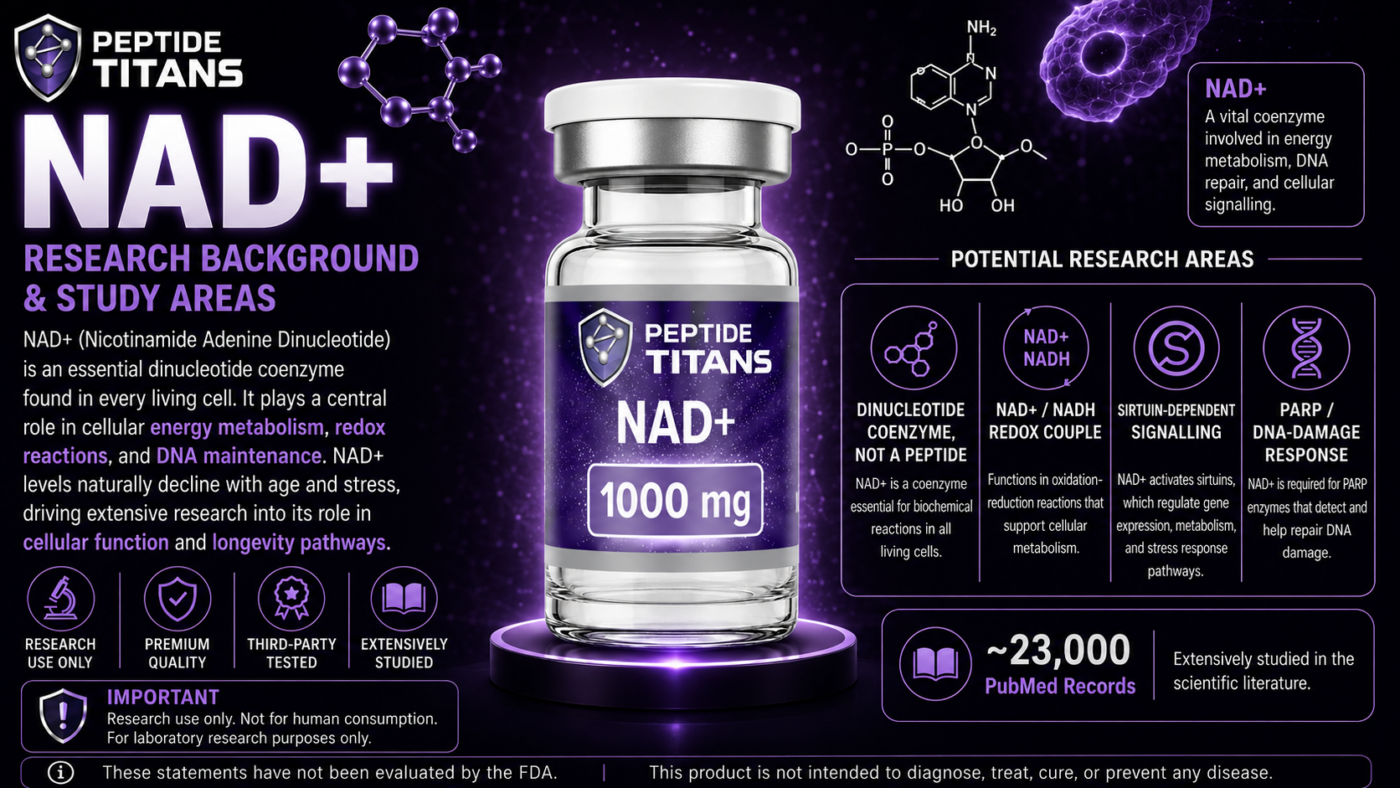
NAD+ (nicotinamide adenine dinucleotide) is a coenzyme present in every living cell, where it acts as an electron carrier in the reactions that release energy from nutrients. It is one of the most-studied molecules in cell biology, with a literature stretching back to its discovery in 1906 and a large modern body of work on metabolism and ageing.
The scale is worth stating precisely, because it is easy to get wrong. A PubMed search for NAD returns 76,392 indexed records as of 20 August 2026. For calibration, most compounds covered in this library return a few hundred records and several return fewer than ten — NAD+ sits in a different order of magnitude entirely. Count retrieved from the PubMed E-utilities API on 20 August 2026; the figure grows continuously.
NAD+ is not a peptide
This is worth stating plainly, because NAD+ is routinely listed alongside peptides by research suppliers and the two are often conflated.
Peptides are short chains of amino acids joined by peptide bonds. NAD+ is a dinucleotide — two nucleotides (one carrying adenine, one carrying nicotinamide) joined through their phosphate groups. Structurally and functionally it belongs to a different class of molecule entirely. Searches for “NAD+ peptide” are common, but no peptide by that name exists; the subject of those searches is this coenzyme.
The practical consequence for a laboratory is that NAD+ does not behave like a peptide in handling terms — it is not a lyophilized amino-acid chain, and its stability profile is its own.
What NAD+ does in the cell
NAD+ cycles between an oxidised form (NAD+) and a reduced form (NADH). That cycling is the mechanism by which it carries electrons, and it puts NAD+ at the centre of several processes the literature examines:
- Redox metabolism — glycolysis, the citric acid cycle and oxidative phosphorylation all depend on the NAD+/NADH couple.
- Sirtuin signalling — sirtuins are NAD+-dependent deacetylases, so their activity is tied to NAD+ availability. This is the link most often drawn between NAD+ and ageing research.
- PARP activity — poly(ADP-ribose) polymerases consume NAD+ during DNA-damage response, which is why DNA damage and NAD+ levels are discussed together.
- Mitochondrial function — reviews describe NAD+ pools as a control point balancing mitochondrial and nuclear energy signalling.
What the published research examines
The sections below describe where the literature is — the study areas, model types and recurring vocabulary. They are not statements of effect and do not describe outcomes in humans.
- Ageing biology: a substantial review literature documents declining NAD+ levels with age across tissues and organisms, and examines what follows from that decline. See the 2021 Nature Reviews Molecular Cell Biology review (PMID 33353981) and the 2015 Science review (PMID 26785480).
- Energy homeostasis: work on how NAD+ availability coordinates mitochondrial and nuclear responses to nutrient state (PMID 26118927).
- Sirtuins in disease models: reviewed extensively in relation to metabolic and neurodegenerative models (PMID 24786309).
- Model types: overwhelmingly in vitro cell systems and rodent models. Human data exists, but see the important caveat below.
Where the human evidence actually sits — and it is not NAD+ itself
This is the most commonly misread part of the NAD+ literature.
Most controlled human studies in this field do not administer NAD+. They administer precursors — nicotinamide riboside (NR), nicotinamide mononucleotide (NMN), nicotinamide, or niacin — and measure whether blood or tissue NAD+ rises. NAD+ is a large, charged molecule that does not readily cross cell membranes intact, which is precisely why the precursor route dominates the research.
So a finding about NR or NMN in a human trial is not a finding about NAD+ administration. Material that presents the two interchangeably is conflating distinct interventions.
What the literature does not establish
NAD+ being well-studied as a molecule is not the same as NAD+ being well-established as an intervention. The reviews cited above are consistent on the gaps:
- Declining NAD+ with age is well documented; that restoring it produces defined outcomes in humans is not established.
- Optimal levels, routes and durations are not defined, and long-term safety data for supplementation is limited.
- Much of the mechanistic work is in cells and rodents, and rodent NAD+ metabolism does not map cleanly onto human metabolism.
There is accordingly no established dosing, route or protocol for NAD+ as a research material, and this page gives none.
Handling and storage
NAD+ is supplied as a lyophilized powder and is hygroscopic — it draws moisture from the air, which is the main practical handling risk. It is also less stable in solution than in the dry state, and stability is pH-sensitive.
- Sealed vials: −20 °C, protected from light and moisture, desiccated. Bring to room temperature before opening to avoid condensation.
- Reconstituted: short-term at 4 °C; aliquot and freeze for longer storage. Minimise freeze–thaw cycles.
- Concentration is simply total mass divided by diluent volume; a 1000 mg vial in 10 mL gives 100 mg/mL.
Frequently asked questions
Is NAD+ a peptide?
No. It is a dinucleotide coenzyme — two nucleotides joined through their phosphates. It is often catalogued alongside peptides by suppliers, which is where the confusion comes from, but it is a different class of molecule.
What is the difference between NAD and NAD+?
The plus sign denotes the oxidised form. NAD+ accepts electrons to become NADH, the reduced form; the pair is usually written as the NAD+/NADH couple. “NAD” is often used loosely to mean the whole system.
What is the difference between NAD+, NMN and NR?
NMN and NR are precursors — smaller molecules the body converts into NAD+. Because NAD+ itself does not readily cross cell membranes intact, most human research uses precursors rather than NAD+ directly.
What are the benefits of NAD+?
No benefits are established for NAD+ as an administered material. What the literature describes is its role in cells — redox metabolism, sirtuin and PARP activity, mitochondrial signalling — and the observation that levels decline with age. Those are descriptions of biology, not demonstrated outcomes from taking it.
Why does NAD+ need to be kept dry?
It is hygroscopic. Absorbed moisture degrades the powder and makes mass measurements unreliable, so desiccated storage and letting the vial reach room temperature before opening both matter more here than for many other materials.
Research use only
This product is not for human consumption. It is sold strictly for research and educational purposes and is not intended to diagnose, treat, cure, or prevent any disease. Research information on this page is derived from peer-reviewed scientific literature and provided for educational reference only; it does not constitute medical advice or product claims.
References
- Covarrubias AJ et al. NAD+ metabolism and its roles in cellular processes during ageing. Nat Rev Mol Cell Biol, 2021. PMID 33353981
- NAD+ in aging, metabolism, and neurodegeneration. Science, 2015. PMID 26785480
- NAD+ metabolism and the control of energy homeostasis: a balancing act between mitochondria and the nucleus. Cell Metab, 2015. PMID 26118927
- NAD+ and sirtuins in aging and disease. Trends Cell Biol, 2014. PMID 24786309
Research-use product reference: NAD+ is listed at Peptide Titans for laboratory research use only. Products are not for human consumption.
Related
- What is SLU-PP-332? — a small-molecule ERR agonist, also not a peptide
- What is KLOW peptide? Composition and research overview
- What is 5-Amino-1MQ? The NNMT inhibitor and its link to NAD+ salvage
- What is CJC-1295? DAC vs No DAC
- Certificates of analysis
Related research resources
- NAD+ research profile — molecular data and indexed literature
- NAD+ research material — lot-tested with a published Certificate of Analysis
- View the lot-specific COA for NAD+