
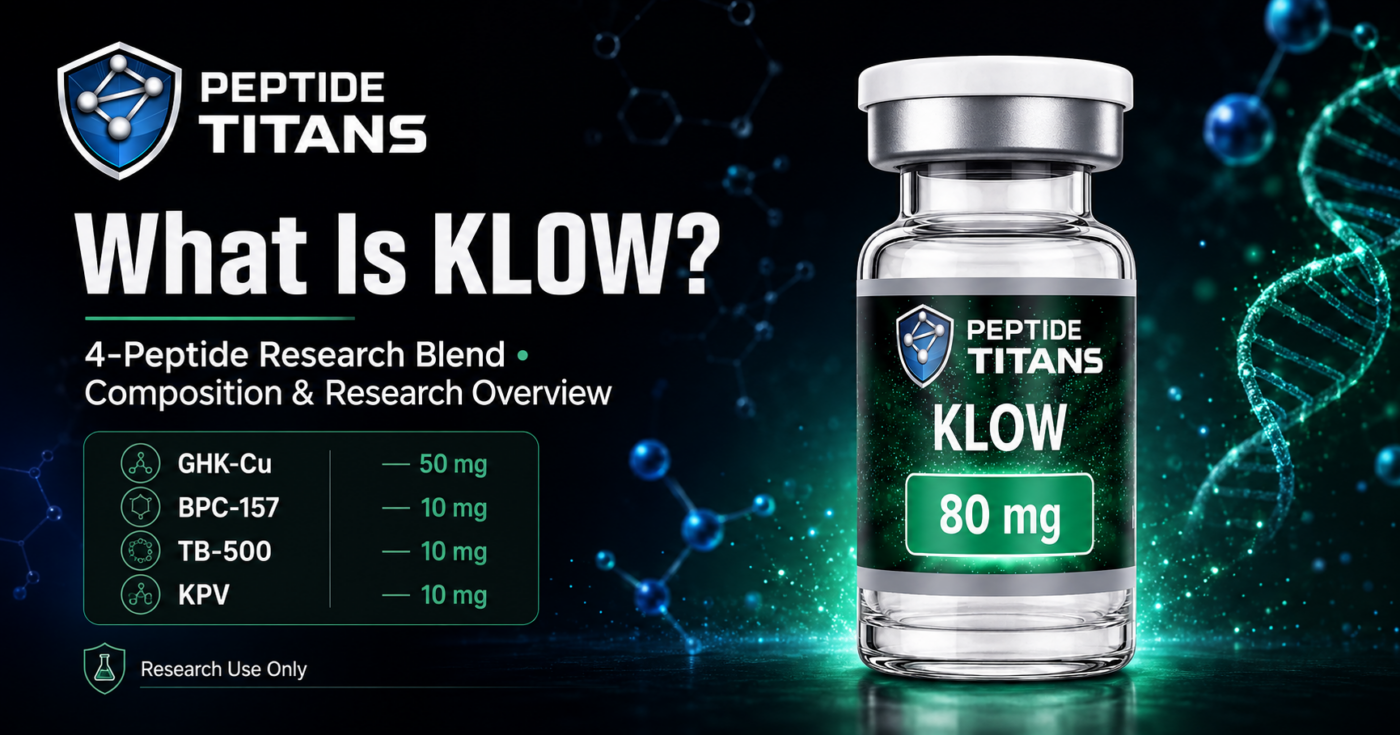
KLOW is a multi-peptide research blend containing four compounds in a single lyophilized vial: GHK-Cu, BPC-157, TB-500 and KPV. A standard vial totals 80 mg. It is a formulation label rather than a chemical entity — there is no single molecule called KLOW, no CAS number, and no entry for it in the scientific literature. Published research addresses the four constituents individually.
What is in a KLOW vial
| Component | Amount | Structure |
|---|---|---|
| GHK-Cu | 50 mg | Copper (II) coordination complex of the tripeptide Gly-His-Lys |
| BPC-157 | 10 mg | 15-amino-acid synthetic peptide |
| TB-500 | 10 mg | Thymosin beta-4 analog, 43-amino-acid peptide |
| KPV | 10 mg | Lys-Pro-Val tripeptide, C-terminal fragment of alpha-MSH |
| Total | 80 mg | Blue-tinted to off-white lyophilized powder |
GHK-Cu accounts for five-eighths of the vial by mass; the other three are present in equal 10 mg portions. Composition and ratios may vary by formulation — the figures above describe the KLOW 80 mg research listing, and lot-specific analytical data appears on each batch certificate of analysis.
Where the name comes from
KLOW is generally read as the GLOW blend with KPV added. GLOW contains GHK-Cu, BPC-157 and TB-500 at 50/10/10 mg for a 70 mg total; KLOW is that same base plus 10 mg of KPV, giving 80 mg. Neither name is standardised nomenclature and neither appears in PubMed. See the full KLOW vs GLOW comparison.
The blue tint often noticed in KLOW powder and solution comes from GHK-Cu specifically. Copper coordination complexes are strongly coloured, so the colour is expected rather than an indicator of anything unusual.
What the published research examines, component by component
The sections below describe where the literature is for each constituent — the study areas, model types and mechanistic vocabulary you will encounter in the papers. They are not statements of effect, and they do not describe outcomes in humans.
GHK-Cu (glycyl-L-histidyl-L-lysine copper complex)
GHK is a naturally occurring tripeptide present in plasma and tissues, which forms a complex with copper (II). Reviews synthesise data from cell culture, gene-expression profiling and animal studies.
- Study areas: collagen and elastin synthesis, glycosaminoglycan regulation, extracellular matrix organisation, angiogenic and neuronal outgrowth signalling, antioxidant and inflammatory or fibrotic gene networks.
- Models: in vitro fibroblast and keratinocyte systems, gene-expression studies, animal tissue-repair models.
- Limitations: predominantly preclinical. Reviews note gaps in large controlled clinical trials and in systemic safety data outside topical or cosmetic contexts.
BPC-157
A 15-amino-acid peptide originally identified in gastric juice, widely represented in preclinical literature as Body Protection Compound-157.
- Study areas: angiogenesis, nitric oxide pathway signalling (Akt–eNOS), ERK1/2 activation, modulation of inflammatory mediators, cytoprotection.
- Models: in vitro cell assays and rodent models of tendon, ligament, muscle and gastrointestinal injury.
- Limitations: almost entirely preclinical. Authors emphasise the need for standardised manufacturing, larger controlled studies and safety evaluation before translational interpretation.
TB-500 / thymosin beta-4
Thymosin beta-4 is an endogenous actin-binding peptide involved in cell migration and cytoskeletal regulation; TB-500 is the analog used in research settings.
- Study areas: re-epithelialisation, angiogenic signalling, matrix metalloproteinase (MMP) regulation, anti-apoptotic pathways, cytoskeletal reorganisation.
- Models: cell migration assays, multiple animal wound models, and some topical clinical trial work in dermatology.
- Limitations: topical clinical studies exist, but systemic applications remain experimental and further controlled research and safety profiling is called for.
KPV (Lys-Pro-Val)
A tripeptide derived from the C-terminus of alpha-melanocyte-stimulating hormone, studied largely in inflammatory and mucosal contexts — a distinctly different research theme from the other three.
- Study areas: inhibition of inflammatory signalling (NF-κB, MAP kinase pathways), reduction of pro-inflammatory cytokine expression in cultured cells, mucosal responses in chemically induced colitis models.
- Models: intestinal cell models and rodent colitis models. Much of the work concerns nanoparticle and hydrogel delivery systems, because peptide stability is a limiting factor. PepT1-mediated uptake is a commonly cited transport route.
- Limitations: preclinical; stability and targeted delivery are recurring unsolved problems in the literature.
What the literature does not establish
This is the most important section on the page, and it is the one most often left out elsewhere.
KLOW has never been studied as KLOW. Every publication cited above examines a single peptide, usually in isolation, usually in cell culture or rodent models. There is no body of research characterising these four compounds administered together, no data on how they interact, and no basis for assuming that findings about one component transfer to the blend. Summing four sets of preclinical findings does not produce evidence about a combination.
Consequently there is no established dosing, no established route of administration, no efficacy data and no human safety profile for KLOW. Material that presents combined outcomes, before-and-after results, or dosing protocols for this blend is not drawing on published research, because that research does not exist.
Handling, storage and reconstitution
KLOW is supplied as a lyophilized powder, soluble in water or phosphate-buffered saline.
- Sealed vials: −20 °C to −80 °C, protected from light and moisture, desiccated.
- Reconstituted: up to 7 days at 4 °C, or −20 °C in single-use aliquots. Minimise freeze–thaw cycles.
- Concentration: depends entirely on diluent volume. An 80 mg vial in 2 mL gives 40 mg/mL total, of which GHK-Cu is 25 mg/mL and each other component 5 mg/mL.
Full per-component figures at every common volume are in the KLOW 80 mg reconstitution and concentration chart.
Frequently asked questions
What is KLOW peptide?
A four-component research blend of GHK-Cu (50 mg), BPC-157 (10 mg), TB-500 (10 mg) and KPV (10 mg), supplied as an 80 mg lyophilized powder. It is a formulation, not a single compound.
What does KLOW stand for?
It is a formulation label rather than a formal acronym. It is generally understood as the GLOW blend with KPV added — the K in front of the existing three-peptide base.
Is KLOW the same as the KPV / GHK-Cu / BPC-157 / TB-500 blend?
Yes. Those four peptides are exactly what the blend contains; the name is shorthand for that combination.
Why is KLOW blue?
GHK-Cu is a copper (II) complex, and copper complexes are strongly coloured. The tint appears in both the powder and the reconstituted solution, and is expected in any GHK-Cu-containing blend.
What is the difference between KLOW and GLOW?
One peptide. GLOW is GHK-Cu, BPC-157 and TB-500 at 70 mg total; KLOW is the same three plus 10 mg of KPV, at 80 mg total.
Research use only
This product is not for human consumption. It is sold strictly for research and educational purposes and is not intended to diagnose, treat, cure, or prevent any disease. Research information referenced on this page is derived from peer-reviewed scientific literature and provided for educational reference only; it does not constitute medical advice or product claims. By purchasing, you acknowledge that you are a qualified researcher and agree to use the material in full compliance with all applicable laws and regulations.
References
- Pickart L, Margolina A. Regenerative and protective actions of the GHK-Cu peptide in the light of the new gene data. Int J Mol Sci. PMC6073405
- Review of BPC-157 preclinical literature. PubMed 30915550
- Thymosin beta-4 in tissue repair — review. PMC8724243
- KPV in intestinal inflammation and delivery systems. PMC5498804
- PepT1-mediated tripeptide KPV uptake reduces intestinal inflammation. PMC2431115
Related
- KLOW 80 mg reconstitution and concentration chart
- KLOW vs GLOW: what is the difference?
- Research guides — handling, reconstitution and laboratory reference material
- Testing and purity articles
- What is GLOW peptide? — the same blend without KPV, 70 mg instead of 80
- What is GHK-Cu? — the largest component of both blends, and the only one with randomised human trials
- What is KPV peptide? — one of KLOW’s four components
- What is TB-500? — another of its components
- KLOW 80 mg research listing and certificate of analysis
Related research resources
- KLOW research blend — GHK-Cu, BPC-157, TB-500 and KPV components
- View the lot-specific COA for KLOW