
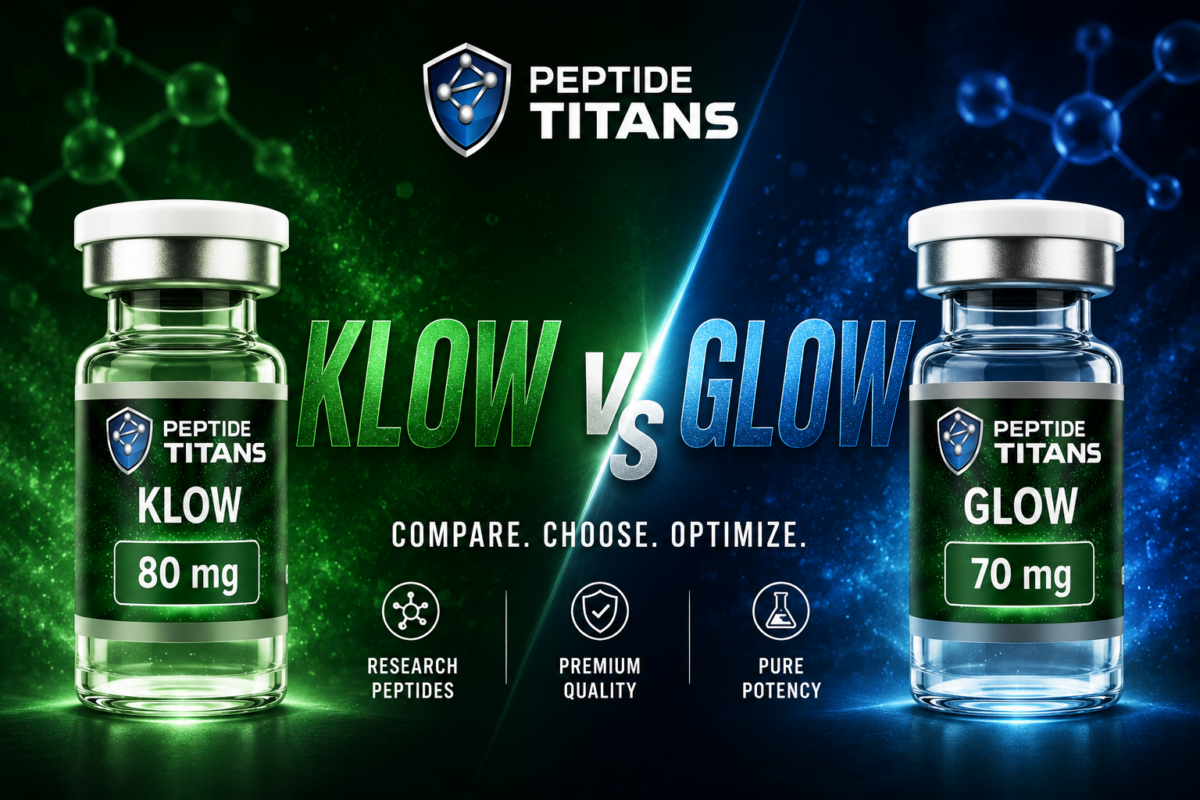
Short answer: KLOW is the GLOW blend with one additional peptide. Both contain GHK-Cu, BPC-157 and TB-500 in identical amounts. KLOW adds KPV, taking the vial from 70 mg to 80 mg. The base three peptides, their ratios and the handling requirements are otherwise the same.
Composition side by side
| Component | GLOW | KLOW | What it is |
|---|---|---|---|
| GHK-Cu | 50 mg | 50 mg | Copper (II) complex of the tripeptide Gly-His-Lys |
| BPC-157 | 10 mg | 10 mg | 15-amino-acid synthetic peptide |
| TB-500 | 10 mg | 10 mg | Thymosin beta-4 analog peptide |
| KPV | — | 10 mg | Lys-Pro-Val tripeptide, the C-terminal fragment of alpha-MSH |
| Total per vial | 70 mg | 80 mg | Lyophilized powder |
Blend composition and ratios may vary by formulation. The figures above describe the Peptide Titans research listings for GLOW 70 mg and KLOW 80 mg; lot-specific analytical data is published on the certificate of analysis for each batch.
Where the name comes from
The two names are formulation labels rather than chemical nomenclature, and neither is a standardised term in the scientific literature. KLOW is generally read as GLOW with KPV added — the same three-peptide base, plus the K. You will not find either name in PubMed; published work addresses the individual constituents.
What the added KPV brings to the literature picture
KPV is a tripeptide derived from the C-terminus of alpha-melanocyte-stimulating hormone. In published work it is examined mainly in inflammatory and mucosal models, which is a different research theme from the extracellular-matrix and dermal focus that dominates the GHK-Cu literature.
- Study areas reported: inhibition of inflammatory signalling (NF-κB, MAP kinase pathways), reduction of pro-inflammatory cytokine expression in cultured cells, and mucosal responses in chemically induced colitis models.
- Model types: predominantly intestinal cell models and rodent colitis models.
- Recurring methodological theme: much of the KPV literature concerns delivery strategy — nanoparticle and hydrogel carriers — because peptide stability is a limiting factor in these models. PepT1-mediated uptake is a commonly cited transport mechanism.
So the practical difference between the two blends, expressed in literature terms, is that KLOW adds a component whose published research sits in inflammatory and epithelial-barrier models rather than matrix remodelling. This is a description of where the papers are, not a claim about combined effects. See the caveat below.
What the literature does not establish
Neither blend has been studied as a blend. Published research examines these peptides individually, usually in isolation and usually in preclinical models. There is no body of work characterising GHK-Cu, BPC-157, TB-500 and KPV administered together, and nothing in the literature supports inferring a combined outcome by adding up the individual findings. Any comparison between KLOW and GLOW is therefore a comparison of composition, not of demonstrated effect.
Handling: no practical difference
Both are lyophilized powders with the same storage and reconstitution requirements. Store sealed vials at −20 °C to −80 °C, protected from light and moisture. Reconstituted solution keeps up to 7 days at 4 °C, or at −20 °C in single-use aliquots; minimise freeze–thaw cycles.
The one thing that does differ is concentration arithmetic, because the vials contain different total masses. Working concentrations for a given reconstitution volume are set out in the KLOW 80 mg reconstitution and concentration reference.
Frequently asked questions
Is KLOW just GLOW with KPV?
In composition terms, yes. The GHK-Cu, BPC-157 and TB-500 amounts are identical at 50 mg, 10 mg and 10 mg; KLOW adds 10 mg of KPV for an 80 mg total against GLOW’s 70 mg.
Do both blends turn the solution blue?
Both contain GHK-Cu, a copper coordination complex, which gives the lyophilized powder a blue tint and colours the reconstituted solution. The colour comes from the copper complex and is expected for both formulations.
Research use only
These products are not for human consumption. They are sold strictly for research and educational purposes and are not intended to diagnose, treat, cure, or prevent any disease. Any research information referenced on this page is derived from peer-reviewed scientific literature and is provided for educational reference only; it does not constitute medical advice or product claims.
References
- Pickart L, Margolina A. Regenerative and protective actions of the GHK-Cu peptide. PMC6073405
- Review of BPC-157 preclinical literature. PubMed 30915550
- Thymosin beta-4 review. PMC8724243
- KPV in intestinal inflammation models. PMC5498804
- PepT1-mediated tripeptide KPV uptake. PMC2431115
Related
- What is GLOW peptide? — full overview of the three-peptide 70 mg blend
- What is KLOW peptide? — full overview of the four-peptide 80 mg blend
- What is KPV? — the component that separates the two
- What is TB-500? — shared by both blends
- Reconstitution and concentration chart