
For laboratory researchers, clarity about analytical quality is essential. The phrase “peptide purity means in lab testing” can refer to several related concepts: chromatographic purity, chemical identity, mass content, and the presence of non-peptide contributors. This article outlines how laboratories determine peptide purity, what analytical packages are commonly reported, and how documentation supports reproducible research.
What peptide purity refers to
In analytical chemistry, peptide purity is not a single absolute number but a context-dependent assessment derived from specific methods and reporting conventions. Purity commonly appears as a chromatographic percentage (e.g., an RP‑HPLC peak area percent) and may be complemented by orthogonal data that confirm sequence and quantify non-peptide material. Laboratory reports typically distinguish between chromatographic purity, identity confirmation, and mass-balance or absolute content.
Analytical methods used in lab testing
Reversed‑phase HPLC (RP‑HPLC)
Reversed‑phase HPLC is widely employed for routine assessment of chromatographic purity because it separates peptides by hydrophobicity and produces UV chromatograms that are convenient to report. Method parameters (column chemistry, gradient slope, detector wavelength) affect peak resolution and the apparent purity. Fast gradients or inappropriate columns can mask closely eluting impurities, so RP‑HPLC results are best interpreted alongside orthogonal data (PMCID: PMC7119934).
Mass spectrometry (MS and MS/MS)
Mass spectrometry provides molecular-weight confirmation and can evidence sequence‑specific fragments via MS/MS. MS confirms whether the major chromatographic peak corresponds to the expected peptide mass and helps identify sequence variants or post‑synthetic modifications that may not be baseline-resolved by HPLC (PMCID: PMC4830481).
Orthogonal chromatographies and capillary methods
Ion‑exchange, size‑exclusion, hydrophilic interaction (HILIC), and capillary electrophoresis are examples of orthogonal techniques. These methods can reveal impurities or aggregation states that co‑elute in a single RP‑HPLC method, increasing confidence in a purity assignment (PMCID: PMC7119934).
Mass‑balance and absolute content
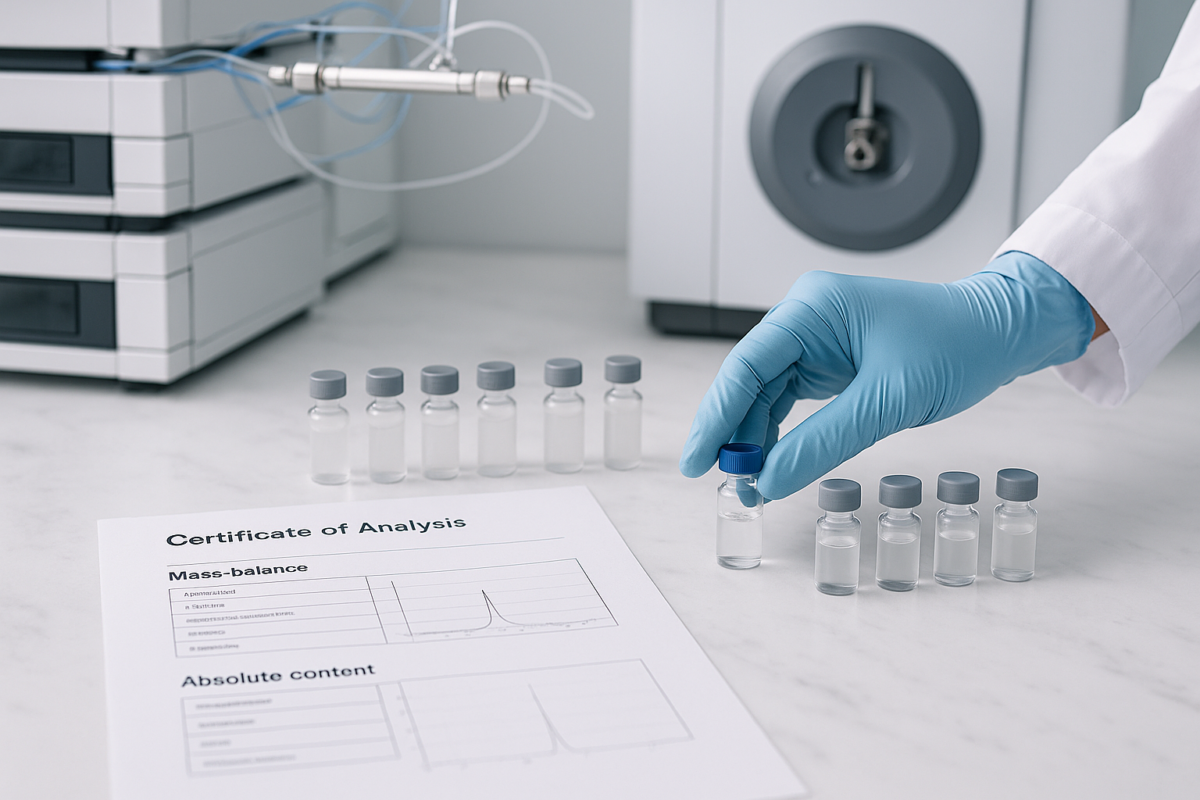
A mass‑balance approach accounts for measured non‑peptide mass contributors—residual solvents, counter‑ions, moisture, and inorganic residues—and subtracts them from 100% to estimate peptide content. Reference standard assignment protocols recommend combining chromatographic, mass‑spectrometric, and non‑peptide assays for robust value assignment (PMCID: PMC10338602).
Quality control and documentation
Quality-control reporting for peptides typically includes a certificate of analysis (COA) or lab results sheet that contains chromatograms, MS data, lot identifiers, and quantitative statements about content. Good documentation links analytical data to traceable reference standards and method descriptions so other laboratories can interpret results or replicate analyses. Inter‑laboratory studies and reference materials improve confidence in assigned values (PMCID: PMC10338602).
Key terms researchers encounter
Understanding common terms helps interpret lab testing reports:
- Chromatographic purity: Percent area of the principal HPLC peak under specified conditions.
- Identity confirmation: MS or MS/MS evidence matching expected mass and fragmentation.
- Mass balance: Estimation of peptide content after accounting for non‑peptide material.
- Orthogonal methods: Additional analytical techniques used to detect impurities not resolved by the primary method.
- LOD/LOQ: Limits of detection and quantification for specific assays.
Limitations and method dependence
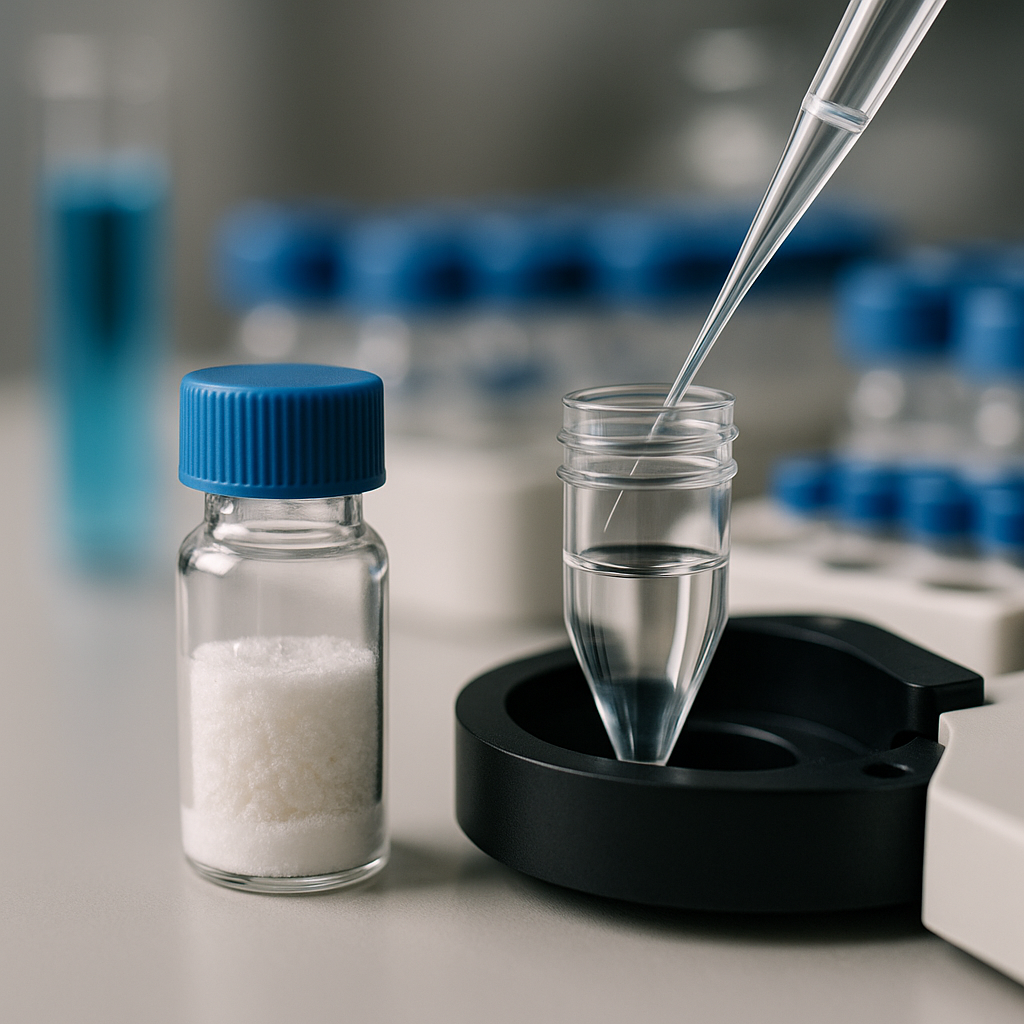
Reported purity values depend heavily on analytical choices. A single RP‑HPLC chromatogram provides a rapid snapshot but may not detect low‑level impurities or sequence isomers. Sample dissolution, gradient steepness, detector wavelength, and column selection all influence the apparent purity. Aggregates or adducts may require size‑exclusion or high‑resolution MS to detect. Regulatory guidance emphasizes the need for sensitive, high‑resolution and orthogonal analytics to resolve closely related impurities and to characterize new species above defined thresholds (FDA guidance).
Why rigorous, research‑only language matters
In laboratory research, clear boundaries about application and interpretation are important. Published literature and regulatory documents focus on analytical characterization, comparability, and traceability rather than outcome claims. When documenting peptide purity for research, reports should emphasize methods, limits of detection, and uncertainty rather than application‑level statements.
Practical considerations for research labs
Researchers preparing or evaluating peptide materials should look for COAs and lab results that include chromatograms, MS data, method parameters, lot numbers, and statements about non‑peptide content. When absolute content is required for quantitative experiments, amino‑acid analysis or validated mass‑balance approaches may be reported. Comparing orthogonal data sets increases confidence in reported values (PMCID: PMC4830481; PMCID: PMC10338602).
Concluding remarks
“Peptide purity” in lab testing is a composite assessment arising from chromatographic profiles, mass confirmation, and analysis of non‑peptide constituents. Method selection, documentation, and orthogonal verification underpin reliable reporting. For researchers, interpreting peptide purity requires attention to the analytical package, method parameters, and the documented limitations of each assay.
Research Sources
Primary references and source materials used for this research-focused overview:
- https://pmc.ncbi.nlm.nih.gov/articles/PMC7119934/
- https://pmc.ncbi.nlm.nih.gov/articles/PMC10338602/
- https://pmc.ncbi.nlm.nih.gov/articles/PMC4830481/
- https://www.fda.gov/media/107622/download
Frequently Asked Questions
How is peptide purity measured in the laboratory?
Peptide purity is typically reported from RP‑HPLC chromatograms (percent area) and supported by mass spectrometry for identity confirmation. Orthogonal methods and assays for non‑peptide contributors may also be included to produce a mass‑balance or peptide content estimate (PMCID: PMC10338602).
Why might HPLC and MS data appear to disagree?
Differences can arise because RP‑HPLC reports chromatographic behavior under a specific method while MS reports molecular mass. Co‑eluting impurities, adducts, or modifications can alter apparent HPLC peak area without changing the mass of the major species; conversely, low‑level variants may be detected by high‑resolution MS but not resolved chromatographically (PMCID: PMC7119934).
What should a certificate of analysis (COA) include?
A robust COA for peptides usually contains method details, RP‑HPLC chromatograms, MS spectra or summaries, lot numbers, stated peptide content or mass‑balance results, and notes about residual solvents, counter‑ions, and moisture. Traceability to reference standards enhances interpretability (PMCID: PMC10338602).
Do orthogonal methods matter for routine research materials?
Orthogonal methods increase confidence in purity assignments by revealing species that a single assay may miss. The extent of orthogonal testing depends on experimental needs and the acceptable uncertainty for a given application (PMCID: PMC7119934).