
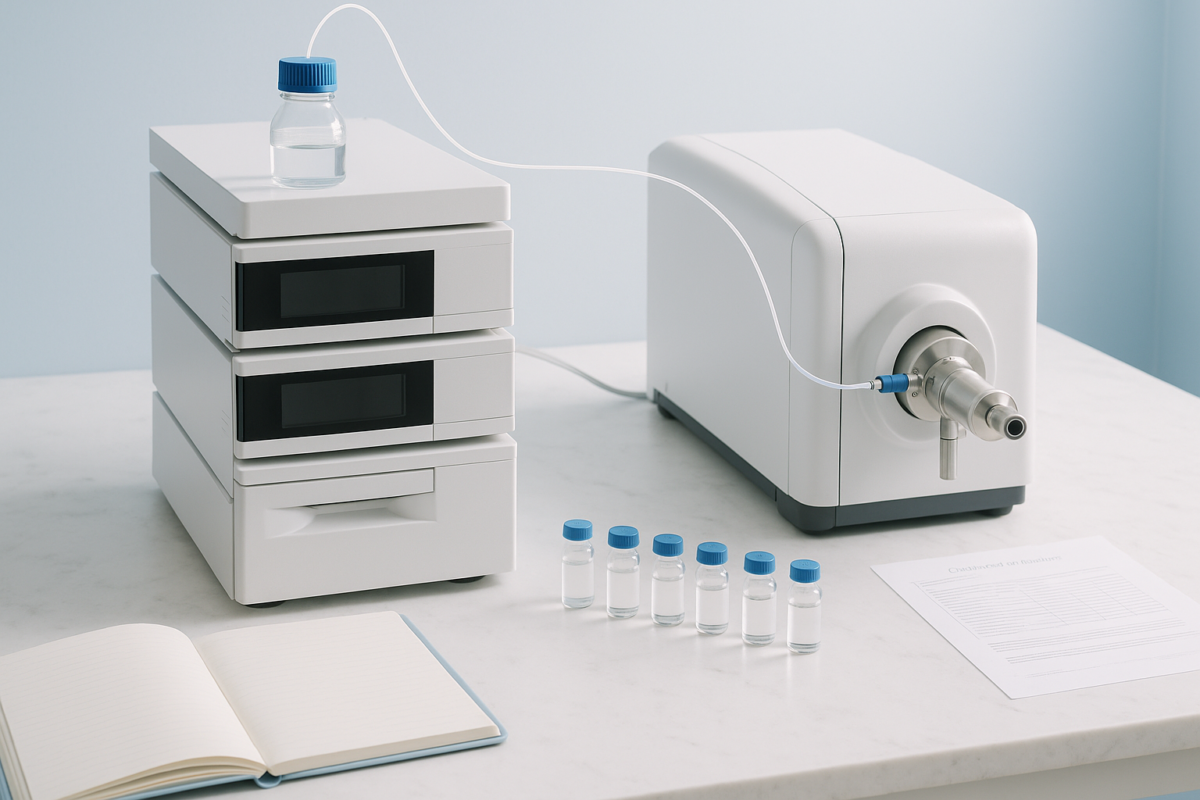
In laboratory research and quality systems, the terms “identity” and “purity” are related but distinct. This article addresses purity vs identity: what is the difference? and explains conceptual and practical distinctions, common laboratory methods, validation considerations, and documentation expectations relevant to research use and quality control.
What does “identity” mean in a laboratory context?
Identity is a qualitative attribute: it confirms that a sample is the claimed substance and discriminates it from closely related materials. For small molecules, identity tests commonly include spectroscopic or chromatographic comparisons (e.g., retention time with a reference standard, mass spectrometry confirmation). For biologics and peptides, sequence confirmation or high-resolution mass spectrometry is often used to verify the primary structure. Regulatory and compendial guidance frames identity as a test or set of tests that specifically confirm the analyte without ambiguity. See FDA Q6A and USP discussions for guidance on suitable identity testing strategies.
Common identity methods
Researchers and quality laboratories use a variety of identity assays depending on material class and complexity. Typical approaches include:
- Spectroscopy (IR, NMR) for structural fingerprints.
- Mass spectrometry (MS) to confirm molecular mass and fragment patterns.
- Sequence-based methods for peptides and proteins (e.g., MS/MS peptide mapping).
- Chromatographic retention time matching to authenticated reference standards.
- Orthogonal combinations (e.g., MS plus chromatographic comparison) for higher confidence.
What does “purity” mean—and how is it assessed?
Purity is a quantitative attribute describing the proportion of the claimed substance relative to impurities and related substances. Purity testing typically involves profiling and quantifying related substances using validated chromatographic or spectrometric assays. Purity assessments set reporting thresholds and may include qualification criteria for specific impurities when concentrations exceed defined limits.
Common purity and impurity profiling methods
Methods used to assess purity include:
- High-performance liquid chromatography (HPLC) or ultra-performance liquid chromatography (UPLC) for related-substance profiling.
- Hyphenated techniques such as LC–MS for identifying unknown impurities.
- Quantitative NMR (qNMR) as an orthogonal assay for assay/potency and purity confirmation.
- Forced-degradation studies to reveal potential degradation products that inform impurity specifications.
Validation and method performance: different expectations
The design and validation of identity and purity assays differ because their objectives are not the same. FDA guidance on analytical procedure validation (Q2(R2)) outlines performance characteristics—specificity/selectivity, accuracy, precision, range, and limits of detection/quantitation—that apply across assays but may be emphasized differently depending on whether a test is qualitative or quantitative. See the FDA Q2(R2) guidance for analytical validation considerations.
Key validation distinctions include:
- Specificity/selectivity: For identity tests, specificity must demonstrate that the assay discriminates the target from closely related structures; for impurity assays, specificity must separate and quantify related substances against the main peak and matrix components.
- Quantitation: Purity assays require validated accuracy, precision, and limits of quantitation; identity tests are generally qualitative but may require semi-quantitative confirmation in some contexts.
- Orthogonal testing: Both identity and purity benefit from orthogonal methods—different analytical techniques that provide complementary evidence.
Complex matrices and the need for layered testing
Materials with complex composition, such as botanical extracts or multicomponent mixtures, often require multiple complementary identity tests (macroscopic, microscopic, chromatographic, chemical) to provide robust assurance of identity and to contextualize purity results. Compendial and academic literature emphasizes layered testing to reduce the risk of adulteration or misidentification.

Documentation, COAs, and quality-control expectations
Certificates of Analysis commonly present identity results (e.g., “Pass” based on specified identity tests) alongside quantitative assay and related-substance data for purity. Quality-control documentation should include the methods used, validation status, acceptance criteria, and reporting thresholds for impurities. Regulatory and standards organizations recommend documenting orthogonal evidence when single tests may be insufficient to discriminate closely related substances. For examples of lab reporting and public COAs, see our Lab Results page.
For organizations that maintain reference materials and certificates, Peptide Titans provides listings of available materials; see the Peptide Titans shop for product and documentation listings and the homepage for general site resources.
Key terms researchers should know
- Specificity/selectivity: The ability of an assay to measure the analyte in the presence of other components.
- Orthogonal methods: Complementary analytical techniques that provide independent evidence.
- Related substances: Process- or degradation-derived species structurally related to the main analyte.
- Limit of detection/quantitation (LOD/LOQ): Smallest concentrations that can be reliably detected or quantified.
- Certificate of Analysis (COA): Document summarizing test results, methods, and acceptance criteria.
Limitations and considerations for researchers
No single test universally fulfills both identity and purity needs. Identity assays can miss novel adulterants if they rely on a single, non-discriminating method. Purity assays depend on adequate separation and detection of impurities; unknown impurities may require additional identification steps. Published guidance encourages method validation, forced-degradation or spiking studies to demonstrate specificity, and use of orthogonal techniques to strengthen confidence in both identity and purity findings.
Why research-only language matters
This article frames identity and purity in a laboratory research and quality-control context. The content is intended for researchers, laboratory managers, and quality professionals seeking to understand analytical distinctions and documentation practices. It does not provide product-use, dosing, clinical, or human-application guidance.
For practical references and regulatory context, readers may consult compendial and regulatory guidance documents such as FDA Q6A and Q2(R2), as well as compendial discussions from USP and academic reviews on identity testing strategies.
Research Sources
Primary references and source materials used for this research-focused overview:
- FDA Q6A: Specifications, test procedures, and acceptance criteria
- FDA Q2(R2): Analytical Procedure Validation guidance
- PMC review: Analytical strategies and identity testing considerations
- USP discussion: Complexity of identity and purity testing
Frequently Asked Questions
1. Can one test confirm both identity and purity?
In some cases a single well-designed assay may provide evidence relevant to both identity and basic purity (for example, a high-resolution chromatographic assay with mass confirmation). However, regulatory and compendial guidance generally recommends orthogonal or complementary tests to provide robust confirmation, since identity tests are qualitative while purity assays are quantitative and have different validation requirements.
2. What are orthogonal methods and why are they recommended?
Orthogonal methods use different physical or chemical principles to analyze the same sample (e.g., LC–MS plus NMR). They are recommended because independent lines of evidence reduce the chance that a single method’s limitations or interferences will lead to incorrect conclusions about identity or impurity content.
3. What should a Certificate of Analysis (COA) include regarding identity and purity?
A COA should list the methods used, the results for identity testing (e.g., pass/fail with method reference), quantitative assay or potency values, related-substance profiles with reporting thresholds, and any applicable acceptance criteria. Documentation of method validation status and reference standards is valuable for reproducibility and traceability.
4. How do validation requirements differ between identity and purity tests?
Both types of tests require demonstration of specificity; purity assays additionally require established accuracy, precision, linearity/range, and limits of detection/quantitation for quantitative reporting. Identity tests emphasize discrimination from related species and may use qualitative acceptance criteria.
Continue in this series
- HPLC testing explained — the purity side
- Mass spectrometry on peptide COAs — the identity side
- Certificates showing both results, per lot