
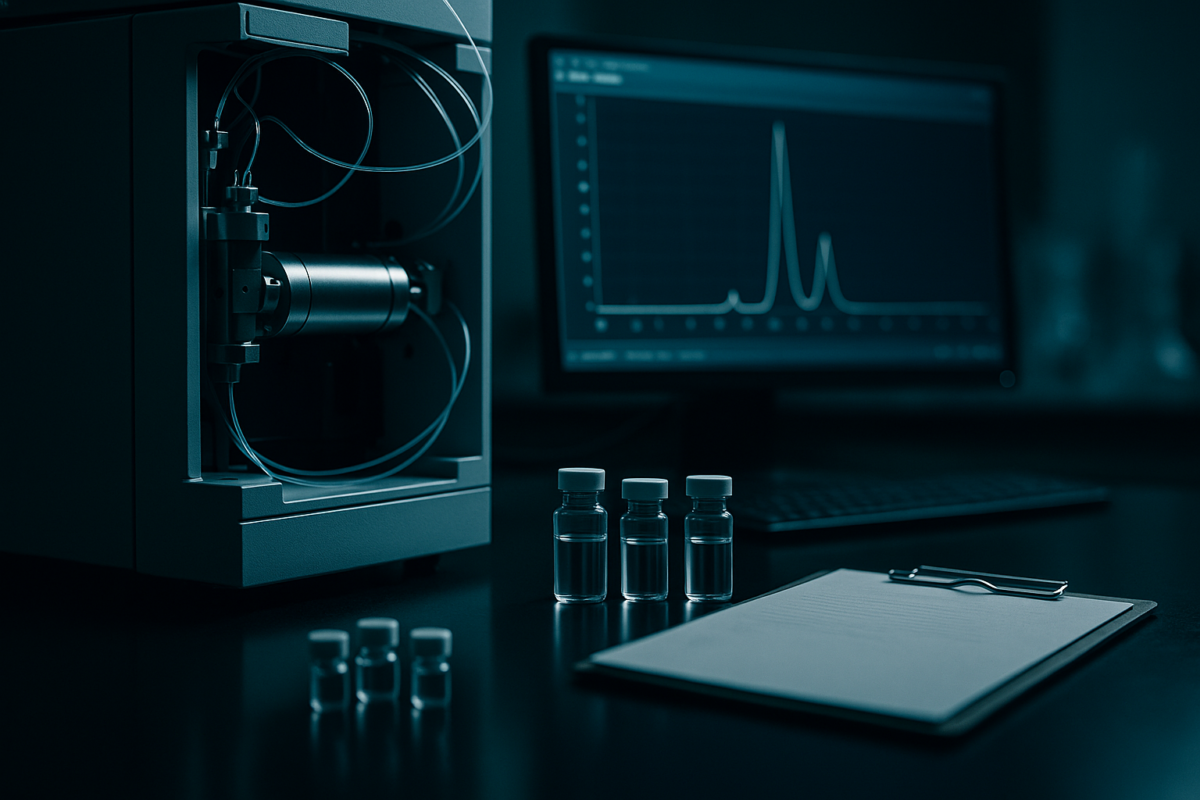
High-performance liquid chromatography (HPLC) is a core analytical technique used in laboratory research and quality control to separate, identify, and quantify chemical components in complex mixtures. This article, prepared for Peptide Titans as an educational resource, summarizes how HPLC is described in the scientific literature, how methods are developed and validated, what chromatographers mean by common terms, and the limitations researchers report when applying HPLC to peptide analysis. The content is research-focused and does not provide product-use guidance.
What is HPLC?
HPLC is a chromatography technique that separates analytes based on their interactions with a stationary phase and a mobile phase under high pressure. In practical terms, a sample is carried through a column filled with packing material while a solvent (mobile phase) flows through the column. Differences in partitioning, adsorption, ion exchange, or other interactions cause components to elute at different times, producing a chromatogram that can be used for identification and quantification.
How HPLC appears in the research literature
Published literature often treats HPLC as both an analytical workhorse and a method that requires careful validation for a given application. Regulatory and compendial guidance (for example, USP General Chapter <621>) frames HPLC as a distribution-based separation method and sets expectations for system suitability and performance checks prior to quantitative analysis. Journal articles and method papers typically describe method development strategies, performance metrics, and in-house validation following frameworks such as ICH Q2(R1).
Typical research contexts
Researchers report HPLC use across several activities: identity confirmation, purity assessment, impurity profiling, stability-indicating assays, and routine quality-control testing. In peptide-focused studies, HPLC is commonly paired with orthogonal detectors (UV, PDA) and mass spectrometry to increase confidence in identity and impurity characterization.
Method development and validation
Method development for HPLC aims to achieve suitable selectivity and resolution for the analytes of interest. Recent literature emphasizes systematic optimization—often using experimental design—to tune pH, mobile-phase composition, solvent ratios, column stationary phase, temperature, and flow rate. This reduces trial-and-error and helps reveal interactions among variables that affect separation quality.
Validation elements researchers report
Validation commonly follows ICH Q2(R1)-style endpoints and includes:
- Specificity/selectivity: evidence the method separates the target analyte from impurities or excipients.
- Linearity and range: demonstration of proportional response across relevant concentrations.
- Precision: repeatability and intermediate precision, often reported as relative standard deviation (RSD).
- Accuracy: recovery studies or comparison to reference standards.
- Limits of detection and quantification (LOD/LOQ): analytical sensitivity thresholds.
- Robustness: evaluation of small deliberate changes in method parameters.
Published method papers provide examples of acceptance criteria and system-suitability tests (e.g., retention time reproducibility, theoretical plate count, resolution between critical peaks, and RSD for replicate injections) used before sample analysis.
Common metrics and key terms
Readers will encounter specific chromatographic terminology in HPLC reports. Key terms include:
- Retention time: the time a compound takes to elute from the column.
- Resolution: the measure of separation between two adjacent peaks.
- Theoretical plates (N): an indicator of column efficiency.
- Peak area and peak height: used for quantitation.
- Selectivity (alpha): relative retention of analytes.
- Limit of Detection (LOD) and Limit of Quantitation (LOQ): sensitivity parameters.
- System suitability: a set of checks ensuring the instrument and method are ready for analysis.
Peptide purity and analytical workflows
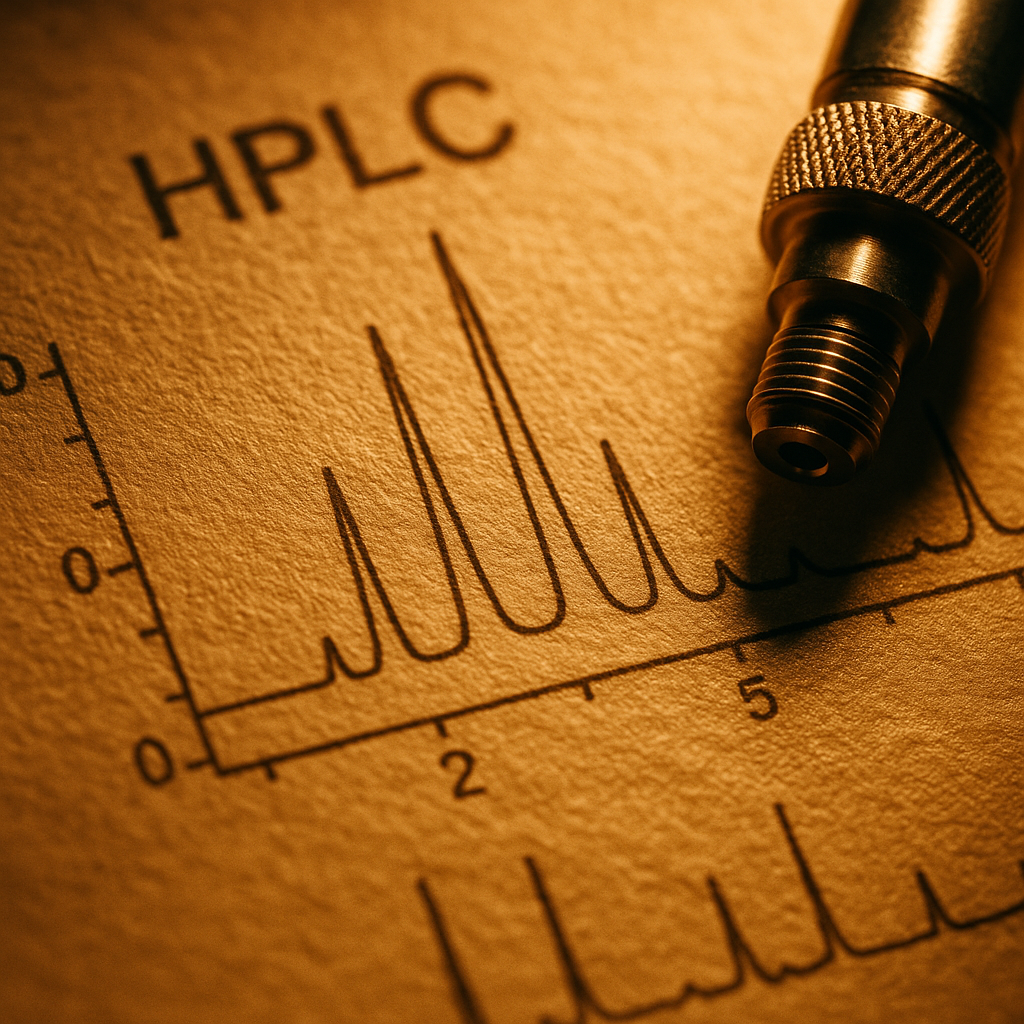
In peptide research, HPLC is routinely applied to assess peptide purity and to monitor process-related and degradation impurities in laboratory workflows. Reports often combine HPLC separation with diode-array detection or mass spectrometry to provide both chromatographic resolution and structural information. Literature also highlights that complementary or orthogonal techniques increase confidence when characterizing closely related species or low-level impurities.
Limits and complementary methods
Published work notes several limitations of HPLC alone: method performance is matrix- and method-dependent, co-eluting impurities can obscure quantitation, and detection limits depend on the detector used. Researchers commonly recommend orthogonal confirmation—such as LC–MS/MS or amino-acid analysis—for identity and impurity characterization, and stress the need to document method applicability and limitations during validation.
Why research-only language matters
This article uses research-focused language because analytical techniques such as HPLC are tools for laboratory investigation and quality-control documentation. Framing content in terms of published literature, method performance, validation, and traceability reflects how scientists and regulatory frameworks discuss HPLC. It avoids implying clinical use, dosing, or product claims and supports transparent communication for research audiences.
Practical documentation and traceability
Laboratories and organizations documenting HPLC results typically produce chromatograms, method records, system-suitability reports, and certificates of analysis (COAs) that summarize validated performance and acceptance criteria. The literature and compendia recommend retaining method development notes and validation data to support reproducibility and traceability in research and QC settings.
Further reading
Readers interested in technical guidance and examples of HPLC method development and validation can consult compendial references and method papers that demonstrate applied validation approaches and system-suitability practices.
Research Sources
Primary references and source materials used for this research-focused overview:
- https://doi.usp.org/USPNF/USPNF_M99380_01_01.html
- https://pmc.ncbi.nlm.nih.gov/articles/PMC8024612/
- https://pmc.ncbi.nlm.nih.gov/articles/PMC4773534/
- https://pmc.ncbi.nlm.nih.gov/articles/PMC11708805/
Frequently Asked Questions
1. What does HPLC tell researchers about peptide purity?
HPLC provides chromatographic separation that can quantify the relative proportion of a target peptide peak versus other chromatographic peaks under defined method conditions. Researchers use HPLC data, often combined with orthogonal detectors or mass spectrometry, to support statements about identity and purity in a research context.
2. What is system suitability and why is it important?
System suitability is a set of checks performed before sample analysis to confirm that the HPLC system and method are functioning as expected. Typical checks include retention time reproducibility, peak shape, resolution, and replicate-injection precision. Literature and compendial guidance recommend these checks to ensure analytical results are reliable.
3. How do researchers validate an HPLC method?
Method validation usually follows a framework like ICH Q2(R1). Researchers document specificity, linearity, precision, accuracy, LOD/LOQ, and robustness to demonstrate that a method is suitable for its intended analytical purpose.
4. Are there common pitfalls when using HPLC for peptides?
Common challenges include co-elution of closely related species, matrix effects that alter retention, and insufficient sensitivity with certain detectors. Published studies recommend method optimization and orthogonal confirmation to mitigate these issues.
Continue in this series
- HPLC results for each lot we ship — the published certificates
- Interpreting mass spectrometry on peptide COAs
- Purity vs identity testing