Formulation Characteristics
Complete Specifications
Blend Composition (Per mL)
Physical Properties
HSN Blend is a composite preparation of nine B-vitamins and related compounds supplied in aqueous solution rather than as a lyophilized powder, so no reconstitution step is required. Its constituents fall into several functional groups: the keratin and barrier-associated components (Biotin, Niacinamide, Pantothenic Acid), the coenzyme precursors of energy metabolism (Thiamine, Riboflavin, Niacin), and the methylation and lipotropic factors (Folic Acid, Choline, Inositol). Because the formulation contains multiple distinct small molecules, overall molecular formula and molecular weight are inherently variable. The characteristic yellow colour derives from the riboflavin fraction and is expected.
Research Applications
Keratin Synthesis and Hair Follicle Research
The biotin and niacinamide fractions make this blend a frequent subject of follicular and keratinocyte research. Laboratory investigations focus on their role in:
- Keratin Gene Expression: Evaluation of keratin isoform transcription in cultured keratinocytes
- Carboxylase Activity: Analysis of biotin-dependent carboxylase function in cellular models
- Follicular Cell Proliferation: Examination of dermal papilla and matrix cell viability
- Nail Matrix Models: Investigation of onychocyte differentiation and plate formation
Experimental protocols commonly utilise keratinocyte culture systems and ex vivo follicle preparations to characterise structural protein output under defined vitamin availability.
Skin Barrier and Dermal Research
Niacinamide and pantothenic acid are among the most extensively studied vitamins in dermal biology. Laboratory investigations focus on their role in:
- Ceramide Synthesis: Measurement of barrier lipid production in epidermal models
- Transepidermal Water Loss: Analysis of barrier integrity in reconstructed skin systems
- NAD+ Precursor Supply: Study of niacinamide as a substrate for cellular NAD+ pools
- Fibroblast Activity: Investigation of proliferation and matrix protein secretion
Reconstructed human epidermis models and primary fibroblast cultures are commonly applied to quantify these endpoints.
Coenzyme and Energy Metabolism Research
Thiamine, riboflavin, niacin, and pantothenic acid are direct precursors to central metabolic cofactors. Laboratory investigations focus on their role in:
- Cofactor Biosynthesis: Measurement of TPP, FAD, NAD+, and Coenzyme A pool formation
- Mitochondrial Respiration: Analysis of oxygen consumption and coupling efficiency
- Krebs Cycle Flux: Examination of substrate throughput in isolated mitochondria
- Redox Balance: Investigation of NAD+/NADH ratios under metabolic challenge
Extracellular flux analysis and targeted metabolomics are commonly applied to characterise cofactor-dependent responses.
Methylation and Lipotropic Research
Folic acid, choline, and inositol position this blend within one-carbon metabolism and lipid handling research. Laboratory investigations focus on their role in:
- One-Carbon Metabolism: Study of folate cycle intermediates and methyl donor availability
- Homocysteine Handling: Analysis of remethylation pathway activity
- Hepatic Lipid Transport: Examination of choline-dependent phosphatidylcholine synthesis
- Inositol Signalling: Investigation of phosphoinositide second messenger pathways
Hepatocyte culture systems and stable-isotope tracer methods are frequently used to separate the contribution of each methyl donor.
Laboratory Handling and Storage Protocols
Unopened Vial Storage
- Store refrigerated at 2°C to 8°C in the original sealed vial
- Protect from light — retain in the outer carton until use
- Do not freeze; freezing may cause precipitation
- Brief excursions to room temperature during handling are acceptable
In-Use Storage and Handling
- Use aseptic technique at every withdrawal
- Return to refrigerated storage promptly after each withdrawal
- Inspect visually before each use
- Discard if discoloration, cloudiness, or particulates are observed
Stability Characteristics
HSN Blend is a multi-component B-vitamin research solution. Unlike the lyophilized preparations elsewhere in this catalogue, it requires no reconstitution, and its stability profile is governed chiefly by light exposure and temperature. The riboflavin and folic acid fractions are photosensitive and degrade measurably under prolonged direct light, which is why light-protected storage is specified rather than merely recommended. The solution should not be frozen, as freeze–thaw cycling can drive precipitation of the less soluble constituents and alter the effective concentration. A gradual deepening of the yellow colour, cloudiness, or visible particulate formation indicates the material should be discarded. When handled according to standard laboratory protocols, the blend maintains compositional consistency suitable for in vitro and analytical research applications.
Frequently Asked Questions
What is HSN Blend?
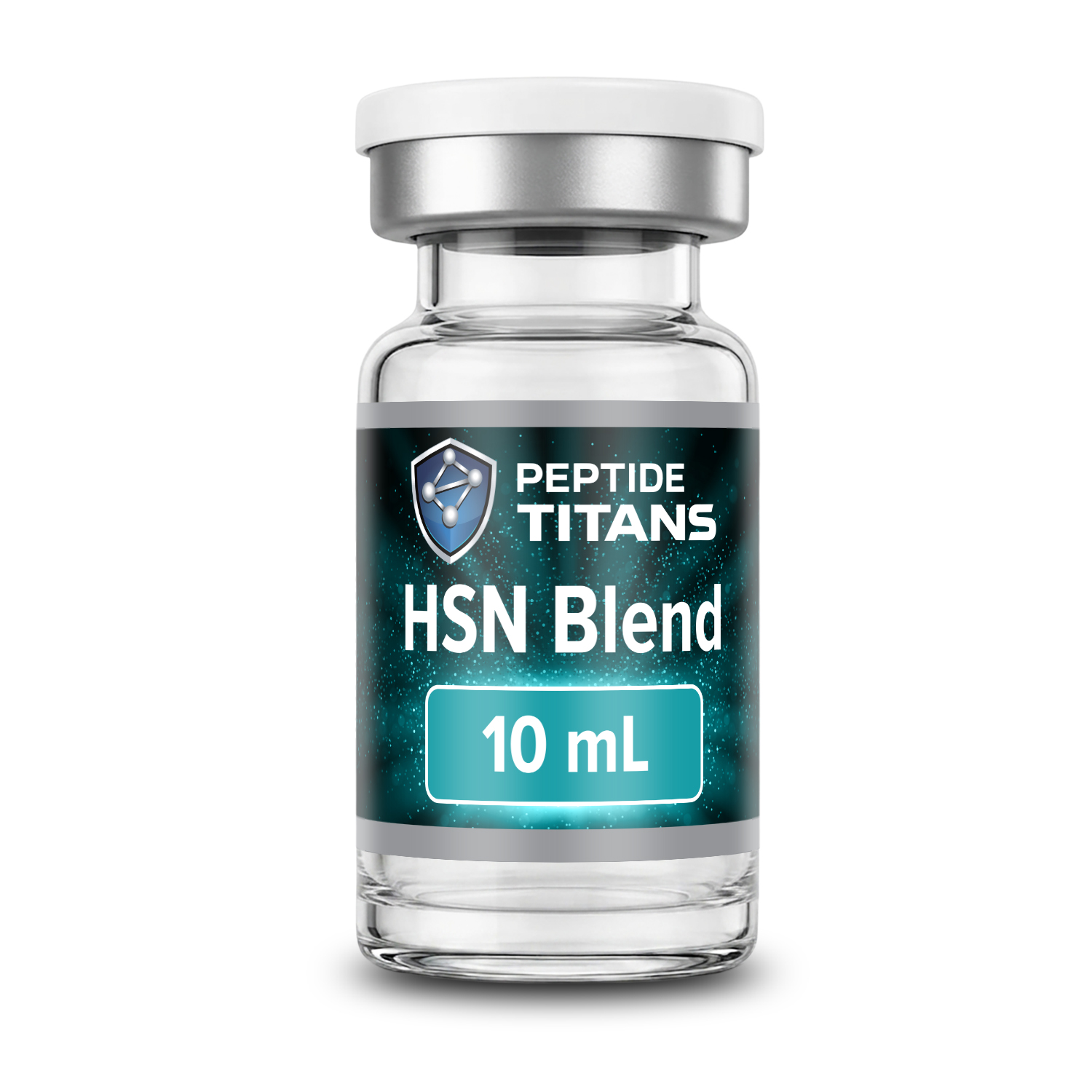
HSN Blend is a multi-component research solution supplying nine B-vitamins and related compounds in a single 10 mL vial. HSN stands for hair, skin, and nails, reflecting the research areas the constituents are most associated with. It is not a peptide and not a lyophilized powder — it ships as a ready-to-use liquid.
What does each vial contain?
Per millilitre, each vial supplies:
-
Niacinamide 50 mg, Thiamine HCl 50 mg, Pantothenic Acid 25 mg
-
Choline 10 mg, Inositol 10 mg
-
Niacin 5 mg, Biotin 5 mg
-
Folic Acid 100 mcg, Riboflavin 100 mcg
That is 155.2 mg/mL of total content, or approximately 1,552 mg across the full 10 mL vial.
What is this blend commonly researched for?
Research on formulations of this type centres on keratin synthesis and follicular biology, skin barrier and ceramide production, coenzyme-dependent energy metabolism, and one-carbon methylation and lipotropic pathways.
Why combine these particular vitamins?
The constituents cluster into complementary groups rather than acting on a single pathway. Biotin, niacinamide, and pantothenic acid relate most directly to keratin and barrier biology; thiamine, riboflavin, and niacin are precursors to the central metabolic cofactors TPP, FAD, and NAD+; and folic acid, choline, and inositol supply methyl donors and lipotropic factors. Supplying them at fixed concentrations allows the combination to be studied under controlled conditions.
Is this a peptide?
No. This is a multi-component vitamin blend, not a peptide. Its constituents are individual small molecules, so the formulation has no single CAS number, molecular formula, molecular weight, or amino acid sequence. Analytical characterisation is performed per component.
Does HSN Blend need to be reconstituted?
No. Unlike the lyophilized peptide products in this catalogue, HSN Blend is supplied as a ready-to-use aqueous solution at the stated concentrations. No bacteriostatic water or other diluent is required, and no reconstitution step is involved.
How is HSN Blend supplied?
The blend is supplied as a clear yellow to amber solution in a sealed 10 mL vial. The yellow colour derives from the riboflavin fraction and is expected rather than a sign of degradation.
How should HSN Blend be stored?
Store refrigerated at 2°C to 8°C, protected from light, and do not freeze. Retain the vial in its outer carton until use, return it to refrigeration promptly after each withdrawal, and inspect it visually before every use. Discard the vial if discoloration, cloudiness, or particulates appear.
Does this blend require a Certificate of Analysis (COA)?
Yes. Each production lot is analysed by an independent third-party laboratory to verify the identity, concentration, and purity of the constituents. A lot-specific COA is generated for every batch and is available for the exact lot supplied.
Is HSN Blend FDA-approved?
No. This blend is not approved by the FDA or any comparable regulatory authority for human or veterinary use. It is sold strictly for research and educational purposes and is not intended to diagnose, treat, cure, or prevent any disease.
This product is not for human consumption. It is sold strictly for research and educational purposes and is not intended to diagnose, treat, cure, or prevent any disease.
Any clinical data or research information referenced on this page is derived from peer-reviewed scientific literature and official publications. This information is provided for educational reference only and does not constitute medical advice or product claims.
By purchasing this product, you acknowledge that you are a qualified researcher and agree to use it in full compliance with all applicable laws and regulations.