
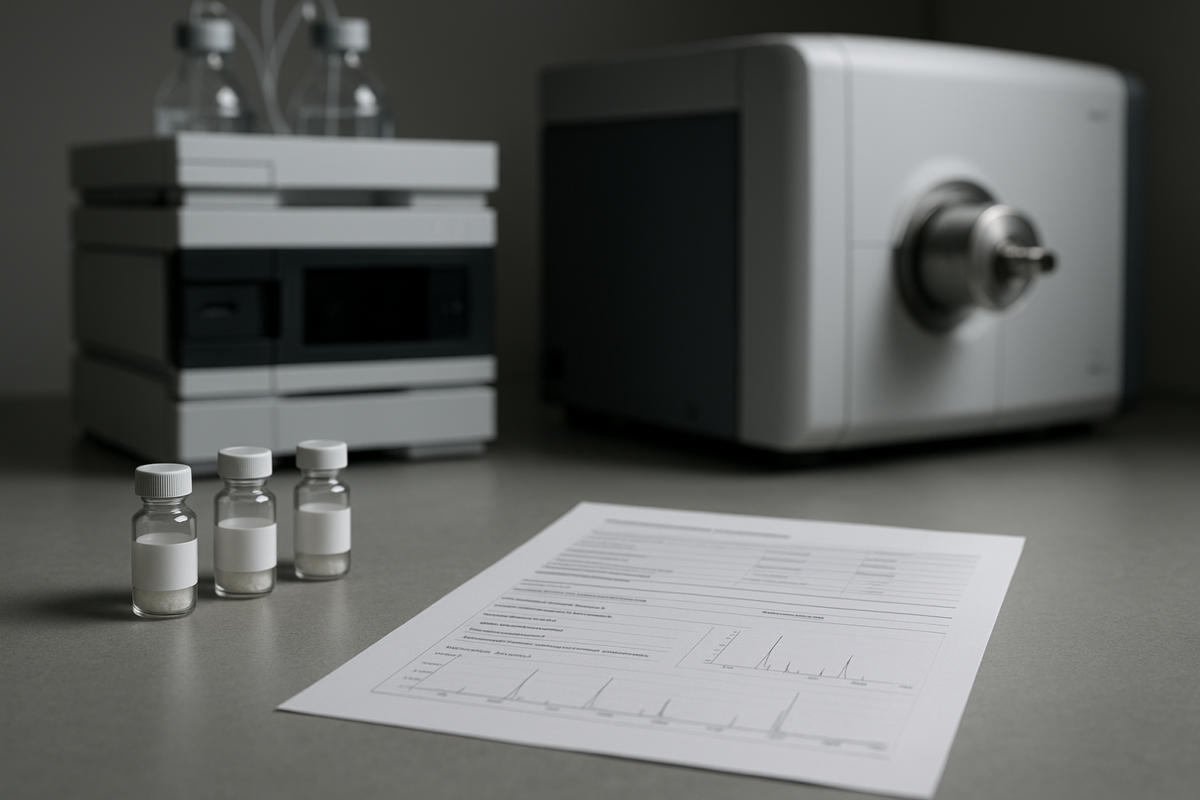
Peptide COA interpretation is essential for laboratory researchers who require reproducible, well-characterized materials. Recent industry reporting has highlighted a widening verification gap in the research peptide supply chain: vendors may publish high chromatographic purity numbers while certificates of analysis (COAs) lack full peptide content detail or clear lot linkage. For laboratory researchers, clear COA interpretation and lot traceability are essential for reproducible in vitro studies and rigorous materials characterization. This guide explains analytical limitations of HPLC percentages, complementary tests and documentation to request, and a practical checklist labs can use when assessing COA trustworthiness.
Peptide COA interpretation: Why a single HPLC purity percentage can be misleading
Reverse-phase HPLC (RP‑HPLC) is widely used to report a purity percentage on peptide COAs. RP‑HPLC is useful for tracking related-substance profiles and degradation, but published literature and compendial guidance caution that an HPLC % alone does not fully define peptide content or identity.
Key limitations to keep in mind:
- Co-elution: structurally related impurities (truncated sequences, isobaric variants, deamidation products) can co-elute with the target peak and be counted within the reported area-percent.
- Counter-ions and non-peptide mass: HPLC chromatograms typically report chromatographic purity but do not account for mass contributions from counter-ions, water content, residual solvents, or inorganic residues—factors that affect mass-balance assignment of peptide content.
- Identity ambiguity: an HPLC peak shape and retention time alone do not confirm sequence identity or distinguish isobaric sequence variants.
Regulatory and standards-focused reviews recommend using validated, orthogonal methods and a mass-balance approach rather than relying solely on chromatographic % values for content assignment (see Research Sources below, including USP and regulatory reviews).
How mass spectrometry and orthogonal tests complement HPLC
Mass spectrometry (MS), especially high-resolution LC‑MS or LC‑HRMS, provides orthogonal information that addresses many chromatographic limitations:
- Identity confirmation: MS can confirm nominal mass and, with MS/MS or peptide mapping, provide sequence-level evidence to detect misincorporations or post-synthetic modifications.
- Impurity detection: LC‑HRMS methods detect low‑level, structurally related impurities (sub‑percent levels) that may be hidden under HPLC peaks.
- Calibration hierarchy: MS coupled with chromatographic separation supports a calibration‑hierarchy and impurity mass-fraction assignment that feed into a mass-balance calculation for assigned content.
Published analytical studies demonstrate that LC‑HRMS can materially change the assigned purity/content compared with a simple chromatographic percent when many low-level impurities are present (see linked studies in Research Sources).
Other complementary analyses to request
Complete peptide characterization requires quantitative data beyond HPLC and MS. Documents and tests to look for include:
- Water content (Karl Fischer) and counter‑ion quantitation (e.g., trifluoroacetic acid, acetate) to support mass-balance calculations.
- Residual solvent analysis and inorganic residue testing (e.g., ICP) where relevant.
- Amino‑acid analysis (AAA) or quantitative NMR (qNMR) used as orthogonal mass‑based assays.
- Endotoxin testing and microbial limits when relevant to in vitro biological studies.
- Stability and forced‑degradation data that show the assay is stability‑indicating and document degradant profiles across storage conditions.
Documentation and traceability: what a trustworthy COA should show
Beyond analytical data, COA trustworthiness relies on explicit linkage between the reported tests and the specific lot or vial supplied. Labs should verify the COA contains:
- Lot number and, where possible, vial or container identifiers that match the shipment.
- Test dates, analyst signature or electronic approval, and method references (including method validation summaries or links to validation reports).
- Statements about whether MS spectra, chromatograms, or other identity data were generated for that specific lot (“lot‑matched” testing).
- Accredited lab identifiers or third‑party testing reports when an independent analysis was performed; chain‑of‑custody or sample‑retention statements are valuable for dispute resolution.
- Acceptance criteria and specification limits (e.g., related‑substance limits, residual solvent limits) with clear pass/fail statements.
Recent industry communications have highlighted suppliers expanding third‑party verification and publishing lot‑matched testing to address earlier gaps in traceability; researchers should interpret these as signals to request clear documentation rather than as implicit product claims.
Stepwise checklist for evaluating a peptide COA (research lab use)
- Confirm lot identifiers: Ensure the COA lot number, vial ID, and shipment labels match.
- Locate orthogonal identity data: Look for LC‑MS/MS spectra, HRMS data, peptide mapping, or NMR that are explicitly tied to the same lot.
- Assess mass‑balance components: Verify presence of counter‑ion quantitation, water content, residual solvents, and any inorganic residues used to assign peptide content.
- Check method validation: Request validation summaries or references showing specificity, accuracy, precision, range, LLOQ/ULOQ, and stability‑indicating capability for key assays.
- Review third‑party or accreditation statements: Prefer COAs with accredited-lab data, third‑party verification, or chain‑of‑custody documentation for critical materials.
- Confirm sample retention: Ask whether retained samples, raw data, or chromatograms are available for independent review if questions arise.
- Document everything: Archive COAs, raw data PDFs, and communications in your lab’s materials record for reproducibility and audit support. For internal resources and archived COAs see the Peptide Titans lab results and research library.
Practical limitations and realistic expectations
Comprehensive analytical characterization requires resources and time. Not all vendors will provide the full suite of orthogonal assays for every product or lot. When full mass‑balance data are not available, record the analytical scope reported on the COA, request additional lot‑matched tests for critical studies, or consider independent third‑party analysis for key reagents. For vendor- or product-level context see industry reports and third‑party verification announcements linked in Research Sources.
Sources and further reading
Selected resources on analytical best practices and recent industry reporting are listed below. These references provide technical detail on mass‑balance approaches, method validation, and LC‑HRMS capabilities:
- USP-led article on peptide reference standards and mass-balance strategies (PMC)
- Review on regulatory and validation expectations for peptide analysis (PMC)
- LC‑HRMS study identifying peptide impurities (PubMed)
- Analytical perspectives on peptide characterization (PMC)
- COA overview and common gaps (PeptideInfo)
- Industry reporting on verification gaps and moves toward third‑party testing (Yahoo Finance)
- Supplier verification via third‑party labs (Des Moines Register)
Closing note for laboratory researchers
For reproducible laboratory research, treat a COA as a technical dossier: interpret HPLC purity alongside orthogonal identity data, mass‑balance components, and explicit lot traceability. When in doubt, request lot‑matched MS spectra, method validation details, and evidence of third‑party or accredited testing. Clear documentation and conservative material characterization practices support robust, reproducible in vitro work. For related materials and catalog context, see the Peptide Titans research-use peptide catalog.
Related Peptide Titans Resources
Research Sources
Primary references and source materials used for this research-focused overview:
- pmc.ncbi.nlm.nih.gov/articles/PMC10338602
- pmc.ncbi.nlm.nih.gov/articles/PMC11806371
- pubmed.ncbi.nlm.nih.gov/29862433
- pmc.ncbi.nlm.nih.gov/articles/PMC4406950
- peptideinfo.ca/peptide-certificate-of-analysis-coa
- finance.yahoo.com/kylo-peptides-publishes-report-verification
- desmoinesregister.com/synthesis-peptides-verifies-40-plus-compounds
Frequently Asked Questions
Q: What does “lot‑matched” COA mean and why does it matter?
A lot‑matched COA indicates that the analytical data (HPLC chromatogram, MS spectra, etc.) were generated on the same production lot and, ideally, the same vial or batch that is being supplied. Lot matching supports traceability and reduces the risk that COA data reflect a different production run with different impurity or stability profiles.
Q: If a COA lists 99% HPLC purity, is additional testing necessary?
An HPLC purity value is informative but not definitive. For materials used in critical experiments, laboratories should seek orthogonal identity evidence (MS/MS, HRMS, peptide mapping) and mass‑balance components (counter‑ion, water, residual solvents) to understand true peptide content and related substances.
Q: Are third‑party or accredited lab reports required for research use?
Third‑party or accredited lab reports increase confidence in COA data because they provide independent verification and established quality systems. For high‑impact or regulated studies, independent verification can be appropriate; for routine screening, thorough vendor documentation and lot‑matched orthogonal data may suffice.
Q: What should I do if the COA lacks method validation details?
Request method validation summaries that demonstrate specificity, accuracy, precision and range. If these are unavailable and the material is critical to your research, consider requesting additional testing or performing an independent characterization.