
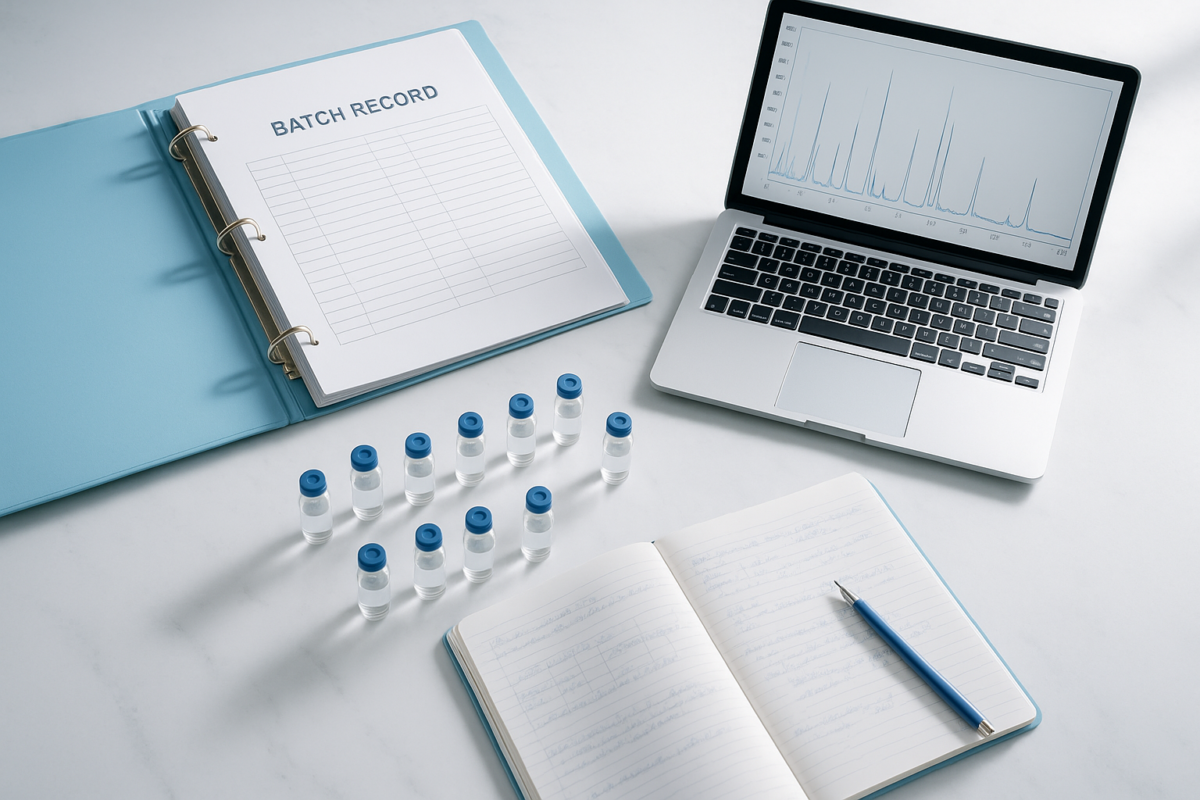
Well-organized documentation is a cornerstone of reproducible laboratory research and regulatory-ready manufacturing. This article outlines practical practices to organize research product documentation, with an emphasis on batch records, quality control traceability, and data-management approaches that support laboratory testing and auditability.
Why organize research product documentation?
Researchers and laboratory managers maintain product-related records to enable traceability, demonstrate control over processes, and support reconstruction of study activities. Clear documentation reduces ambiguity during internal reviews and external audits and supports links between analytical results, batch records, and specifications.
Core principles to guide documentation
International and regulatory guidance emphasize a number of foundational principles for records. The FDA frames data integrity around ALCOA attributes: Attributable, Legible, Contemporaneous, Original, and Accurate. These principles should inform how teams capture and store raw data, batch records, and quality-control logs to ensure records remain trustworthy and reconstructible over time.
ALCOA and data governance
Apply ALCOA when drafting SOPs and templates: record who made an entry, when it was made, and include sufficient context to understand why. Implement access controls and version management to prevent overwrites and to maintain original raw data files alongside processed outputs.
GMP and documentation scope
Good Manufacturing Practice (GMP) frameworks describe essential document types that support product control. Typical document categories include master formulas, batch processing and packaging records, standard operating procedures (SOPs), cleaning logs, and certificates of analysis (COAs). Traceability between these records and quality-control testing is a recurrent theme in regulatory literature.
Folder structure and file-naming conventions
A consistent folder structure and file-naming scheme make files findable and interpretable by current team members and future reviewers. Define templates at the project level before work begins, and document them in a README or documentation index.
Practical folder template
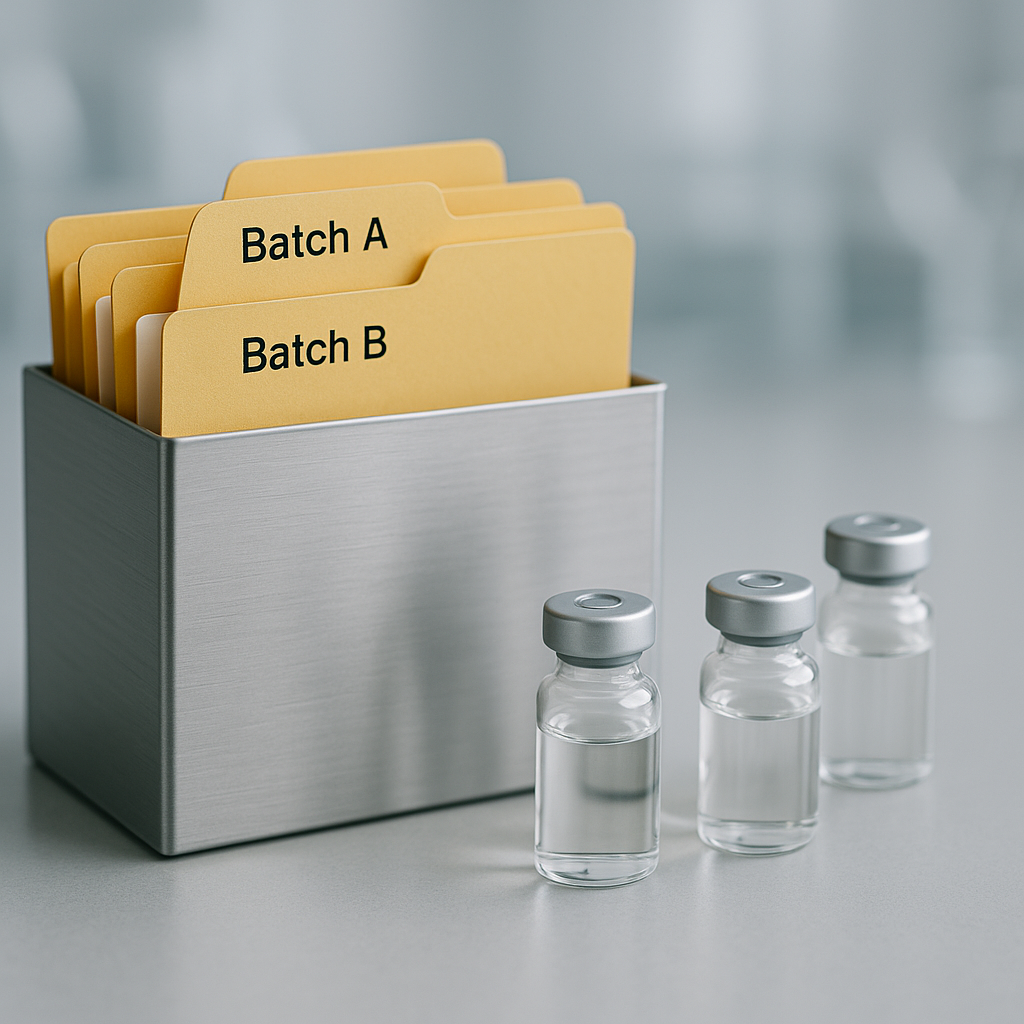
Organize top-level folders by project and then by functional area (e.g., batch_records, qc_results, raw_data, methods, SOPs, COAs, reports). Within batch_records, keep a dedicated folder per lot or batch with a consistent identifier that matches the COA and the laboratory sample identifiers used in analytical testing.
File naming recommendations
Include stable elements in filenames such as project ID, document type, date (YYYYMMDD), and version code (v01). Avoid obscure abbreviations and prefer descriptive names so files remain meaningful outside the immediate context of the laboratory.
Version control, provenance, and READMEs
Implement version control to capture the history of changes to methods, spreadsheets, and reports. For non-code files, clear version stamps and an archived “previous_versions” folder prevent accidental overwrites. README files and data dictionaries provide context about file purpose, variable definitions, and known limitations.
Document provenance
Provenance records should link raw outputs (e.g., instrument files, chromatograms) to derived datasets and to final reports. Keep instrument output files in their native format when possible and store processing steps or scripts alongside derived files so reviewers can reproduce analytical steps.
Quality-control and lab testing records
Quality-control documentation must connect analytical results to the product batch they support. Typical QC documents include instrument logs, calibration records, method validation summaries, in-process test records, and COAs. Ensure that each QC entry references the batch identifier and the analyst who performed the test.
COA and batch record linkage
Maintain explicit traceability between COAs and the corresponding batch records. A best practice is to include a COA reference in the batch-record master sheet and to store the COA PDF within the batch folder. This practice aids rapid review and supports reproducibility during investigations.
Data management planning and sharing
For funded projects or collaborative research, a Data Management and Sharing (DMS) plan clarifies what data will be shared, when, and where it will be stored. DMS plans should cover metadata standards, repository choices, access controls, retention periods, and ethical or legal constraints on data sharing.
FAIR principles and repositories
Adopt FAIR-aligned practices—Findable, Accessible, Interoperable, Reusable—by using descriptive metadata, persistent identifiers, and open formats for long-term preservation. Identify appropriate repositories up front and budget for stewardship where required by funders or institutional policy.
Backups, preservation, and the 3-2-1 rule
Preserve critical records by following a robust backup strategy, such as the 3-2-1 rule: keep three copies of important data, store them on two different media types, and retain one copy off-site. Prefer open, non-proprietary formats for long-term archiving and ensure retention policies align with regulatory and institutional requirements.
Operational recommendations for batch records
Batch records should be designed to reflect the process and to capture key parameters that are referenced by QC. Use checklists and standardized fields to reduce free-text variability, and include explicit sign-off fields for responsible personnel. Cross-reference SOPs and method validation documents so reviewers can quickly locate supporting procedures.
Limitations and considerations
Documentation practices must balance thoroughness and usability. Excessively complex templates can reduce compliance, while insufficient detail undermines auditability. Consider risk-based approaches to determine the level of record detail required for different products or experiments.
Why research-only language matters
This guidance focuses on documentation practices that support laboratory research, analytical testing, and quality management. It does not provide instructions for product use, dosing, clinical application, or claims about efficacy. Maintain research-only wording in records and reports to align with regulatory expectations and avoid implying clinical intent.
Further reading and guidance
For regulatory context and practical templates, refer to agency and institutional guidance on data integrity, GMP documentation, and data-management planning. The FDA’s data integrity guidance summarizes ALCOA principles; GMP literature outlines required document types; and university research data-management guides provide concrete folder and naming examples suitable for laboratory teams.
Combining clear folder architectures, consistent naming conventions, provenance tracking, and traceability between batch records and QC outputs will make it easier to reproduce results, respond to inquiries, and maintain research integrity.
Research Sources
Primary references and source materials used for this research-focused overview:
- https://www.fda.gov/media/165536/download
- https://pmc.ncbi.nlm.nih.gov/articles/PMC9891391/
- https://grants.nih.gov/policy-and-compliance/policy-topics/sharing-policies/dms/writing-dms-plan
- https://library.virginia.edu/sites/default/files/rds-docs/RDM-Fundamentals-2018.pdf
Frequently Asked Questions
What is the minimum information a batch record should contain?
A batch record should identify the batch, reference the master formula and applicable SOPs, record process steps and in-process checks, reference QC tests and COAs, and include sign-offs with dates and initials. Templates should be tailored to reflect process-critical parameters while maintaining traceability to analytical data.
How should instrument raw data be preserved?
Keep raw instrument files in native formats when feasible, alongside exported, non‑proprietary versions for long-term access. Store processing scripts or method logs with derived datasets and document the processing steps in a README so analytical work can be reconstructed.
When should I create a Data Management and Sharing (DMS) plan?
A DMS plan is appropriate at project initiation, particularly for funded research. The plan should describe what data will be shared, metadata standards, repositories, timing, and any restrictions on sharing due to ethical, legal, or proprietary constraints.
How do I link COAs to batch records effectively?
Include COA reference numbers in the batch-record header and store the COA document within the batch folder. Maintain a cross-reference table that links batch IDs, COA filenames, and sample identifiers used during testing to facilitate rapid verification.