

In laboratory research and regulated testing, documentation and sample management are integral to producing auditable data. This article explains why the chain of custody matters in testing, and how elements such as lot numbers, traceability systems, and batch records contribute to analytical integrity and reproducibility in research contexts.
What is chain of custody in a testing context?
Chain of custody is a chronological record that documents who handled a sample, when transfers occurred, and under what conditions the sample was stored and analyzed. It creates an auditable trail from collection through final disposition, linking the physical sample to analytical results and associated documentation.
Core components of an effective custody trail
Unique identifiers and lot numbers
Unique identifiers — including lot numbers and sample IDs — provide unequivocal linkage between a sample and its source material or production batch. Lot numbers are critical when traceability to a manufacturing batch or production run is required, and they allow analysts to cross-reference analytical findings with batch records and manufacturing data.
Transfer records and signatures
Every handoff or transfer should be documented with date/time, personnel identity, reason for transfer, and condition on receipt. Witness signatures or electronic audit logs reduce ambiguity and help investigators or auditors reconstruct events if integrity is questioned.
Storage and handling condition logs
Documenting storage conditions (temperature, humidity, freeze–thaw events) and packaging integrity is essential for interpreting analytical data. Records that capture environmental conditions and deviations support decisions about sample acceptance or rejection during quality review.
How traceability and batch records intersect with custody
Traceability is the ability to follow a product, sample, or dataset backward and forward through production, testing, and distribution. Batch records contain production details for a specific lot or batch and are a primary reference when linking analytical test results to manufacturing history.
When analysts can link a test result to a lot number and corresponding batch records, reviewers can evaluate whether observed data relate to documented production variables, raw material sources, or procedural deviations. This linkage underpins reproducibility and regulatory review.
Systems and tools that support custody and traceability
Laboratory Information Management Systems (LIMS)
Electronic systems such as LIMS provide audit trails, timestamped events, user authentication, and linkage between samples and metadata (including lot numbers and batch records). Consensus recommendations in the literature encourage LIMS adoption to maintain custody traces across a specimen’s lifespan (sample management consensus).
Tamper-evident packaging and physical controls
Tamper-evident seals, secure storage, controlled access, and minimizing unnecessary transfers all reduce opportunities for contamination or misplacement. Physical controls complement documentation and are commonly recommended in regulatory guidance.
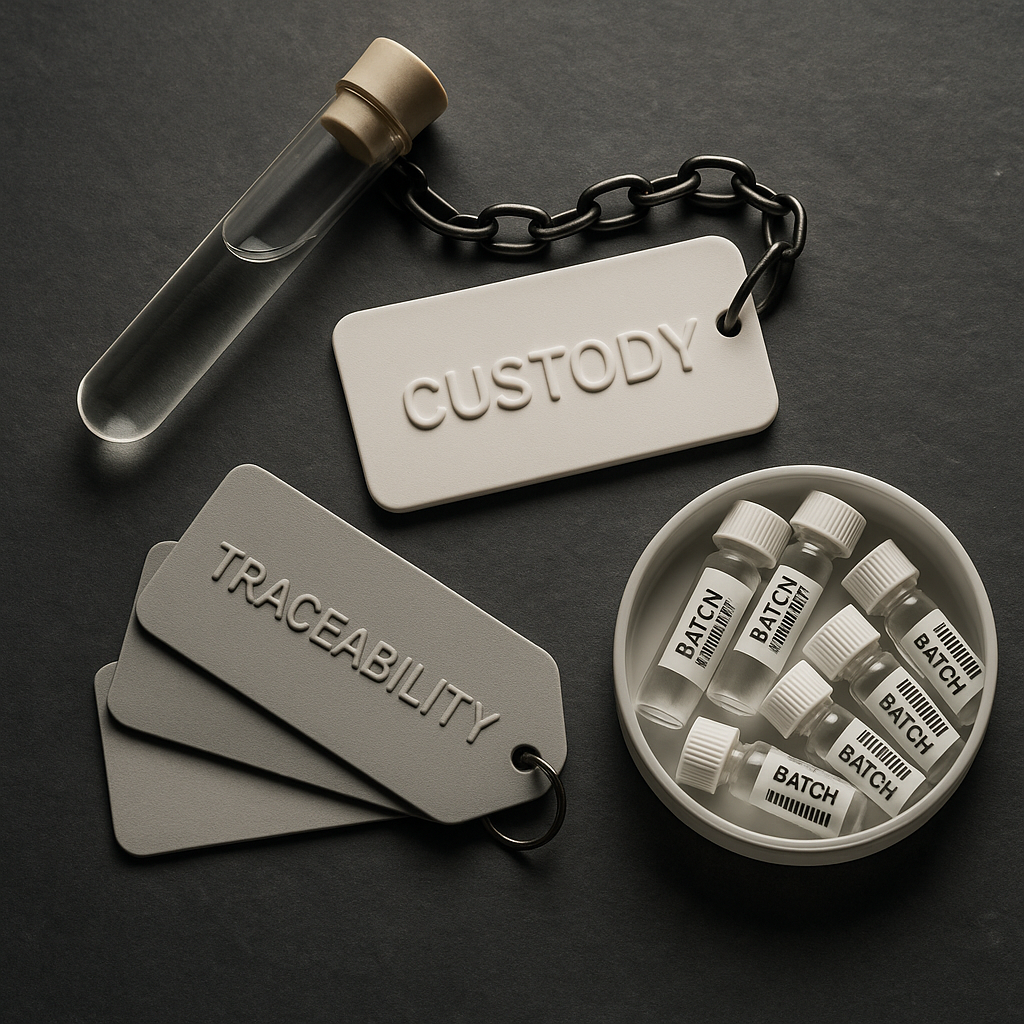
Why chain-of-custody documentation matters to laboratories and regulators
Regulatory agencies and auditors rely on uninterrupted custody records to accept analytical data. The U.S. Food and Drug Administration and other authorities emphasize that sampling, labeling, and transfer records must preserve traceability to a specific lot or batch for regulatory analyses (FDA sampling guidance).
Breaks or gaps in custody documentation can undermine the interpretability of results, complicate investigations into contamination or deviation, and reduce the evidentiary value of samples in compliance or legal settings (forensic chain-of-custody review).
Operational practices: planning, acceptance criteria, and disposition
Best practice guidance recommends that sample management be described in study protocols and lab manuals, including acceptance and rejection criteria for compromised specimens. Clear disposition records (retention, archival, or disposal) complete the custody trail and support future reproducibility or audits (clinical/forensic reference).
Documentation of end-of-study actions and linkage to batch records ensures that downstream reviewers can verify how long materials were retained and under what conditions.
Limitations and practical challenges
Maintaining a rigorous chain of custody can be resource-intensive. New evidence types (digital files, networked instruments) introduce additional traceability challenges and require adapted procedures. Small laboratories may face barriers in implementing advanced LIMS or standardized packaging, and human error in documentation remains a common vulnerability.
Research teams should plan custody procedures early in study design, define roles, and train personnel to reduce transfers and documentation errors. Where complete custody cannot be guaranteed, explicit recordation of deviations and rationale supports transparent interpretation of data.
Why research-only language and traceability matter
In research and analytical communications, careful language avoids implying product performance or clinical efficacy. Emphasizing traceability, lot number linkage, and robust batch records focuses the discussion on data integrity, auditability, and reproducibility—criteria that are essential irrespective of downstream application.
Maintaining clear custody records is a foundational component of laboratory quality systems and supports the scientific and regulatory acceptability of analytical outcomes.
Research Sources
Primary references and source materials used for this research-focused overview:
- https://pmc.ncbi.nlm.nih.gov/articles/PMC10000967/
- https://www.fda.gov/media/73540/download
- https://www.ncbi.nlm.nih.gov/books/NBK551677/
- https://pmc.ncbi.nlm.nih.gov/articles/PMC4779093/
Frequently Asked Questions
1. What does a chain-of-custody record typically include?
A chain-of-custody record typically lists unique sample identifiers (and lot numbers where relevant), dates and times of transfers, names or IDs of personnel involved, storage and transport conditions, reasons for transfers, and signatures or electronic audit entries documenting each step.
2. How do lot numbers relate to batch records in traceability?
Lot numbers uniquely identify a production batch and allow analysts to cross-reference test results with batch manufacturing details recorded in batch records. This linkage supports investigations into production variables, raw materials, or deviations that may affect analytical outcomes.
3. What role does LIMS play in preserving custody?
LIMS provide timestamped audit trails, user authentication, and data linkage between samples and metadata such as lot numbers and storage logs. Electronic systems reduce manual transcription errors and improve traceability across a specimen’s lifecycle.
4. What should a laboratory do if custody documentation is incomplete?
If documentation gaps occur, laboratories should record the discrepancy, describe attempted corrective actions, and apply predefined acceptance/rejection criteria. Transparent recordation helps downstream reviewers assess the reliability of affected data.
5. Are tamper-evident measures necessary for routine research samples?
Tamper-evident packaging and controlled access are widely recommended as part of good laboratory practice because they provide physical assurance that a sample’s condition was not altered between transfers, supporting the auditability of results.