
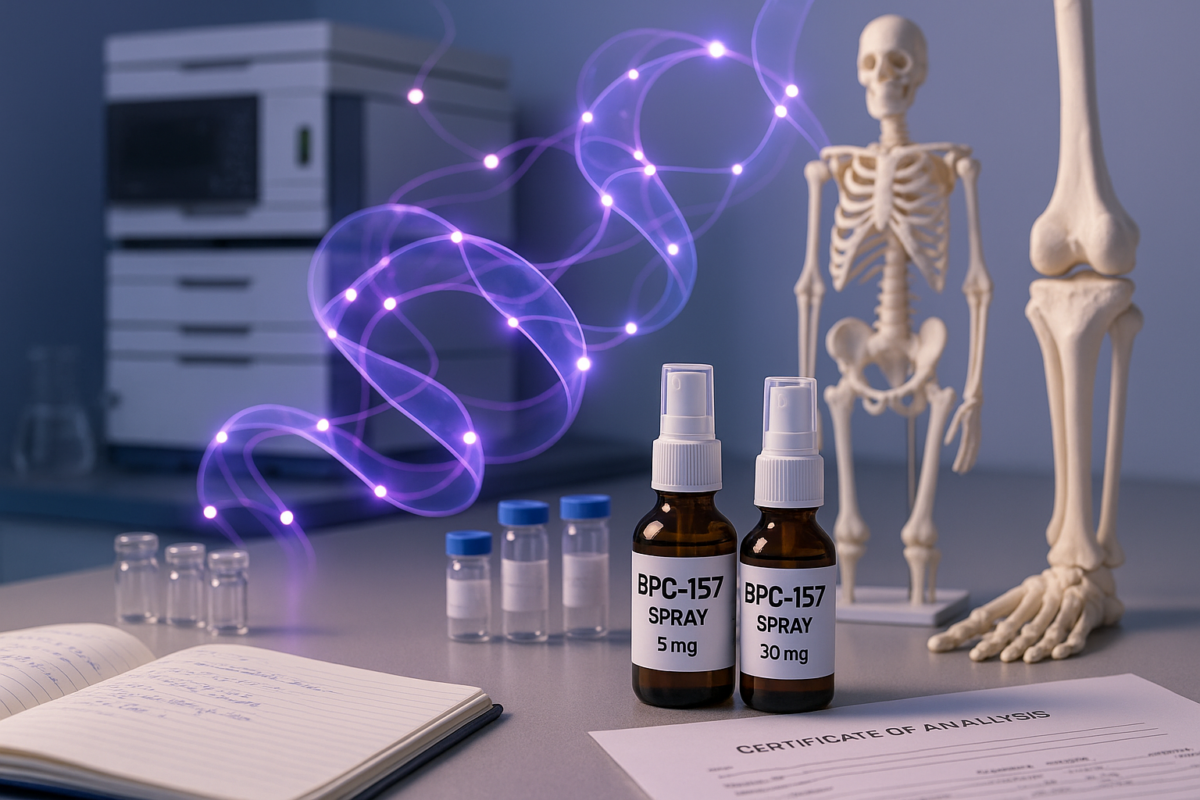
Peptide Titans presents an evidence-focused primer on BPC-157 with an emphasis on published literature, mechanistic themes, and research-only terminology. This article addresses how BPC-157 appears in laboratory research and places the spray format in product‑format context only (spray formats appear in some third-party retail listings). The content below is intended for educational and laboratory-research audiences and does not provide clinical guidance or use instructions.
What is BPC-157?
BPC-157 is a pentadecapeptide first identified from gastric juice. In the scientific literature it is typically described by its amino‑acid sequence and as a synthetic peptide modeled on a naturally occurring gastric protein fragment. Researchers have studied BPC-157 in vitro (cell culture) and in vivo (animal) settings to explore cellular responses and system-level effects in a laboratory context.
How BPC-157 appears in the published literature
Published literature on BPC-157 is dominated by preclinical studies. Narrative and systematic reviews synthesize results from cell-based assays and multiple animal models while noting the relative scarcity of well-controlled human clinical trials (see sources below). Reviews commonly highlight methodological variation across studies and discuss the need for standardized manufacturing and third‑party testing when translating experimental protocols into regulated research pipelines (PMCID: PMC12446177, PubMed: 40756949).
Major study areas and model types
1. Musculoskeletal models
Researchers have examined BPC-157 in rodent models of tendon, ligament, muscle, and bone. Experimental endpoints reported across studies include histological assessments, biomechanical testing, and structural organization metrics. Systematic reviews emphasize that much of this evidence arises from a limited number of research groups and predominantly from animal models (PubMed: 30915550).
2. Gastrointestinal and mucosal models
Because the peptide was initially identified in gastric tissue, investigators have studied mucosal protection and gastrointestinal models in vitro and in animals. These studies often focus on epithelial integrity, ulcer models, and related laboratory endpoints (see comprehensive reviews for details) (PMCID: PMC11859134).
3. Cardiovascular, nervous-system, and multi-organ experiments
Preclinical work has extended into cardiovascular, nervous-system, and broad toxicology experiments. Reviews collate data on organ‑level findings and on laboratory safety endpoints, while highlighting the predominance of preclinical methods in these research areas (PMCID: PMC12195719).
Mechanisms and pathways investigators investigate
Published studies and narrative reviews identify several recurrent mechanistic themes that researchers have investigated in laboratory settings:
- Modulation of angiogenesis and vascular signaling (including VEGFR2‑related pathways).
- Interactions with the nitric‑oxide (NO) system and downstream Akt–eNOS signaling nodes.
- Engagement of intracellular cascades such as ERK1/2 and gene-expression changes linked to growth and repair processes.
- Effects on fibroblast activity, collagen organization, and endothelial behavior in cell and tissue models.
These mechanistic observations come primarily from animal and cell studies and are reported as laboratory findings rather than clinical outcomes (PMCID: PMC12446177, PMCID: PMC11859134).
Key terms readers may see in BPC-157 literature
- Preclinical model: descriptive of animal or in vitro research rather than human clinical trials.
- Histological endpoints: tissue‑level microscopy outcomes commonly reported in soft‑tissue studies.
- Biomechanical testing: mechanical property measurements used in tendon and ligament research.
- Angiogenesis: laboratory assessments of new blood‑vessel formation or vascular signaling.
- Toxicology endpoints: preclinical safety metrics reported in controlled laboratory experiments.
Limitations of the research
Authors of several recent reviews emphasize consistent themes in limitations: the literature is largely preclinical, a relatively small number of research groups account for a substantial portion of studies, and there is heterogeneity in experimental design and reporting. Reviews call for standardized methodologies, independent replication, and regulatory‑grade quality control (including third‑party testing and certificate‑of‑analysis documentation) before laboratory findings are extrapolated beyond research contexts (PMCID: PMC12195719, PubMed: 40756949).
Why research‑only language matters
Using research‑only terminology helps maintain a clear boundary between laboratory evidence and clinical application. Statements confined to “research use,” “published literature,” and “preclinical models” accurately reflect the current evidence base and reduce the risk of implying clinical efficacy or safety. Reviews of BPC-157 explicitly recommend caution in interpretation and stress the need for clinical trials and manufacturing standardization before translational or clinical statements can be supported.
Practical notes for laboratory researchers
Researchers planning literature reviews or experimental work should consult peer‑reviewed sources, verify peptide identity and purity through appropriate analytical testing, and document quality-control data such as certificates of analysis. When referencing product formats in background or materials sections, state the form only as context (for example, noting that some commercial sources list spray presentations such as 5 mg and 30 mg) without addressing administration, dosing, or human use.
For further reading and source material, see the external review articles and systematic reviews cited below.
Research-use product reference: BPC-157 is listed at Peptide Titans for laboratory research use only. Products are not for human consumption.
What the published record says about delivery route
Because this article is indexed under a spray format, the route question deserves a direct answer from the record rather than an assumption.
A PubMed search on 20 August 2026 returns 226 indexed records for BPC-157. Of those, 18 mention oral administration and just one mentions intranasal. The delivery-route question the literature actually engages with for this peptide is oral versus injection — not nasal.
That question is covered in detail, including what the frequently cited absorption figure actually measured, in BPC-157 oral vs injection.
For calibration: Semax, a peptide with a genuine intranasal research history, returns 39 records mentioning intranasal administration. BPC-157 returns one.
What Peptide Titans supplies: BPC-157 is stocked as lyophilized powder in a vial, for laboratory research use only. Counts retrieved from the PubMed E-utilities API on 20 August 2026.
Research Sources
Primary references and source materials used for this research-focused overview:
- https://pmc.ncbi.nlm.nih.gov/articles/PMC12446177/
- https://pmc.ncbi.nlm.nih.gov/articles/PMC11859134/
- https://pmc.ncbi.nlm.nih.gov/articles/PMC12195719/
- https://pubmed.ncbi.nlm.nih.gov/40756949/
- https://pubmed.ncbi.nlm.nih.gov/30915550/
Frequently Asked Questions
What is BPC-157?
BPC-157 is a laboratory-researched pentadecapeptide originally identified from gastric tissue. The scientific literature describes its amino‑acid sequence and reports findings from cell and animal experiments.
Are there human clinical trials for BPC-157?
Published reviews indicate the literature is dominated by preclinical studies; human clinical evidence is limited and reviewers call for rigorously controlled clinical trials and standardized product testing.
What kinds of models do researchers use?
Researchers commonly use in vitro cell systems and a variety of animal models, including rodent models for musculoskeletal, gastrointestinal, cardiovascular, and nervous‑system experiments. Study endpoints often include histology, biomechanical testing, and molecular signaling assays.
Does the spray format change how researchers report results?
In academic reporting, the physical product format (capsule, spray, vial) is noted only as material context. Experimental methods sections focus on experimental design, analytical verification, and quality‑control data rather than commercial presentation.
Where can I find primary literature on BPC-157?
Key reviews and systematic analyses are available via PubMed and PMC; the external links in this article provide starting points for peer‑reviewed summaries and bibliographies.