
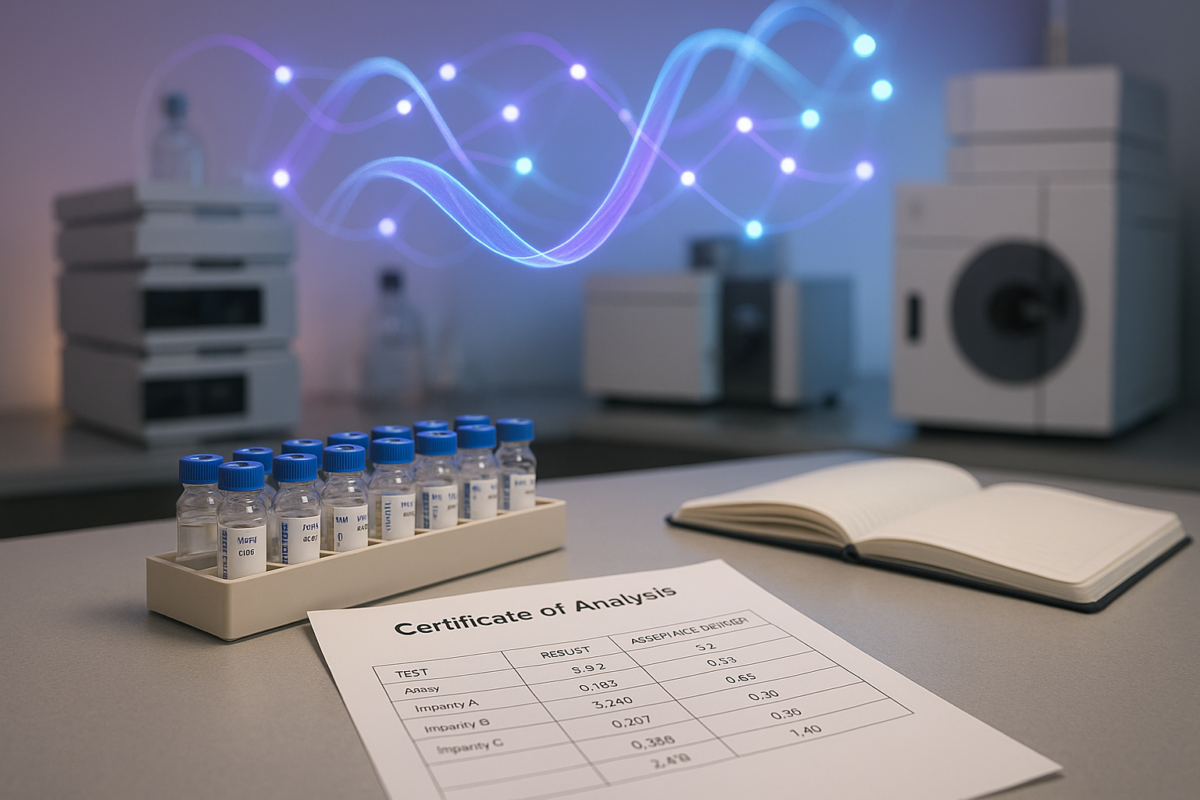
Certificates of Analysis (COAs) are central documents in laboratory research, quality control, and material traceability. This article explains what makes a coa easy to verify for research organizations and laboratory scientists, summarizing COA components and verification cues that support evaluation, reproducibility, and traceability. For related resources, see the Peptide Titans homepage (peptidetitans.com).
Why verification matters in a research setting
Verification of a COA supports transparency and reproducibility in laboratory research. Readable and well-documented COAs let researchers assess whether reported tests and methods are appropriate for their experimental context, whether values are traceable to recognized standards, and whether the reported data include sufficient metadata to support independent review.
What makes a coa easy to verify: core elements
COAs vary by laboratory and material type, but several elements commonly appear in guidance from regulatory and standards bodies. Including these elements on a COA improves the ease of independent verification.
1. Clear product and batch identifiers
A COA should identify the product name, grade, and a unique batch or lot number. Batch-level identifiers enable traceability through distribution records and permit matching of the COA to a specific physical sample or aliquot. Regulatory guidance highlights the importance of batch/lot identifiers for tracing production and distribution history (FDA Q7A guidance).
2. Tests performed, numerical results, and acceptance criteria
Listing each test performed together with numerical results, units, and acceptance criteria allows third parties to determine whether results are within expected bounds. Where applicable, reporting limits and units promotes consistent interpretation across laboratories. COAs that omit acceptance criteria or report only pass/fail statements reduce transparency.
3. Method references and validation status
COAs that reference the analytical methods used — and indicate whether those methods are compendial, validated, or otherwise verified — make verification substantially easier. Validation attributes such as accuracy, precision, limits of detection/quantitation, and linearity provide context for interpreting reported values. Guidance on analytical method validation outlines attributes laboratories should document to support confidence in results (FDA Q2(R1)).
4. Laboratory accreditation and contact information
Providing laboratory accreditation status (for example, ISO/IEC 17025) and contact details helps researchers follow up with questions and verify laboratory credentials. Accreditation statements and easily accessible contact points enable direct verification when needed.
5. Traceability and reference materials
Statements of traceability to recognized reference materials or standards strengthen a COA’s credibility. COAs for reference materials commonly include assigned values, associated measurement uncertainty, and traceability statements that laboratories can use to assess method suitability for calibration or quality checks. Compendial expectations and reference-material reporting examples are discussed in USP and published literature (USP compendial reference, PMC article on reference materials).
6. Measurement uncertainty and system suitability
Including measurement uncertainty and system suitability or quality-control outcomes aids interpretation. Reporting uncertainty (or indicating how to interpret control-chart data) helps researchers understand the confidence around a reported value and whether small differences are analytically meaningful.
7. Dates, signatures, and revision history
Release or test dates, authorized signatures, and a clear revision or version history enable reviewers to confirm which COA corresponds to a material’s release. Noting retest or expiry dates where relevant also supports appropriate material handling in laboratory workflows.
8. Metadata, electronic verification, and original-source linkage
Modern COAs may include metadata, embedded document identifiers, or machine-readable links that reference the originating laboratory’s database or the original manufacturer’s batch certificate. QR codes or secure hyperlinks that resolve to an immutable source or archival record can simplify verification while reducing the risk of document tampering.
Practical verification steps for researchers
When assessing a COA in a research context, consider the following steps: confirm the batch/lot number matches the physical material; review methods and validation statements; check for laboratory accreditation; evaluate measurement uncertainty and acceptance criteria; and, where necessary, contact the issuing laboratory for raw data, chromatograms, or system-suitability records. For lab-specific reports and example COAs, see Peptide Titans lab results documentation (Peptide Titans lab results).
Common limitations and red flags
Even with a COA in hand, researchers should remain aware of limitations. COAs can be incomplete, lack method details, or omit uncertainty estimates. Red flags include missing batch identifiers, vague method descriptions (e.g., “internal method” without further detail), absent laboratory credentials, or inconsistent dates. In some cases, repackers or resellers may provide derivative COAs that reference an original manufacturer; documentation linking to the original manufacturer and original COA is important for full verification.
Standards and guidance to consult
Several authoritative resources describe expectations relevant to COA content and analytical-method validation. Useful public guidance and standards include:
- FDA Q7A — Good Manufacturing Practice Guidance for Active Pharmaceutical Ingredients
- FDA Q2(R1) — Validation of Analytical Procedures
- Published discussion on reference materials and uncertainty (PMC)
- USP compendial guidance on reference materials and reporting
These resources provide regulatory and standards context relevant to COA content, method validation, and traceability expectations.
Summary
COAs that are easy to verify typically include clear batch identifiers, detailed test results with units and acceptance criteria, references to validated or compendial methods, accreditation and contact information, traceability statements, and measurement uncertainty or system-suitability data. Combining these elements improves transparency and supports reproducible laboratory research.
For further reading and primary guidance, consult the Research Sources section below.
Research Sources
- FDA Q7A — Good Manufacturing Practice Guidance for Active Pharmaceutical Ingredients
- FDA Q2(R1) — Validation of Analytical Procedures
- PMC article — discussion of reference materials and uncertainty
- USP compendial reference on reference materials and reporting
Frequently Asked Questions
What should I check first on a COA?
Begin by confirming the product name and batch/lot number match the physical material. Then review the tests listed, numerical results with units, and any acceptance criteria or method references.
How important is method validation information on a COA?
Method validation or verification data provide essential context for reported results. Information about accuracy, precision, detection limits, and linearity helps determine whether the method is fit for the intended analytical purpose.
Can a COA be independently verified online?
Some laboratories and manufacturers provide secure, machine-readable links or archived COAs that facilitate online verification. However, direct contact with the issuing laboratory or access to raw data may sometimes be necessary for full verification.
What are common red flags on COAs?
Red flags include missing batch identifiers, absent method references, lack of units or acceptance criteria, and no laboratory accreditation or contact information. Inconsistencies in dates or values also warrant follow-up.
When should I request additional documentation?
Request additional documentation if the COA lacks method details, validation statements, system-suitability data, or if you need chromatograms and raw data to evaluate the measurements in a research context.