

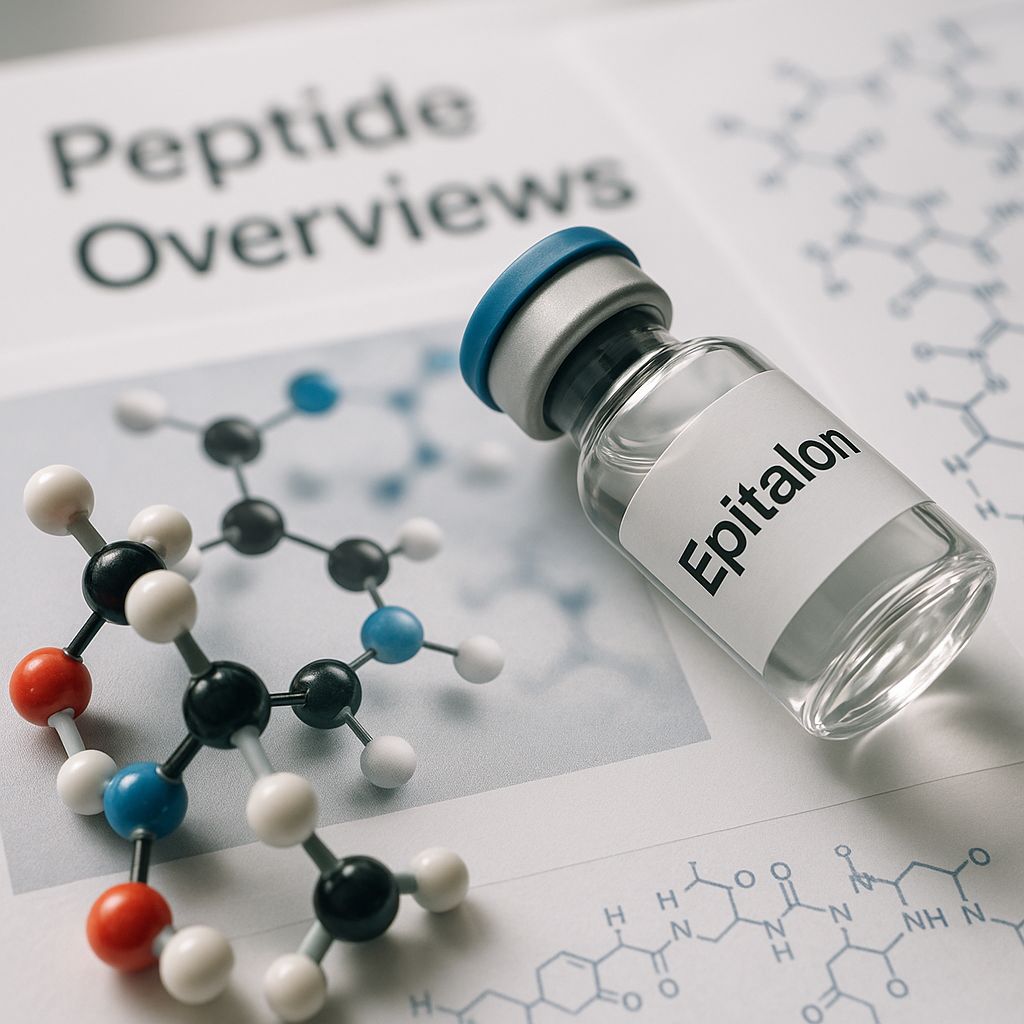
Epitalon (also spelled epithalon) is a synthetic tetrapeptide composed of alanine, glutamic acid, aspartic acid and glycine (Ala–Glu–Asp–Gly; often abbreviated AEDG) that was derived from studies of a pineal gland extract called epithalamin. Published literature has examined epitalon across cellular, animal and computational models. This article provides a research-focused summary of what epitalon is, how it appears in the literature, major study areas and model types, commonly encountered technical terms, limitations of the current evidence, and reasons to maintain research-only framing.
What is epitalon?
Epitalon is described in primary sources as a low–molecular‑weight synthetic peptide fragment originally identified from pineal extracts. The compound has been investigated as a discrete chemical entity in laboratory experiments rather than as a clinically established pharmaceutical. Researchers studying epitalon typically report biochemical, cellular and physiological end points in controlled research contexts.
How epitalon appears in the research literature
Reviews and experimental studies summarize a heterogeneous body of work. A recent comprehensive review synthesizes in vitro, in vivo and in silico studies and maps major research strands—telomere and telomerase biology, modulation of pineal/melatonin‑related pathways, antioxidant and antimutagenic activity, and effects on gene expression and signaling. Authors of that review note that methods and models vary considerably across studies and that the precise molecular mechanism remains incompletely verified (Int J Mol Sci, 2025).
Experimental papers in cell culture and animal models have reported biochemical and molecular changes after exposure to epitalon. Examples include modulation of telomerase activity and telomere length in cultured cells, changes in antioxidant enzyme markers in aged rodents, and observations of altered melatonin‑related rhythms in several preclinical models. These reports are framed as mechanistic or exploratory laboratory research rather than clinical recommendations.
Major study areas and model types
Telomere and telomerase biology
One prominent literature strand evaluates telomere length and telomerase-associated measures. Cell‑culture experiments have assessed hTERT mRNA expression and telomerase enzymatic activity alongside telomere length endpoints. Some studies report telomere‑related changes in normal somatic cell lines and distinct responses in certain cancer cell lines, where alternative lengthening of telomeres (ALT) pathways were observed in specific contexts (Biogerontology, 2025).
Pineal/melatonin‑related pathways and circadian measures
Early work originating from studies of epithalamin emphasized pineal gland biology and melatonin rhythms. Several preclinical reports describe modulation of melatonin‑related markers and circadian parameters in animal and ex vivo tissue models (Neuro Endocrinol Lett., 2002).
Antioxidant and antimutagenic activity
Rodent studies have reported changes in total antioxidant or antiradical activity and in activities or expression of endogenous antioxidant enzymes such as superoxide dismutase and glutathione peroxidase. Authors have contrasted these findings with direct free‑radical scavenging mechanisms associated with melatonin, suggesting distinct biochemical pathways may be involved (Arch Gerontol Geriatr., 2007).
Gene expression and signaling pathways
Laboratory studies have assessed changes in gene expression and signal transduction following exposure to epitalon. Examples in the literature include reported changes in STAT1 phosphorylation and other signaling markers, with the caveat that findings vary by model system and experimental design (Int J Mol Sci, 2025).
Model types used in studies
Published work employs a range of models: cultured mammalian cell lines (including human epithelial and fibroblast lines and some cancer cell lines), rodent models, invertebrate models or lifespan experiments in non‑mammalian species, ex vivo tissue preparations, and computational or in silico analyses. Each model class addresses specific mechanistic questions and carries distinct interpretive constraints.
Key technical terms readers may encounter
- Telomere: repetitive DNA at chromosome ends often measured to assess replicative change.
- Telomerase/hTERT: enzyme complex and catalytic subunit that can elongate telomeres; hTERT denotes the human catalytic subunit.
- ALT (Alternative Lengthening of Telomeres): a telomere maintenance mechanism distinct from telomerase, sometimes active in cancer cell lines.
- Epigenetics: biochemical modifications to DNA or chromatin (for example, methylated cytosine or histone interactions) that influence gene expression.
- Epithalamin: a pineal gland extract from which the tetrapeptide fragment was identified.
- AEDG: abbreviation for the amino‑acid sequence Ala‑Glu‑Asp‑Gly that defines epitalon.
Limitations and gaps in the literature
The published literature on epitalon includes heterogeneous methods, variable model systems and a predominance of preclinical experiments. Key limitations reported by authors and reviewers include methodological variability, limited independent replication for many findings, small sample sizes in some animal studies, and uncertainty when extrapolating molecular or cellular findings to whole‑organism contexts. Some cell‑culture observations—such as activation of ALT pathways in certain cancer cell lines—highlight model‑specific biological responses that require cautious interpretation. Overall, authors emphasize that remaining questions are best addressed by targeted mechanistic studies and reproducible experimental designs.
Why research‑only language matters
Maintaining research‑only framing reflects the current state of the evidence and avoids implying clinical application where it has not been established. Scientific communication about epitalon focuses on experimental endpoints, replicable methodology and the need for independent verification. For laboratory researchers and analytical teams, quality control measures such as third‑party analysis and certificate of analysis review are important when assessing material identity and purity; Peptide Titans provides laboratory results for transparency about analytical testing.
Selected primary sources
For readers who wish to consult original publications, representative sources include a recent review that synthesizes in vitro, in vivo and in silico studies (Int J Mol Sci, 2025), an experimental cell‑culture study reporting telomere/telomerase measures (Biogerontology, 2025), historical syntheses of early pineal peptide research (Neuro Endocrinol Lett., 2002) and a rodent study that assessed antioxidant enzyme measures (Arch Gerontol Geriatr., 2007). These sources illustrate the range of experimental approaches and highlight the need for further mechanistic clarity.
Researchers and laboratory personnel interested in epitalon are encouraged to consult primary literature, verify analytical data, and interpret findings within the confines of preclinical and experimental contexts. This article is intended as an educational literature overview and not as guidance for clinical or practical application.
Research-use product reference: Epitalon is listed at Peptide Titans for laboratory research use only. Products are not for human consumption.
Related Peptide Titans Resources
Research Sources
Primary references and source materials used for this research-focused overview:
- pmc.ncbi.nlm.nih.gov/articles/PMC11943447
- pmc.ncbi.nlm.nih.gov/articles/PMC12411320
- pubmed.ncbi.nlm.nih.gov/12374906
- pubmed.ncbi.nlm.nih.gov/17317455
Frequently Asked Questions
What is epitalon?
Epitalon (epithalon) is a synthetic tetrapeptide (Ala‑Glu‑Asp‑Gly, AEDG) derived from studies of a pineal gland extract called epithalamin. It has been investigated in laboratory research across cellular and animal models.
What are the main research topics for epitalon?
Published literature commonly examines telomere and telomerase biology, pineal/melatonin‑related pathways, antioxidant enzyme markers, gene expression and signaling pathways, and lifespan or physiological endpoints in model organisms.
Which model systems have researchers used?
Researchers have used cultured human and animal cell lines (including some cancer cell lines), rodent models, invertebrate or non‑mammalian lifespan models, ex vivo tissues and computational analyses.
Are findings from cell culture directly applicable to whole organisms?
No. Authors and reviewers note that cell‑culture findings require independent replication and careful translation to whole‑organism or clinical research contexts. Model‑specific responses can differ substantially.
Where can I find the original studies and analytical data?
Primary studies are available through bibliographic databases and journal platforms; representative links are provided below. For analytical testing and certificates of analysis relating to research materials, consult independent laboratory reports and third‑party data when available.