
Recent industry updates describing expanded batch‑specific third‑party testing and publicly accessible COAs have increased interest in robust peptide COA verification workflows for laboratory research (see the Uther Peptide announcement).[1] This practical guide explains how laboratory researchers can confirm COA authenticity and applicability using QR‑linked portals, lot‑matched reports, and accreditation checks — and what limitations to record for traceability and audit readiness.
Why rigorous peptide COA verification matters in laboratory research
Certificates of Analysis are a key record linking a material lot to analytical data. Published regulatory and community guidance stresses that traceability requires an unbroken chain of documentation linking test results to specific lot identifiers and validated methods (ISO/IEC 17025, FDA guidance).[2][3] For research labs, establishing that a COA is authentic and lot‑matched supports reproducibility, data integrity, and audit preparedness.
How QR‑code COA verification works
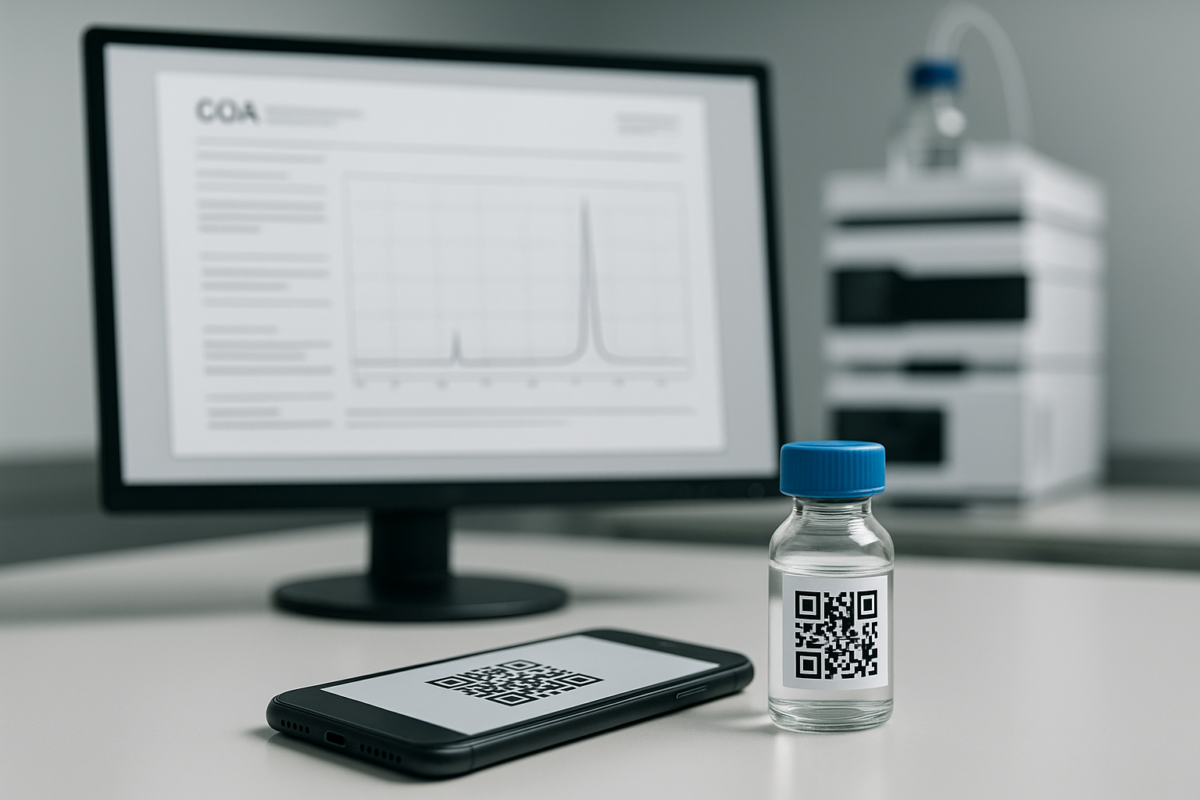
Many suppliers and independent laboratories now embed QR codes on packaging or certificate PDFs. When scanned, a QR code should resolve to a secure, independent portal or document viewer that displays a lot‑specific analytical report. Effective QR‑based verification workflows include:
- Confirming the QR resolves to an HTTPS portal with a domain matching the accredited lab or supplier.
- Verifying the visible report contains the identical lot number, sample date, and COA identifier shown on the physical label or original certificate.
- Saving a timestamped screenshot or PDF of the portal view to lab records to preserve the state of the COA at verification time.
Be cautious when a QR redirects to a generic company site or a non‑secure location; genuine lot‑matched reports should be directly accessible or retrievable from a secure third‑party portal.
Lot matching and traceability: exact linking of tested material
Lot matching is the practice of confirming the analytical data applies specifically to the material lot used in an experiment. Regulatory guidance emphasizes recording batch identifiers for comparability studies and for traceability of reference materials.[2][4]
Key lot‑matching checks
- Ensure the COA lot number exactly matches the supplier label and internal issuance records.
- Confirm test dates and report IDs; the analysis date should precede or match the COA issue date.
- When a supplier provides a manufacturer lot and a distributor lot, verify which lot was tested and used.
- Retain a copy of the COA and a record of who performed the verification and when.
What fields to verify and record on a COA
Expert guidance and community recommendations identify minimum COA fields needed for regulated bioanalysis.[4] Laboratories should capture and retain the following COA elements in their records:
- Supplier name and contact information.
- Material description and catalogue number.
- Exact lot/batch number used in the study.
- COA identifier/version and issue date.
- Analytical methods reported (e.g., RP‑HPLC, LC‑MS/MS) including method validation status or references.
- Assay/purity values and acceptance criteria; chromatograms or spectra where provided.
- Test sample preparation notes, sample weight/amount, and test date.
- Analyst or laboratory performing the test and any accreditation statements (e.g., ISO/IEC 17025).
- Expiration or retest dates, storage conditions, and any special handling notes.
Recording these fields supports an auditable trail that links material identity and analytical evidence to experimental records.
Third‑party testing and accreditation checks
Third‑party testing adds an extra layer of independence. When evaluating a COA that cites an external laboratory, confirm the lab’s technical competence by checking:
- Accreditation status (ISO/IEC 17025) and whether the accreditation scope covers the reported methods.
- Whether the lab provides method validation details or references for key assays.
- Presence of an accreditation body logo on the COA that links to the accreditor’s directory entry for the lab, or a searchable portal listing that verifies the lab identity.[5]
Where possible, maintain a cross‑reference record of the lab’s accreditation certificate and scope alongside the COA.
Limitations of COAs and important caveats
COAs are valuable but have known limitations. Peer‑reviewed characterization literature highlights that identity assignment for synthetic peptides generally requires orthogonal methods (e.g., NMR, LC‑MS/MS, amino acid analysis) rather than a single assay.[6]
- Chromatographic purity (HPLC) and mass spectral identity are complementary but may not detect all impurities or counterions; full characterization may need additional orthogonal techniques.
- Endotoxin or pyrogen testing is analytically distinct from HPLC or MS. COAs reporting only chromatographic purity do not substitute for LAL/kinetic chromogenic endotoxin assays when pyrogen data are needed.[7]
- COAs report what was tested; they do not guarantee homogeneity across an entire production run unless the certificate explicitly addresses lot homogeneity or replicates.
Practical verification checklist for laboratory records
Use this concise checklist when accepting peptide materials or recording COAs:
- Scan QR and save portal PDF/screenshot (record date/time and verifier).
- Confirm exact lot number match between vial/label, COA, and purchase record.
- Record methods listed, analyst name, test date, COA ID/version, and accreditation statements.
- Note any absent tests relevant to planned research (e.g., endotoxin, orthogonal ID methods).
- File COA with the associated experiment’s master file or study binder and retain per institutional retention policy.
Concluding notes
QR‑linked COAs and searchable third‑party portals can materially improve traceability when implemented thoughtfully. Combining QR verification, strict lot matching, accreditation checks, and comprehensive recordkeeping aligns with regulatory and best‑practice guidance and supports reproducible laboratory research.
References and guidance are available from industry announcements and regulatory literature including the Uther Peptide third‑party testing announcement, practical COA guides, and peer‑reviewed and FDA documents cited below.
Related Peptide Titans Resources
Research Sources
Primary references and source materials used for this research-focused overview:
- pmc.ncbi.nlm.nih.gov/articles/PMC10338602
- fda.gov/media/166571/download
- pubmed.ncbi.nlm.nih.gov/33847160
- fda.gov/regulatory-information/search-fda-guidance-documents/pyrogen-and-endotoxins-testing-questions-and-answers
- fda.gov/media/73956/download
Frequently Asked Questions
1. What is a peptide COA and why verify it?
A Certificate of Analysis documents analytical data for a specific material lot. Verifying a COA confirms that the analytical data apply to the exact lot used in research and that the methods and laboratory credentials are appropriate for the intended analyses.
2. How can I tell if a QR code on a COA is authentic?
Scan the QR and confirm it resolves to a secure (HTTPS) portal that displays a lot‑specific report matching the physical label and COA ID. Save a timestamped copy of the portal view and, where available, confirm the portal is hosted by the named third‑party laboratory or supplier.
3. Does chromatographic purity include endotoxin results?
No. Chromatographic methods (HPLC) and mass spectrometry assess identity and purity but do not detect endotoxin. Endotoxin testing requires specific assays such as LAL or kinetic chromogenic methods; look for explicit endotoxin results on the COA if relevant to your laboratory application.
4. What should I record in my lab notebook when accepting a COA?
Record supplier, lot number, COA ID/version, issue date, methods reported, analyst or lab name, accreditation status, and a saved copy or screenshot of the COA or portal. Note any tests not performed that may be relevant to your planned work.
5. How long should COAs be retained?
Retention periods depend on institutional and regulatory policies. Best practice guidance recommends retaining COAs for the duration necessary to support study traceability and audits; recordkeeping should enable linking experimental data back to the tested lot.