
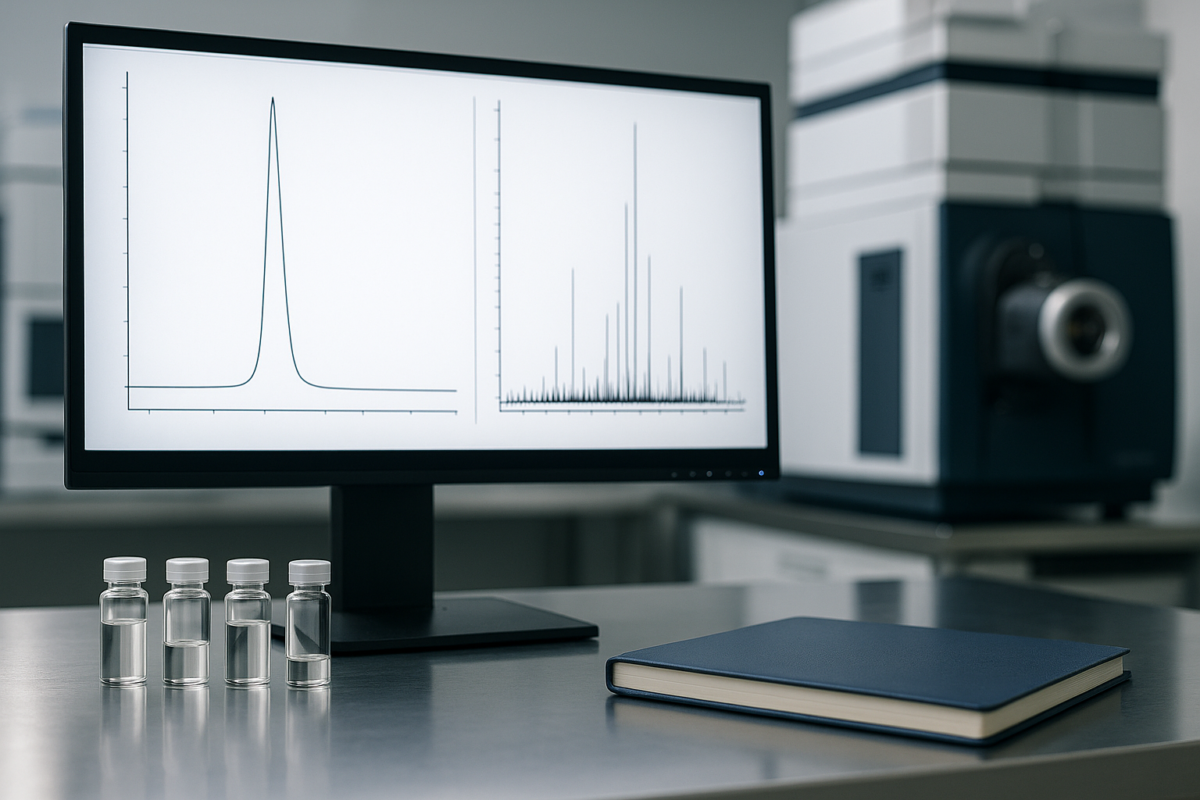
Recent regulator and standards updates emphasize that a single chromatographic retention time is insufficient to demonstrate peptide identity. For laboratory researchers working with synthetic peptides, Certificates of Analysis (COAs) remain the primary batch-level record; understanding what to look for and how to verify orthogonal identity confirmation is essential for defensible quality assessment in research contexts.
Why regulators now expect orthogonal testing
Regulatory and standards bodies have signaled a shift toward multi‑modal analytical evidence for peptide identity and impurity characterization. Recent summaries of draft guidance and agency commentary note expectations for chromatographic data paired with mass spectrometric confirmation, tighter impurity reporting thresholds, and clearer COA documentation. These shifts do not change basic laboratory practice overnight, but they do raise expectations for method detail, traceability, and orthogonal confirmation when COAs are used in research workflows.
Core elements a defensible COA should include
Not all COAs are created equal. When assessing a batch-level COA for a research peptide, look for explicit, batch-specific documentation rather than generic method statements.
Lot traceability and sample identifiers
COAs should state the lot number, manufacturing date, analytical lot or sample ID, and the date(s) of testing. Traceability fields enable you to match the COA to retained samples, stability data, and any follow-up analyses.
Assay and identification methods
COAs should list the analytical techniques used for identity and purity (for example, HPLC/UPLC, LC‑MS, MS/MS, intact mass, peptide mapping). For methods claiming identity confirmation, look for method titles, brief descriptors (e.g., column chemistry, gradient type), and references to validated procedures or SOP identifiers.
System suitability and reference standards
Good COAs include system suitability results and identify reference standards used (internal or external). If co‑injection or comparative retention time matching was used, the COA should say so and identify the reference lot.
What orthogonal identity confirmation looks like in practice
Orthogonality means independent, complementary measurements. For peptides this commonly combines chromatographic separation (HPLC/UPLC) with mass spectrometry (intact mass and/or MS/MS peptide mapping).
HPLC/UPLC reporting considerations
An HPLC chromatogram on a COA is useful but limited by itself. On a defensible COA, check for:
- Chromatogram image with labeled retention times and peak integration values
- Column identity (chemistry, dimensions, particle size)
- Mobile phase composition and gradient summary
- Detection wavelength(s) or detector type (UV, PDA) and system suitability numbers (e.g., resolution, tailing)
Mass spectrometry and peptide mapping details
Mass data provide orthogonal evidence: intact mass confirms molecular weight, while MS/MS peptide mapping (bottom‑up) supports primary sequence assignments. On a COA, desirable MS elements include:
- Intact mass spectrum with measured m/z, charge states, and deconvoluted mass
- Mass accuracy or error (e.g., ppm) and instrument type (e.g., HRMS, TOF, Orbitrap)
- MS/MS fragmentation spectra or a statement that peptide mapping was performed, including protease used and key fragment assignments
- Notes on database/search parameters or manual review criteria if peptide mapping was used
Interpreting HPLC chromatograms and MS spectra: practical pointers
Reading graphical data quickly helps flag potential issues.
Chromatogram interpretation basics
Retention time matching is supportive but not definitive. Peak shape, baseline resolution, and relative area percentages are informative. Look for annotated impurities and thresholds used for reporting (for example, which peaks were reported as >x%). If only a single peak is shown with no impurity detail, that COA is limited.
Mass spectrum interpretation basics
Key items are the observed intact mass versus theoretical mass, isotopic pattern matching, and mass accuracy. For peptide mapping, MS/MS fragment coverage and noted sequence ions strengthen confidence. Where available, fragmentation spectra with annotated b/y or c/z ions indicate which residues were confirmed.
Mass accuracy and resolution expectations
High‑resolution MS instruments enable low ppm mass errors that are valuable for identity calls. The exact expectation varies with instrument and method, but COAs should report the observed error and, where possible, the resolving power or instrument model. Absence of mass accuracy figures reduces the interpretability of the reported mass data.
Limitations of single‑method reporting and common red flags
An HPLC retention-time match alone cannot resolve isobaric species, sequence isomers, or certain post‑synthetic modifications. Red flags include:
- COAs that only present a single UV chromatogram without MS or peptide mapping
- Missing system suitability or unspecified reference standards
- Undocumented integration thresholds and impurity reporting limits
- Mass data lacking instrument or accuracy information
Practical checklist for evaluating peptide COAs (research use)
- Confirm lot number, sample ID, and testing dates are present.
- Verify that identity is supported by orthogonal methods (HPLC + intact mass and/or MS/MS peptide mapping).
- Review method descriptors: column, gradient, detector, instrument, protease (if mapping).
- Check for system suitability data and identification of reference standards.
- Look for mass accuracy, isotope pattern consistency, and MS/MS fragment coverage if available.
- Note impurity reporting thresholds and whether new peak detection procedures were applied.
Documentation, traceability, and next steps for labs
If a COA lacks sufficient orthogonal data, request batch-level raw data or a certificate addendum from the supplier that provides the missing method details, spectra, or chromatograms. For research workflows that require higher confidence, seek COAs aligned with the approaches discussed in modern guidance and peer‑reviewed best practices.
Further technical details and regulatory context can be found in USP materials and recent agency presentations and reviews on peptide characterization and mapping.
Related Peptide Titans Resources
Research Sources
Primary references and source materials used for this research-focused overview:
- doi.usp.org/USPNF/USPNF_M17655_10101_01.html
- fda.gov/media/166572/download
- pmc.ncbi.nlm.nih.gov/articles/PMC12563827
- pmc.ncbi.nlm.nih.gov/articles/PMC10338602
Frequently Asked Questions
What does “orthogonal testing” mean for peptide COAs?
Orthogonal testing refers to using complementary analytical techniques that rely on different physical or chemical principles—commonly chromatography (HPLC/UPLC) plus mass spectrometry (intact mass or MS/MS peptide mapping)—to provide independent evidence for identity and impurity characterization in a COA.
Is an HPLC chromatogram alone acceptable for identity confirmation?
In research contexts, an HPLC chromatogram provides useful information about chromatographic purity and retention behavior, but regulators and standards bodies now emphasize that retention time matching alone is insufficient for unambiguous identity confirmation without complementary mass spectrometric evidence.
What mass spectrometry information should appear on a COA?
Useful MS details include the observed intact mass and deconvoluted value, instrument type, reported mass error (ppm), isotopic pattern consistency, and—when performed—MS/MS peptide mapping with fragment assignments or coverage statements.
How should I proceed if a COA lacks method details or orthogonal data?
Request batch-specific raw data or a COA addendum from the supplier that includes method descriptions, spectra, chromatograms, and system suitability. If necessary for your research, prioritize batches with comprehensive documentation.