
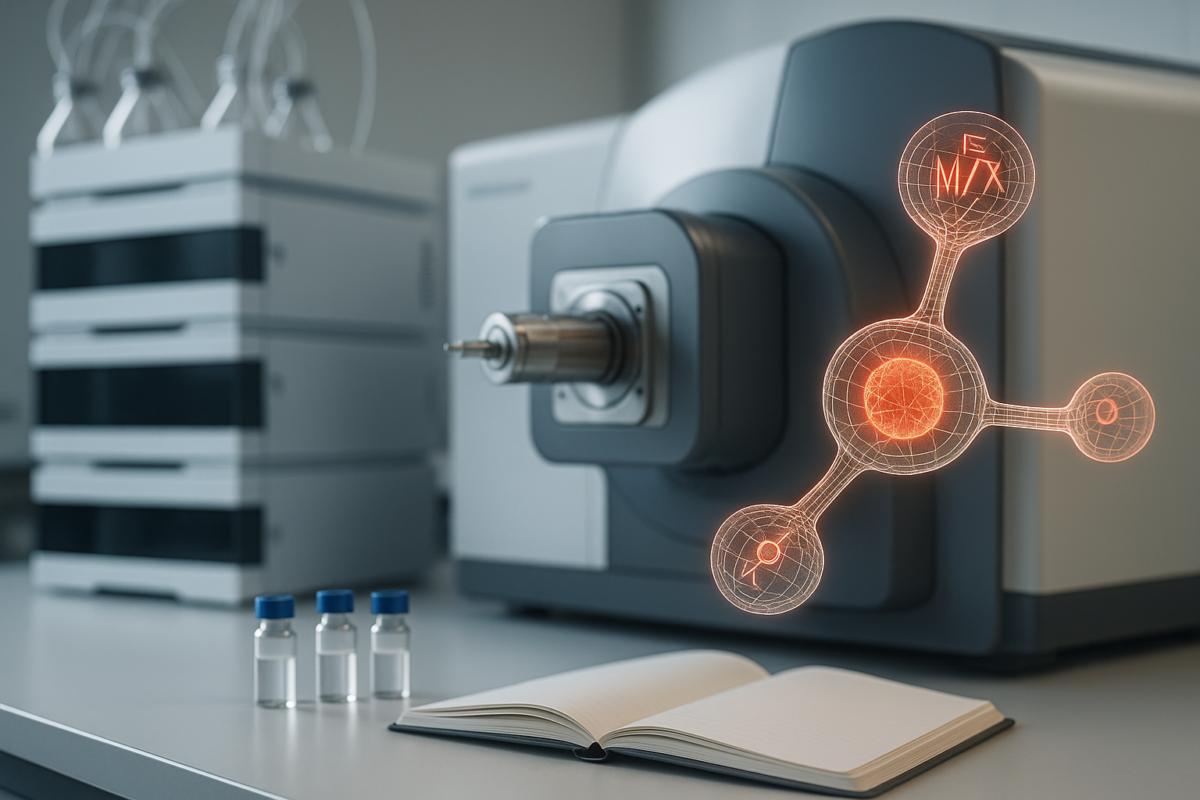
Recent regulatory and standards discussions have reinforced a point that laboratory researchers and quality personnel have long observed: a single chromatographic retention time or reported purity percentage (from HPLC/UPLC) is not sufficient evidence by itself to establish peptide identity. Agencies and standards bodies now emphasize combining chromatographic data with orthogonal analytical methods. This article describes what “orthogonal peptide identification” means in practice, how common methods appear on batch-specific Certificates of Analysis (COAs), and what documentation researchers should request from suppliers to support traceability and quality review in a research setting.
Why a single HPLC result is limited
Reverse-phase HPLC or UHPLC is widely used to report percent area and relative retention times. Chromatography provides useful information about sample complexity and a reproducible fingerprint under a given method. However, retention time is a physicochemical characteristic influenced by column chemistry, mobile-phase composition, temperature, and sample matrix. Different analytes can co-elute or present similar retention under one method, and isobaric or sequence-variant peptides can be indistinguishable by retention time alone.
Common HPLC limitations
Shortcomings relevant to identity assessment include co-elution of impurities, inability to resolve isomeric residues (for example, Leu vs. Ile), and method-specific selectivity that may mask minor sequence variants. Because of these factors, regulators and standards bodies recommend orthogonal approaches to increase confidence in peak assignments and identity claims.
What “orthogonal” identification methods are
In analytical chemistry, orthogonal methods are independent techniques that provide complementary evidence about an analyte’s identity or purity. For peptides, common orthogonal methods include mass spectrometry (MS), tandem MS (MS/MS) sequencing, peptide mapping, nuclear magnetic resonance (NMR), amino-acid analysis (AAA), and alternative chromatographic separations. Each technique interrogates different physicochemical properties.
High-resolution mass spectrometry and MS/MS
High-resolution LC–MS (HRMS) provides accurate mass measurements for the intact peptide and, when combined with MS/MS fragmentation, can provide sequence-level information. Mass data can discriminate between species that co-elute in HPLC and can identify mass shifts due to modifications or truncations. MS/MS spectra can be used to match theoretical fragmentation patterns, supporting sequence assignments.
Peptide mapping and alternative chromatographic methods
Peptide mapping (often using enzymatic digestion followed by LC–MS/MS) localizes sequence and modification information across the molecule. Orthogonal chromatographic separations—using different stationary phases or mobile-phase chemistries—can reveal co-eluting species that a single reversed-phase method misses.
NMR and amino-acid analysis
NMR provides complementary structural information (useful particularly for reference-standard characterization), while amino-acid analysis offers a mass-balance approach to quantify total amino-acid content and detect gross compositional discrepancies. These methods are sometimes used in combination when a rigorous assignment of a reference material is required.
How orthogonal data appear on batch-specific COAs
Batch-level COAs can include a variety of entries reflecting orthogonal characterization. Researchers reviewing COAs should expect to see method identifiers, acceptance criteria, and links or references to supporting data rather than a single chromatogram alone.
Typical COA entries and supporting evidence
- HPLC/UHPLC chromatogram with reported percent area and system suitability information.
- Mass spectrometry confirmation: intact-mass value with mass accuracy (ppm), isotopic pattern, and often the observed charge states.
- Annotated MS/MS or peptide-map chromatograms supporting sequence fragments or peptide coverage.
- Reference-standard information and traceability (lot numbers, certificate for the reference standard used in comparisons).
- Method references and brief validation attributes (specificity/selectivity statements, limits of detection when relevant).
Practical documentation and traceability steps researchers should request
For laboratory research and quality control review, requesting clear, batch-specific documentation helps with traceability and reproducibility. Consider asking suppliers for:
Recommended data and documentation
- Raw instrument files or readable exports for chromatograms and MS spectra linked to the COA.
- Method descriptions including column type, mobile-phase composition, gradient, MS settings (ionization mode, resolving power), and calibration references.
- Reference-standard certificates and chain-of-custody for standards used in identity confirmation.
- Summary of peptide-mapping or MS/MS coverage (percent sequence coverage where applicable) and annotated fragment ions.
- Stability or forced-degradation summaries if available, especially when working with materials intended for multi-week experiments or comparative studies.
- Statements on method validation for identity assays (specificity, accuracy of mass assignments, system suitability criteria).
Limitations: what these tests can and cannot demonstrate
Orthogonal analytical strategies substantially increase confidence that a sample matches an expected sequence and that major impurities are detected. However, laboratory analysts should be aware of remaining limitations:
- Analytical methods detect physicochemical attributes; they do not demonstrate biological activity, safety, or functional equivalence in biological systems.
- Minor sequence variants at low abundance may evade detection if methods lack sufficient sensitivity or if MS/MS coverage is incomplete.
- Certain isomeric substitutions can remain challenging to distinguish without targeted strategies (for example, specialized chromatography or NMR approaches).
- COA summaries are only as useful as their supporting raw data and method descriptions—lack of raw data limits independent assessment.
Conclusions and practical takeaways for researchers
Orthogonal peptide identification combines complementary analytical evidence—chromatographic profiling plus mass spectrometric, mapping, or structural data—to provide a more robust basis for identity statements on COAs. Researchers conducting laboratory studies or quality reviews should request batch-specific MS data, methodological details, and reference-standard traceability alongside chromatograms. Such documentation supports reproducibility, traceability, and informed evaluation of materials in a research-only context.
For further reading on regulatory expectations and reference-standard characterization strategies, see the FDA and peer-reviewed sources cited below.
Related Peptide Titans Resources
Research Sources
Primary references and source materials used for this research-focused overview:
- fda.gov/media/166572/download
- fda.gov/drugs/drug-alerts-and-statements/fda-publishes-revised-draft-product-specific-guidances-certain-generic-peptide-products
- pmc.ncbi.nlm.nih.gov/articles/PMC10338602
- usp.org/sites/default/files/usp/document/events-and-training/03-CMC-Regulatory-Experiences-and-Expectations_Katharine-Duncan.pdf
Frequently Asked Questions
Q: Why isn’t HPLC retention time enough to confirm peptide identity?
A: HPLC retention time is method-dependent and can be shared by different species under a given set of chromatographic conditions. Orthogonal evidence—such as accurate mass, MS/MS fragmentation, or peptide mapping—is needed to discriminate co-eluting or isobaric species.
Q: What is the role of high-resolution mass spectrometry in identity testing?
A: High-resolution mass spectrometry provides accurate mass measurements for intact peptides and, when combined with MS/MS, can supply fragment ion information that supports sequence assignments. It complements chromatographic data by addressing mass-based specificity.
Q: What documentation should I request from a supplier to evaluate a COA?
A: Request batch-specific chromatograms, MS spectra or MS/MS annotations, method descriptions (instrument settings, columns, mobile phases), reference-standard certificates, and any available peptide-mapping or forced-degradation summaries to support traceability and independent assessment.
Q: Can orthogonal testing prove biological activity?
A: No. Orthogonal analytical methods assess physicochemical identity and purity. They do not demonstrate biological activity, potency, or suitability for any biological use; separate functional assays would be required for such evaluations in a research context.