
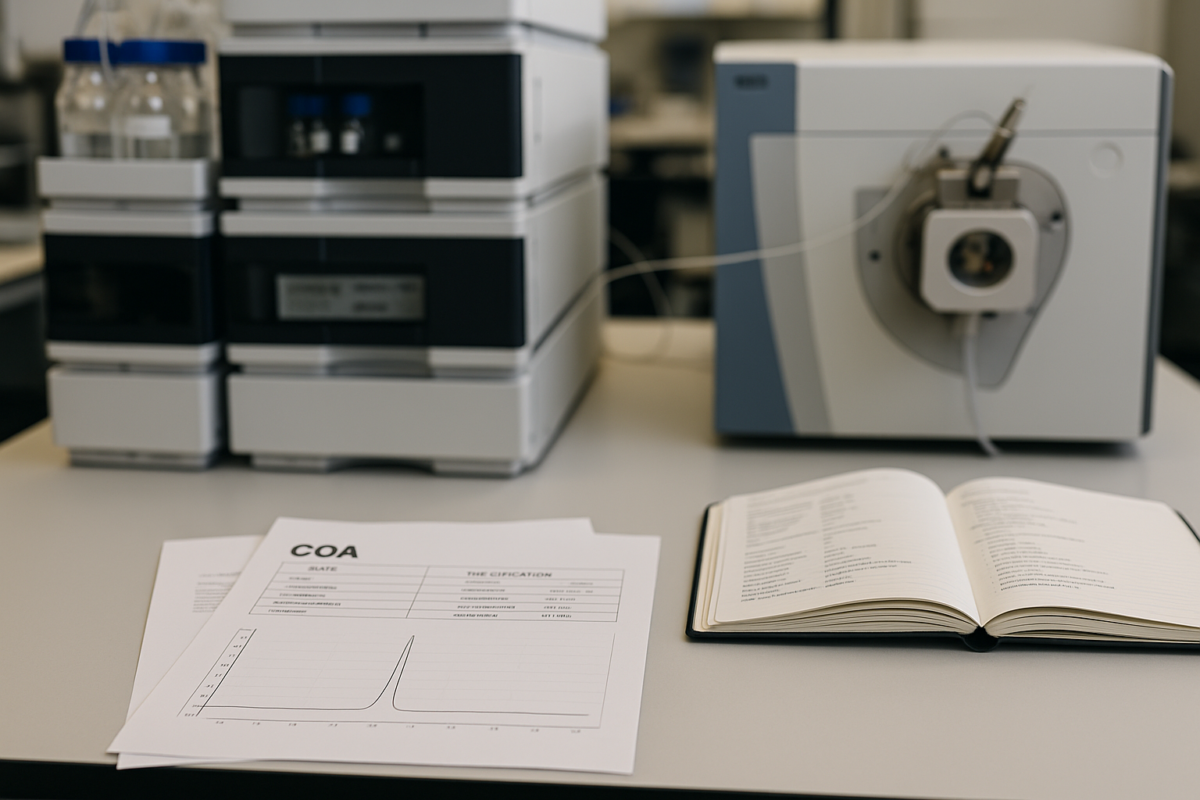
Understanding a peptide COA is central to interpreting peptide analytical reports after the FDA’s 2026 impurity guidance. This short, lab-focused checklist helps researchers, quality staff, and third-party analysts evaluate whether a COA and batch report provide the orthogonal and impurity-detail expected under the new guidance. For related materials intake practices, see the Peptide Titans lab-results summary and our research-use peptide catalog.
How to read a peptide COA (quick checks)
Regulatory updates influence what analytical detail is expected in supporting documentation. The FDA’s 2026 documents and related technical notes emphasize lower impurity reporting thresholds and the need for orthogonal confirmation of identity; these expectations are useful when assessing COAs for research materials.
Top-line COA checklist: what to look for
Use the following checklist when evaluating a peptide COA or accompanying batch report. Each item helps determine whether the analytical information is sufficient for research-grade characterization or whether additional data should be requested.
1. Method identifiers and scope
Confirm that each reported result lists the analytical method used (for example, UHPLC-UV assay, LC-HRMS, MS/MS peptide mapping). A COA should specify column type, mobile-phase composition, detection wavelength (UV), MS instrument and resolution, and any method reference or SOP identifier. Absence of method identifiers or only generic method names makes it difficult to assess fit-for-purpose.
2. Orthogonal evidence for identity
The FDA and pharmacopeial discussions stress combining retention-time/UV methods with mass-based or structural tests. On a COA you should expect at least one chromatogram plus mass evidence linked to the principal peak. Acceptable orthogonal data includes intact mass (HRMS) and MS/MS fragment spectra, peptide mapping, or amino-acid analysis. If a COA shows only an HPLC retention-time comparison, request MS or peptide-mapping confirmation.
3. Impurity reporting thresholds and identification
Confirm what reporting and identification limits were applied. Recent guidance documents recommend reporting peptide-related impurities at lower levels (for example, down toward 0.10%) and identifying impurities above higher thresholds (commonly cited near ~0.5% in product-specific contexts). A COA should state the reporting threshold and identify which peaks were integrated and quantified. If low-level peaks are present but not reported, ask for the integration list and limit-of-detection/quantitation details.
4. Chromatograms: reading the traces
Chromatograms on COAs are often the first visual check. Look for baseline resolution of the main peak, presence of nearby peaks, peak symmetry, and whether peak-purity assessments were performed. If a peak shows shoulders or co-elution, the COA should reference orthogonal confirmation (for example, LC-MS extracted-ion chromatograms or MS/MS) demonstrating whether co-eluting species are present.
5. Mass spectrometry evidence
MS data should be traceable to specific chromatographic peaks. Useful elements on a COA include observed monoisotopic mass versus theoretical mass, mass error (ppm), charge-state distribution, and representative MS/MS fragment spectra with annotated fragment ions. If MS evidence is provided only as a single intact mass without chromatographic linkage, request extracted-ion chromatograms or MS/MS supporting the assignment.
6. Forced-degradation and stability notes
Forced-degradation (stress) studies demonstrate whether an analytical method is stability-indicating and reveal likely degradation products. COAs or supporting reports should indicate whether the assay method was validated as stability-indicating and summarize forced-degradation findings (for example, key degradation peaks and identification of degradation products via MS/MS). At minimum, the COA should state whether stress studies were performed and where to find the data.
7. Reference standards and traceability
Check that reference standard identities, lot numbers, and stated purities are listed. Effective COAs note the source and lot of reference peptides used for calibration or identity confirmation. This traceability supports reproducibility and helps assess batch comparability across analyses.
8. Limits of detection/quantitation and method qualifications
A COA should report analytical sensitivity metrics (LOD/LOQ) for impurity and assay methods, or reference method qualification/validation reports. For peaks near the reporting threshold, knowing the LOQ and precision helps interpret whether reported values are robust or semi-quantitative.
Practical QC documentation checks
In addition to analytical content, examine administrative and QC elements on the COA:
- Batch metadata: lot number, manufacture date, sample age at testing, analyst and analyst signature.
- Instrument run IDs and raw data availability: presence of chromatogram and MS file identifiers to enable data review if needed.
- Change-control or deviation notes: any analytical deviations or out-of-specification comments relevant to the report.
- Comparative testing: whether multiple batches or aged samples were tested (useful when stability-related impurities are a concern).
When to request additional testing or raw data
Request more information if the COA lacks orthogonal identity evidence, does not state impurity reporting thresholds, shows unresolved chromatographic peaks without MS linkage, or lacks forced-degradation summaries. For critical research analyses, ask for raw chromatograms and mass spectra, method SOPs, and reference-standard documentation so analytical conclusions can be independently assessed.
Putting the checklist into practice
Adopt the checklist as part of routine materials intake for research labs and third-party analysts. Use it to standardize COA review, document when additional data are requested, and maintain reproducible records of material characterization. These guidance-based expectations align with recent FDA documents and analytical reviews that advocate orthogonal testing and enhanced impurity reporting. For further in-house guidance and examples, consult the Peptide Titans research library and our third-party lab results and COAs page.
Research Sources
Primary references and source materials used for this research-focused overview:
- peptidestaff.com: FDA revised guidance — peptide impurity limits (2026)
- medpath trial note: single HPLC result insufficient for peptide identity
- Springer analytical review on peptide identity and orthogonal methods (2026)
- FDA: revised draft product-specific guidances and technical materials (download)
- PubMed Central: analytical considerations for peptides
Related Peptide Titans Resources
Frequently Asked Questions
Q: What does “orthogonal evidence” mean on a COA?
Orthogonal evidence refers to two or more independent analytical approaches that confirm identity or impurity assignments (for example, a chromatographic retention-time/UV result supported by high-resolution MS and MS/MS peptide mapping).
Q: If a COA lists impurities at 0.2%, is that above the reporting threshold?
Reporting and identification thresholds vary by guidance and context; recent FDA documents emphasize reporting peptide-related impurities down to about 0.10% and identifying impurities at higher levels (commonly near ~0.5%). A COA should state which thresholds were applied.
Q: Are chromatograms alone sufficient to establish peptide identity?
Chromatograms are useful for quantitation and purity assessment, but current guidance and analytical literature recommend confirming identity with mass-based or orthogonal structural methods where possible.
Q: What should I ask a testing lab to include if the COA is incomplete?
Request method SOPs, LOQ/LOD values, raw chromatogram and mass-spectra files, reference-standard lot numbers, and a summary of any forced-degradation/stability-indicating studies referenced in the report.