
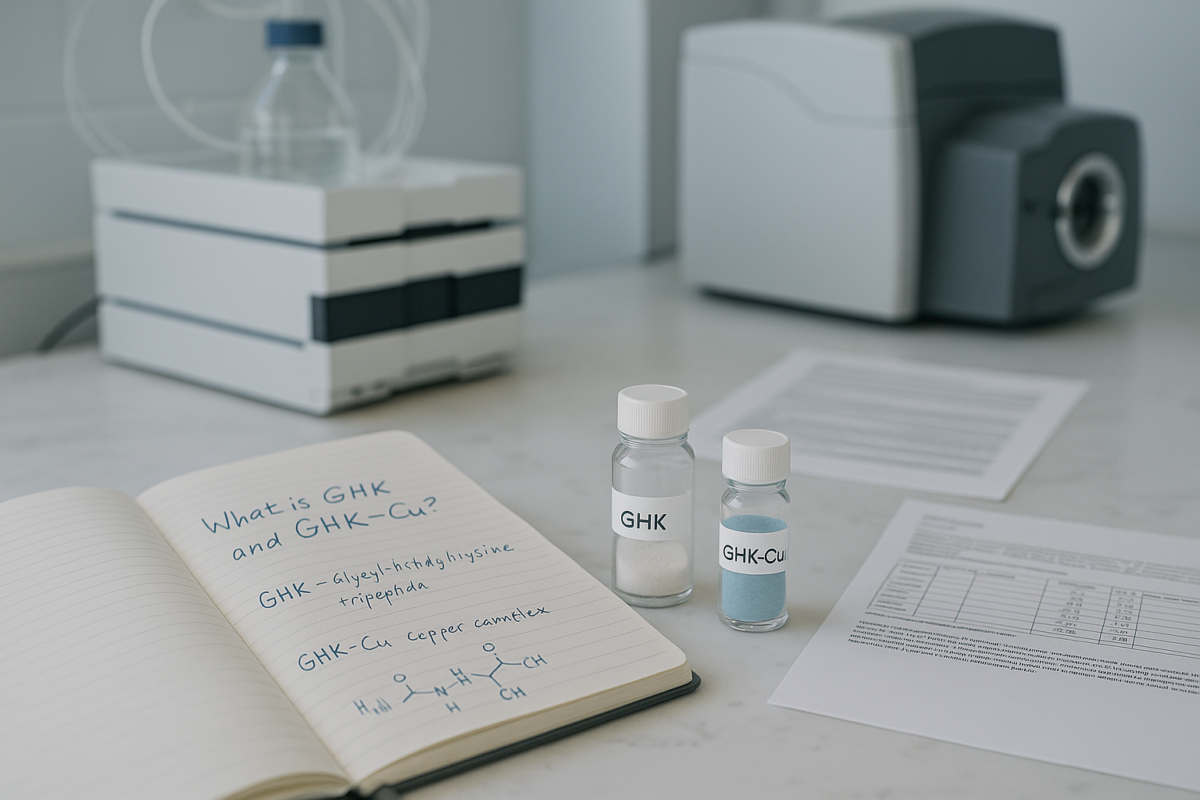
This article summarizes published literature on the tripeptide glycyl-L-histidyl-L-lysine (GHK) and its copper complex (GHK-Cu), focusing on research themes, model systems, common terminology, and limits of the evidence. Content is presented in a research-only context for laboratory and preclinical audiences.
What is GHK and GHK-Cu?
GHK is a naturally occurring tripeptide (gly-his-lys) first identified in human plasma. In experimental settings the peptide is often studied as a copper chelate, GHK-Cu, formed by high-affinity binding to Cu2+. Published literature treats the parent tripeptide and the copper-chelated form as related but distinct experimental agents; many reports contrast effects of unchelated GHK versus GHK-Cu.
How GHK-Cu appears in the research literature
Over several decades researchers have explored GHK and GHK-Cu in basic science and translational research. The body of work includes in vitro cellular experiments, animal-model studies, ex vivo tissue assays, genome-wide expression profiling, and a limited number of small clinical or cosmetic pilot studies. Review articles synthesize these strands and highlight recurring experimental endpoints and molecular readouts.
Major study areas and model types
In vitro cellular models
Laboratory studies commonly use cultured cell lines and primary cells to examine biochemical and signaling responses to GHK or GHK-Cu. Reported endpoints include gene-expression changes, enzyme activity assays, cytokine and growth-factor measurements, and proteasome function tests.
Ex vivo and organ/tissue assays
Ex vivo tissue systems—such as skin explants or reconstructed epidermal/dermal systems—have been used to probe structural markers, extracellular-matrix components, and permeability characteristics of peptide derivatives under controlled conditions.
Animal models
Preclinical work in rodents and other animal models appears across studies examining tissue repair–associated processes, extracellular-matrix modulation, and inflammatory signaling. Animal models are often used to evaluate molecular and histological outcomes rather than to establish clinical efficacy.
Genome-wide and omics approaches
Several publications report genome-wide expression profiling after exposure to GHK or GHK-Cu. These studies aim to identify networks of up- and down-regulated genes, signaling pathways of interest, and broader patterns that may explain observed cellular responses.
Key terms and experimental measures readers may see
Familiarity with common terminology can aid interpretation of the literature. Key terms include:
- GHK (glycyl-L-histidyl-L-lysine) and GHK-Cu (copper-chelated form)
- Palmitoylation (e.g., Pal-GHK) — a chemical modification reported in formulation studies
- Matrix metalloproteinases (MMPs) and tissue inhibitors of metalloproteinases (TIMPs)
- Angiogenesis-associated signals (e.g., bFGF, VEGF) reported in some model systems
- Proteasome activity, cytokine and inflammatory mediator assays
- Genome-wide expression profiling, transcriptomics, and related omics readouts
- Analytical methods such as HPLC and mass spectrometry for peptide characterization

Themes emerging from published research
Review articles and primary studies converge on several recurring themes explored across laboratory and preclinical work:
- Modulation of extracellular-matrix–related molecules and enzymes in cell and tissue models.
- Alterations in gene-expression networks identified through transcriptomic analyses.
- Investigations of inflammatory and cell-protective signaling in multiple tissue contexts.
- Comparative studies of unchelated GHK versus GHK-Cu, with chelation often emphasized as an experimental variable.
- Formulation-focused research on derivatives such as palmitoylated GHK and their physicochemical properties.
Limitations and gaps in the evidence
Several methodological and translational limitations recur in the literature reviews. These include:
- A predominance of in vitro and animal-model work relative to large, randomized clinical trials.
- Heterogeneity in experimental designs, doses, and outcome measures across studies, which complicates cross-study synthesis.
- Limited standardized data on formulation effects and tissue permeability for certain derivatives.
- Genome-wide and omics readouts that identify associations but often require further mechanistic follow-up to clarify causal pathways.
Why research-only language matters
Published literature frequently emphasizes exploratory, hypothesis-generating findings from cellular and preclinical models. Translational steps from bench to wider clinical application require controlled, reproducible studies and regulatory evaluation. Consequently, this summary uses research-focused wording—such as “investigated,” “reported,” and “preclinical models”—to reflect the current state of evidence and to avoid implying clinical or product-level conclusions.
Sources and further reading
Selected review and research articles provide detailed overviews and primary data for readers seeking deeper analysis. These include systematic reviews and focused articles that compile experimental models, molecular end points, and formulation considerations in the GHK/GHK-Cu literature.
Concluding remarks
GHK and its copper complex GHK-Cu appear in a broad experimental literature spanning cellular assays, animal models, ex vivo tissue studies, and genome-level analyses. The published body of work highlights multiple molecular pathways and methodological approaches but also identifies important gaps that warrant further systematic investigation. Readers are encouraged to consult primary sources and reviews for methodological specifics and to interpret findings within a laboratory research context.
Research-use product reference: GHK-Cu is listed at Peptide Titans for laboratory research use only. Products are not for human consumption.
Research Sources
Primary references and source materials used for this research-focused overview:
- https://pmc.ncbi.nlm.nih.gov/articles/PMC4508379/
- https://pmc.ncbi.nlm.nih.gov/articles/PMC6073405/
- https://pmc.ncbi.nlm.nih.gov/articles/PMC8789089/
- https://pubmed.ncbi.nlm.nih.gov/39963574/
Frequently Asked Questions
1. What is the difference between GHK and GHK-Cu?
GHK denotes the tripeptide glycyl-L-histidyl-L-lysine. GHK-Cu refers to the copper(II) complex formed when GHK binds Cu2+. Many studies compare unchelated GHK with the copper-chelated form as separate experimental conditions.
2. What types of experimental models are used in GHK-Cu research?
Researchers use in vitro cell cultures, ex vivo tissue assays (for example, skin explants), animal models, and genome-wide expression studies. Each model type addresses different mechanistic or molecular questions.
3. Are there large clinical trials on GHK-Cu?
The literature includes a limited number of small clinical or cosmetic pilot studies, but review articles note a lack of large, controlled clinical trials. Most available evidence remains preclinical or exploratory in scope.
4. What common laboratory measurements appear in the literature?
Common measures include transcriptomics/gene-expression profiling, assays for matrix metalloproteinases and TIMPs, proteasome activity, cytokine and growth-factor quantification, and analytical chemistry methods such as HPLC and mass spectrometry for compound characterization.
5. Where can I find primary reviews and studies?
See the referenced review articles and primary reports listed in the external links for comprehensive bibliographies and primary data descriptions.