
This article summarizes published literature for each component commonly referenced as “BPC-157 + TB-500.” It is structured as a component-by-component literature overview and uses research-only language. Readers should understand that the summaries below reflect laboratory and preclinical study designs, common mechanistic themes investigators explore, and limitations of the available evidence.
What is BPC-157?
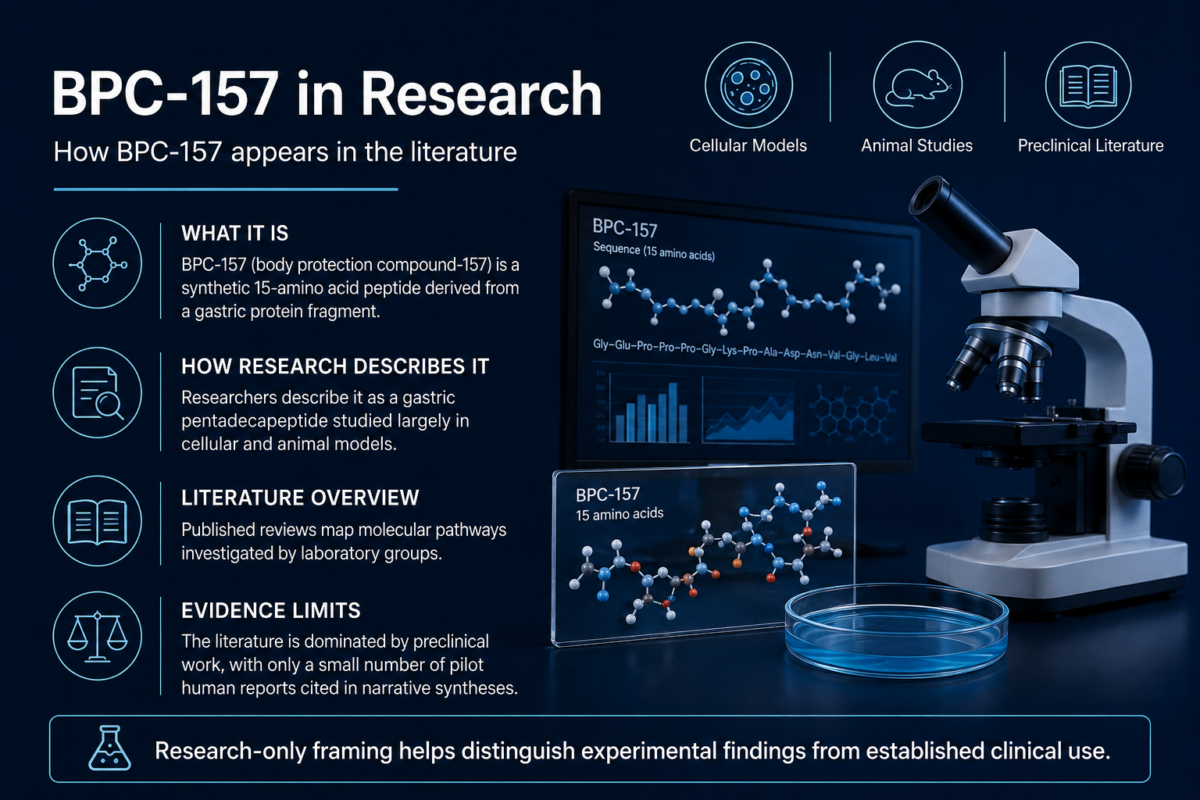
BPC-157 (body protection compound-157) is a synthetic 15–amino acid peptide derived from a gastric protein fragment. Researchers describe it in the literature as a gastric pentadecapeptide studied largely in cellular and animal models. Published reviews map molecular pathways investigated by laboratory groups and note a predominance of preclinical work with a small number of pilot human reports cited in narrative syntheses.
How BPC-157 appears in the research literature
Published literature has explored BPC-157 in rodent and in vitro systems. Narrative reviews and focused summaries emphasize recurring themes across experimental paradigms, while also noting that most evidence comes from a limited number of laboratories and primarily non‑clinical models.
Major study areas and model types for BPC-157
Researchers have studied BPC-157 across several preclinical domains, including:
- Soft‑tissue repair models (tendon, ligament, skeletal muscle) in small animals.
- Skeletal, smooth, and cardiac muscle experimental paradigms, including ischemic and injury models.
- Cell culture studies examining signaling pathways, angiogenic markers, fibroblast activity, and nitric‑oxide–related signaling.
Mechanisms and key terms in BPC-157 studies
Common mechanisms investigators investigate include angiogenesis, modulation of inflammatory signaling, nitric oxide pathways, fibroblast responses, and cytoprotective signaling. Readers will encounter terms such as “preclinical models,” “in vitro assays,” “angiogenic markers,” and “nitric oxide modulation” in primary reports and reviews.
Limits and research gaps for BPC-157
Authors of recent reviews highlight that most BPC-157 data derive from animal and laboratory models, with only a small number of pilot human reports referenced. Key limitations include reproducibility across independent groups, sparse controlled clinical data, and incomplete human safety documentation. These gaps are routinely cited as reasons for further controlled translational studies.
What is TB-500 (Thymosin beta‑4)?
TB-500 commonly refers to thymosin beta‑4 (Tβ4), a naturally occurring 43–amino acid peptide with well‑documented intracellular roles. In the scientific literature, Tβ4 has been studied across cellular systems and animal models to examine its role in cell migration, cytoskeletal regulation, angiogenic signaling, and modulation of inflammatory pathways.
How Tβ4 appears in the research literature
Thymosin beta‑4 has an established literature base spanning basic cell biology to translational preclinical studies. Reviews compile cellular, animal, and some early clinical-stage investigations and discuss delivery and stability challenges that investigators address in experimental designs.
Major study areas and model types for Tβ4
Common research contexts include:
- Wound‑repair and skin models in rodents and cell cultures assessing keratinocyte and fibroblast behavior.
- Cardiac and neurovascular research exploring remodeling and angiogenic signaling in preclinical settings.
- In vitro mechanistic studies on actin‑sequestration, cell migration assays, and anti‑apoptotic signaling pathways.
Mechanisms and key terms in Tβ4 studies
Key mechanistic themes for Tβ4 include actin monomer binding (actin‑sequestration), promotion of cell migration, angiogenic signaling, and modulation of apoptosis and inflammation. Readers will see terms such as “re‑epithelialization,” “keratinocyte migration,” “actin dynamics,” and “preclinical cardiac models” in the literature.
Limits and research gaps for Tβ4
While Tβ4 has a broader published base than some peptides, authors emphasize translational gaps, delivery and stability considerations in experimental work, and the need for rigorous clinical trials to clarify safety profiles and translational relevance.
Key terms and study terminology to know
Familiarity with study terminology can aid literature navigation. Common phrases include “preclinical models,” “in vitro assays,” “animal injury models,” “angiogenesis markers,” “cytoskeletal regulation,” and “mechanistic studies.” Systematic reviews and narrative summaries frequently use these terms when describing experimental approaches and outcomes.
Why a research‑only framing matters
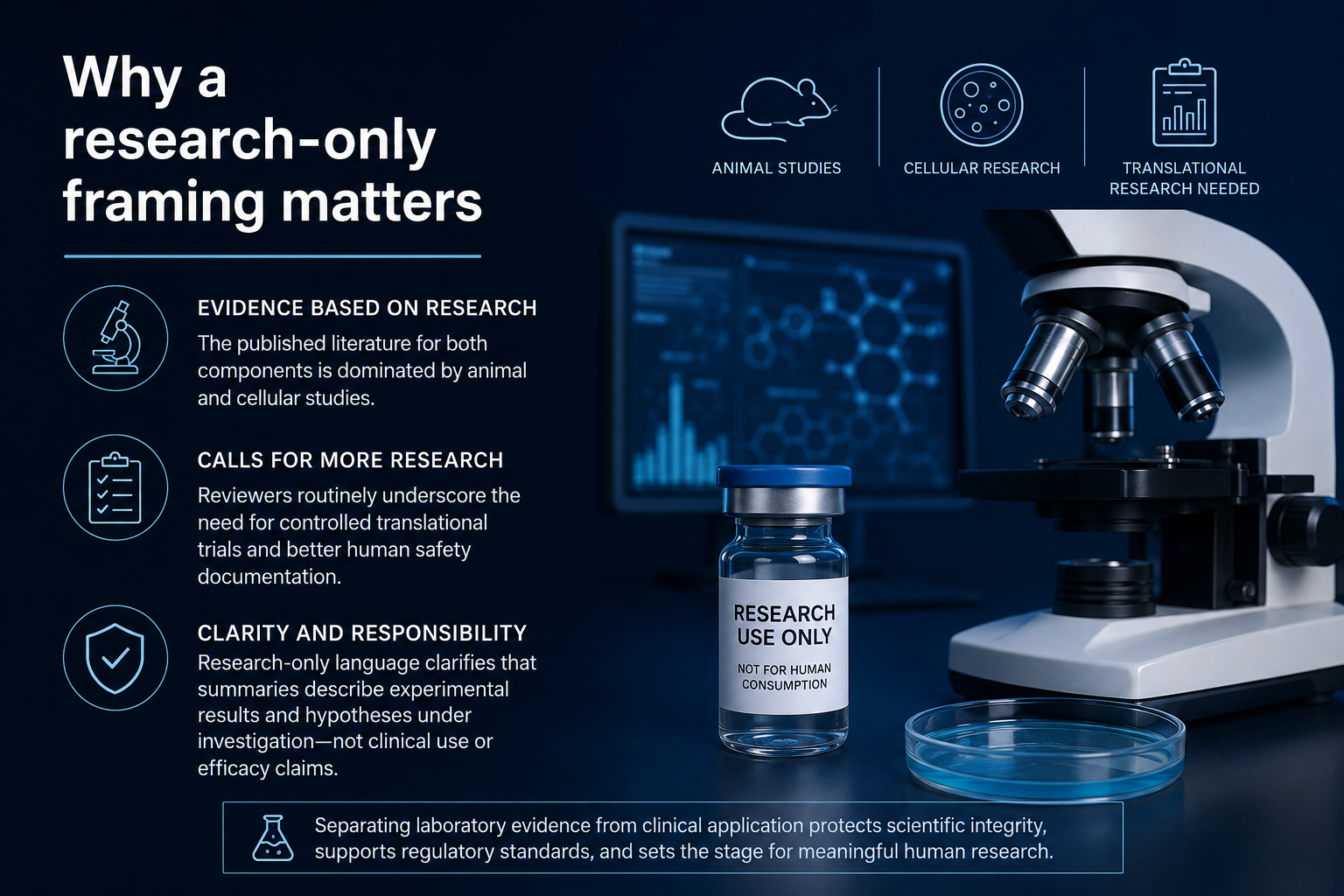
Separating laboratory evidence from clinical application is essential. The published literature for both components is dominated by animal and cellular work; reviewers routinely underscore the need for controlled translational trials and better human safety documentation. Using research-only language clarifies that summaries describe experimental results and hypotheses under investigation rather than assertions about clinical use or efficacy.
Further reading and primary sources
The following reviews and primary studies provide more detailed coverage of the topics summarized above. These sources were selected for their synthesis of experimental models, mechanistic discussion, and commentary on translational gaps.
Selected references:
- Recent narrative review summarizing preclinical and limited clinical literature for BPC-157 (PMC review).
- 2019 review focused on soft‑tissue models for BPC-157 (PubMed).
- 2021 review on thymosin beta‑4 summarizing multifunctional roles and research directions (PubMed).
- Foundational 1999 rat wound model study often cited in Tβ4 literature (PubMed).
Readers interested in primary reports should consult the linked sources below and evaluate study designs, model types, and sample sizes when interpreting findings.
Note: This overview is intended for educational and research‑reference purposes only and does not provide clinical guidance or usage recommendations.
Research-use product reference: TB-500 is listed at Peptide Titans for laboratory research use only. Products are not for human consumption.
Research Sources
Primary references and source materials used for this research-focused overview:
- https://pmc.ncbi.nlm.nih.gov/articles/PMC12446177/
- https://pubmed.ncbi.nlm.nih.gov/30915550/
- https://pubmed.ncbi.nlm.nih.gov/36551977/
- https://pubmed.ncbi.nlm.nih.gov/34992578/
- https://pubmed.ncbi.nlm.nih.gov/10469335/
Frequently Asked Questions
What types of studies exist for BPC-157 and TB-500?
Published literature primarily comprises in vitro cellular studies and animal (rodent and other small‑animal) models. For BPC-157, narrative reviews emphasize a predominance of preclinical reports with a few pilot human mentions. For thymosin beta‑4, the literature spans cell biology, animal models, and some early translational investigations.
Are there clinical trials for these peptides?
Reviews note that BPC-157 data are mainly preclinical, with very limited pilot human reports cited in narrative syntheses. Thymosin beta‑4 has a broader research base with some clinical‑stage investigations referenced in reviews, but both compounds require further controlled clinical studies to clarify translational relevance and safety.
What mechanisms do researchers investigate?
Common mechanistic themes include angiogenesis, cell migration, actin dynamics (for Tβ4), nitric‑oxide signaling (for BPC-157), modulation of inflammatory pathways, and markers of cytoprotection. Mechanistic work is typically conducted in vitro or in animal models.
Where can I find primary literature and reviews?
Primary sources and narrative reviews are available via PubMed and PubMed Central. See the external links provided below for selected review articles and foundational studies.